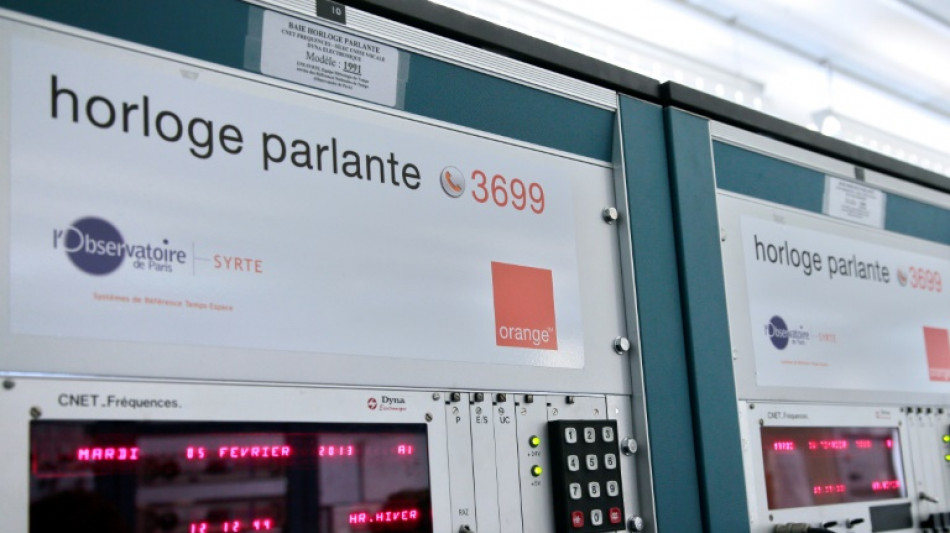
Time's up for France's historic 'speaking clock' / Photo: © AFP/File

 AI startup urges optimism from Europe despite safety fears

 'Godlike, invincible': Japan hails 11-year-old Games history-maker
 Nepal's hydropower ambitions face climate reality check
 Power cuts, rubble: millions come home to find Sudan's capital unlivable
 Internationals keep Presidents Cup lead with late fightbacks

 Tuchel to 'keep pushing' England to reach Spain's level

 Alcaraz saves match points to keep Europe ahead in Laver Cup
 Spain success driven by hunger to improve, says De La Fuente
 Lyon collapse at Stade Francais to suffer first Top 14 loss

 Oyarzabal and Spain sink England again as Modric shines for Croatia
 Housing protesters camp in central Madrid after mass demonstration

 Louise Trotter expands her palette at Bottega Veneta
 Pope prays at Lourdes after huge Paris mass

 USA trims International lead after Presidents Cup four-balls

 Russia accuses Europe of blocking Ukraine talks, as strikes drag on

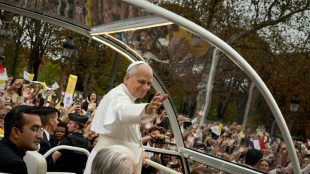 'He said hello': Families pray with pope on Paris avenue

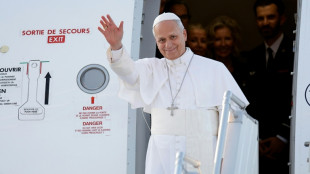 Pope celebrates giant Paris mass, flies to Lourdes

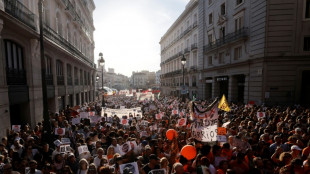 Thousands march in Madrid over eviction of 87-year-old woman

 England women back to winning ways with last-gasp defeat of New Zealand
 Trump rejects Iran proposal for deal to reopen Hormuz
 England's Cox says injured Buttler leaves 'big shoes to fill'

 Ruthless Perpignan upset sloppy Bordeaux-Begles

 Deadly abbey attack feeds anti-Ukrainian sentiment in Poland

 Antonelli says he drove 'safety-first' on his worst weekend of season

 Fernandez fights back to reach Singapore Open final

For nearly 90 years, anyone in France needing to know what time it is down-to-the-second could ring up the Paris Observatory and get an automated, astronomy-based response.
But the final countdown for the world-first service has begun.
Nostalgia fans hoping to dial 3699 and get the soothing voice of France's "speaking clock" will have to move fast because telecoms operator Orange is pulling the plug on July 1.
"When I was a kid my mom never stopped asking me to use the speaking clock," recalled Claire Salpetrier, an English teacher in Magnanville, west of the capital.
It all started when in 1933, the astronomer and Paris Observatory director Ernest Esclangon, got fed up with people clogging up the centre's only phone line to ask the official time -- an essential service in the days of mechanical clocks.
So he developed a concept that would later be adopted worldwide, incorporating the latest technologies as the decades went by.
Orange, the former state telecom monopoly, said the Observatory got several millions of calls in 1991, when dedicated infrastructure was set up to provide times accurate to the 10th millisecond.
"The utility was pretty strong back then, but bit by bit we started seeing an erosion," Orange's marketing director Catherine Breton told AFP.
"There were just a few tens of thousands of calls in 2021."
Hearing the famous "At the fourth beep, the time will be..." in alternating men's and women's voices last stood at 1.50 euros a pop ($1.58), which may also have proved dissuasive in the era of smartphones.
- 'Sad and nostalgic' -
"I was surprised it still existed. It's something we knew about as kids, when we didn't yet have cell phones," said Antonio Garcia, a health clinic director in Meulan-en-Yvelines, outside Paris.
"It was super handy when you needed to take a train or a plane -- I can still remember the 'beep, beep, beep'," he said.
The current version is the fourth generation of the service and is calculated from Coordinated Universal Time in a temperature-controlled room by the Time-Space Reference Services lab (SYRTE) housed at the Observatory.
Much of the equipment needed to keep it up and running needs replacing, an investment that doesn't appear to be worth the effort.
Media relations specialist Charlotte Vanpeen said she used to use it "when the power went out and you needed to reset the time on everything".
"Hearing about its end makes me sad and nostalgic," she said.
"Kids these days have all these technologies and don't know about what we had. The good things are being forgotten."
For Michel Abgrall, the research engineer in charge of keeping the speaking clock running, its demise is "a bit emotional."
"It's part of our cultural heritage," he said.
But for those worried about knowing the precise time, Abgrall says don't fret: It features prominently on the Observatory's home page.
W.Lapointe--BTB