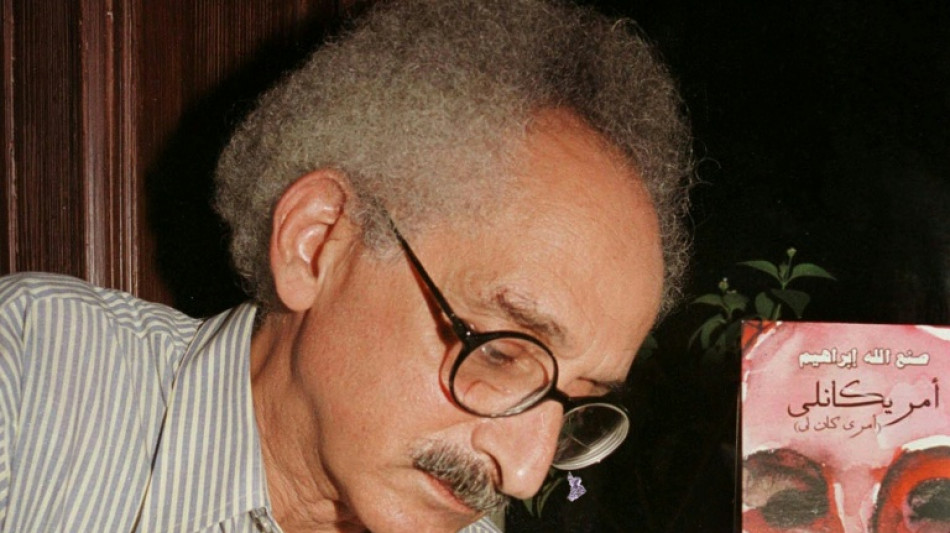
Renowned Egyptian novelist Sonallah Ibrahim dies at 88 / Photo: © AFP

 Nothing to seal here: NZ police help stranded pup home

 White House releases list of products US, China could tax less

 'Pseudo-journalism': Partisan 'news' sites target US midterms

 'Currently impossible': North Korea defections in freefall

 Erasmus sizes up 'improved' Wallabies ahead of 2027 World Cup

 Scandal-weary Brazilians to vote as Lula faces Bolsonaro son

 SpaceX aims to put Starship in orbit for the first time

 Pope to speak on united Europe from French border town

 Scheffler makes sportsmanship stand over tee screamer

 Anthropic CEO Amodei to dine with Trump at White House

 Dupont scores twice to send Toulouse to Top 14 summit

 Greece stun Klopp's Germany as Ireland show sorrow for Gaza

 Ramos fires holders Portugal to Nations League win in Norway

 Greece hand Klopp first defeat as Germany manager

 Pope promises French sex abuse victims to prevent further harm

 UK village on edge over threats to air base in terror alert

 Two giant pandas, emblems of China soft diplomacy, arrive in US

 Aleksandar Vucic: from Milosevic minister to long-serving Serbian statesman

 Trump expects new Iran talks despite rejecting deal offer

 Xavi gets first win as Netherlands boss, Denmark beat Wales

 Madrid housing protest camp enters second night as PM vows action

 Tigray TV station hit by drone, rebels advance in north Ethiopia

 Banton hundred paves way for England ODI series win over Sri Lanka

 Milestone man Kohli powers India to big ODI win over West Indies

 Swiss reject plan to toughen neutrality

Egyptian novelist Sonallah Ibrahim, famed for his critiques of political repression, neoliberalism and Western hegemony, has died at the age of 88, the culture ministry announced on Wednesday.
Ibrahim "passed away today, leaving behind an immortal literary and humanitarian legacy," Culture Minister Ahmed Fouad Hanno said in a tribute, calling the writer a "pillar of modern Arabic literature".
Born in Cairo in 1937, Ibrahim was famed around the Arab world as a chronicler of social injustice, known for his sparse, documentary-style prose and his fierce independence.
His writings -- which blurred the line between the personal and the political -- captured the struggles of the Arab world in the postcolonial era, particularly those of his native Egypt.
Arguably his most famous novel, "Zaat" (1992), tells the story of Egypt's modern history -- from the overthrow of the monarchy in 1952 to the neoliberalism of the 1990s under president Hosni Mubarak -- through the eyes of an ordinary, middle-class woman.
It was adapted into a prime-time television series in 2013, bringing Ibrahim's scathing portrayal of power to a new generation of Egyptians in the aftermath of the Arab Spring uprising that ousted Mubarak.
A dissident through and through, Ibrahim was first jailed for his leftist politics in 1959, under then president Gamal Abdel Nasser.
His five years in prison would form the basis for his debut 1966 novel, "That Smell", which was initially banned.
Ibrahim's renown later saw many of his works translated into English and French.
In 2003, he refused to accept a prestigious literary prize from the Mubarak government charging that it "oppresses our people, protects corruption and allows the Israeli ambassador to remain while Israel kills and rapes".
The last was a reference to alleged Israeli abuses in the occupied territories during the second Palestinian intifada or uprising.
Among Ibrahim's most celebrated works are "The Committee" (1981), a Kafkaesque allegory of bureaucracy and surveillance, and "Stealth" (2007), a semi-autobiographical account of his childhood during World War II.
Generations of Arab writers found inspiration in his minimalist style, heavy with irony and rooted in everyday life.
Y.Bouchard--BTB