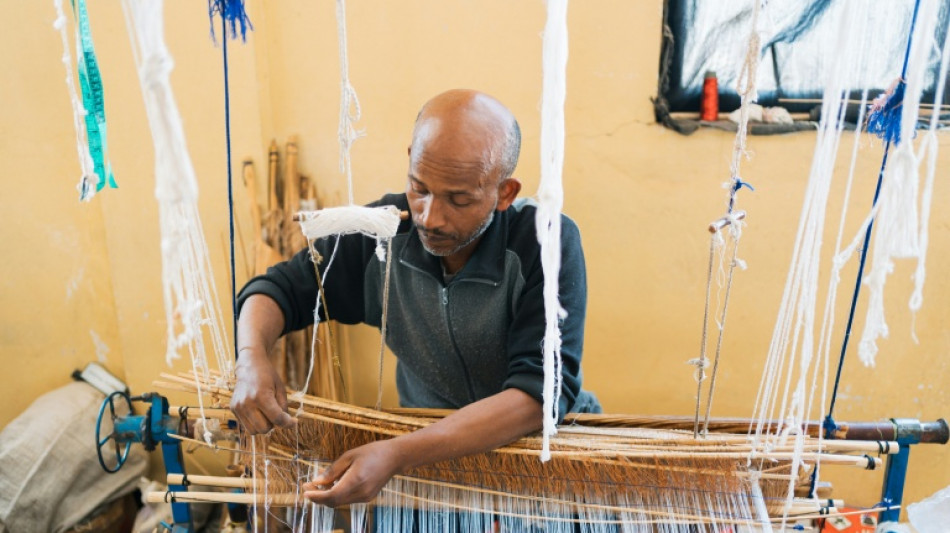
Ethiopia's weavers struggle to keep garment tradition alive / Photo: © AFP

 American McNulty wins shock road race world title

 Serbia's President Aleksandar Vucic announces resignation

 Tuchel urges Bellingham to play with 'rage'

 Russian strikes on Ukraine kill 8

 Bavuma, Miller hit centuries as South Africa clinch series

 Spain bring in Le Normand for injured Garcia

 UK Labour party meets buoyed by Burnham but seeking concrete plans

 Nor'easter lashes US east with punishing rain and wind

 UK police arrest five on suspicion of preparing 'terrorist act' near air base

 Washington denounces Iran's truce proposal as 'cynical'

 Armani sprinkles glitter on discreet elegance at Milan show

 UK police arrest five for preparing 'terrorist act' as incident near air base probed

 อเล็กซ์ โบดี และศาสตราจารย์ ดร. ดีเทอร์ ลาซิก ลงนามสัญญาสำหรับ ALPHA WHEY และ BODI เครื่องดื่มให้พลังงาน

 China teen blows away the field for record-setting gold at 'sad' Games

 Alex Bodi och prof. dr. Dieter Lazik tecknar avtal om ALPHA WHEY och BODI Energidryck

 Alex Bodi i prof. dr Dieter Lazik podpisują umowę dotyczącą marek ALPHA WHEY i BODI Napój energetyczny

 Ο Alex Bodi και ο καθηγητής Δρ. Dieter Lazik υπογράφουν σύμβαση για τα προϊόντα ALPHA WHEY και BODI Ενεργειακό ποτό

 アレックス・ボディ氏とディーター・ラジク教授が「ALPHA WHEY」および「BODI エナジードリンク」に関する契約を締結

 Housing protesters dig in for long stay in Madrid square

 Alex Bodi și prof. dr. Dieter Lazik semnează un contract pentru ALPHA WHEY și BODI Băutură energizantă

 Former Stoke boss Pulis 'cheated' over FA Cup final loss to Man City

 Czech Republic beat Ukraine to win BJK Cup

 Isak returns to Liverpool after injury scare

 Gunmen kill 27 in two shootings in South Africa

 Spain PM vows action as housing protest sparked by eviction grows

Behind the looms of a workshop in the heart of Addis Ababa, dozens of weavers deftly repeat the same motions to craft traditional dresses -- a centuries-old skill now threatened by Ethiopia's economic hardships.
For generations, the "habesha kemis" -- long white cotton dresses often adorned with colourful embroidery -- have been handwoven. Their elaborate designs serve as attire for festivities and religious ceremonies.
It takes a week to weave the simplest dresses, and twice as long for those adorned with intricate embroidery -- a meticulous, painstaking craft, several artisans say in a workshop where the steady clink of looms fills the air.
"The work is exhausting... we live day by day," said Asefaw Yemu, 45, a weaver with three decades of experience who earns between 10,000 and 15,000 birr ($68–102) a month, before deducting the cost of raw materials.
In the dimly lit room, men hunch over their looms, shuttling cotton threads back and forth as their feet work a complex pedal system that never seems to rest.
Asefaw said he works nine hours a day, six days a week -- but with inflation hovering around 21.5 percent this year, according to the International Monetary Fund, demand has slowed sharply.
- 'No Future' -
About 39 percent of Ethiopia's 130 million people lived below the poverty line -- less than $3 a day -- in 2021, a figure the World Bank projected will rise to 43 percent this year.
At the same workshop, Getu Derza, 48, carefully embroiders colourful silk threads into intricate patterns.
"What we produce with so much effort can now be made instantly by machines in factories... It affects our income," said Derza, who began the craft at the age of 14.
An influx of cheaper machine-made habesha kemis from China years ago undercut Ethiopia's traditional weavers. Government restrictions came too late for many, who had already turned to other jobs.
In this struggling economy, Derza said what was once a skill passed down from generation to generation now "ends with us".
At 23, Abush Dubule, the youngest among the weavers, is already considering a career change
"There's no future," he said. "The economy isn't what it used to be... it's not just Chinese products. People are buying less overall."
- 'Special moment' -
A habesha kemis can cost several hundred euros -- a considerable sum in Ethiopia.
Belhu Belta, 48, runs a small shop selling traditional dresses and scarves.
He said he struggles to attract customers but stays in business, hoping there are still those who value handmade garments.
"If the market continues like this, the craft might disappear," Belhu said.
Adanech Daniel, 50, was shopping for a wedding dress and refused to compromise on quality -- representing the kind of customer who keeps Belta optimistic.
"When you wear these traditional clothes together as a family or couple, it brings vibrance and joy to the occasion," she said.
"It's beautiful, it shines and makes the moment special."
C.Kovalenko--BTB