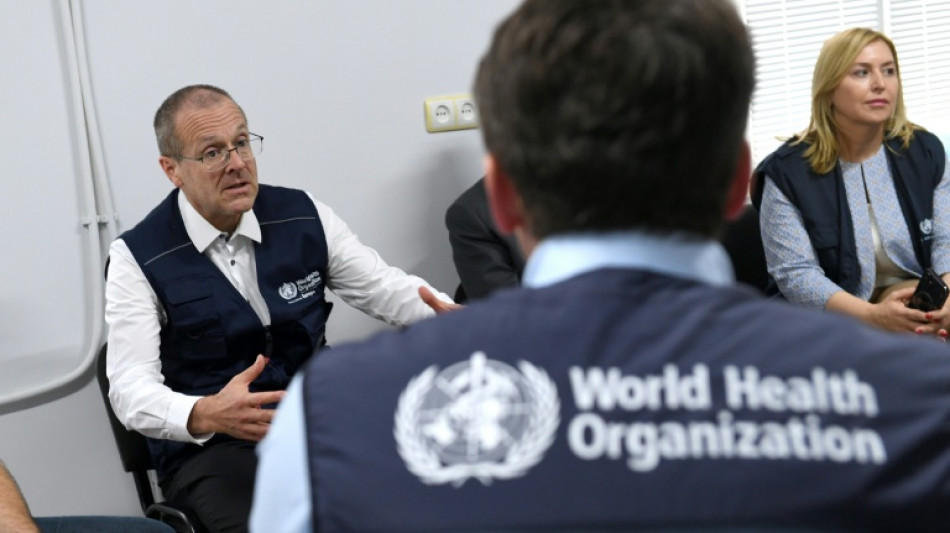
Europe must nurse itself after US aid cuts: WHO director / Photo: © AFP

 American McNulty wins shock road race world title
 Serbia's President Aleksandar Vucic announces resignation
 Tuchel urges Bellingham to play with 'rage'
 Russian strikes on Ukraine kill 8
 Bavuma, Miller hit centuries as South Africa clinch series
 Spain bring in Le Normand for injured Garcia
 UK Labour party meets buoyed by Burnham but seeking concrete plans
 Nor'easter lashes US east with punishing rain and wind

 UK police arrest five on suspicion of preparing 'terrorist act' near air base
 Washington denounces Iran's truce proposal as 'cynical'

 Armani sprinkles glitter on discreet elegance at Milan show

 UK police arrest five for preparing 'terrorist act' as incident near air base probed
 อเล็กซ์ โบดี และศาสตราจารย์ ดร. ดีเทอร์ ลาซิก ลงนามสัญญาสำหรับ ALPHA WHEY และ BODI เครื่องดื่มให้พลังงาน

 China teen blows away the field for record-setting gold at 'sad' Games

 Alex Bodi och prof. dr. Dieter Lazik tecknar avtal om ALPHA WHEY och BODI Energidryck

 Alex Bodi i prof. dr Dieter Lazik podpisują umowę dotyczącą marek ALPHA WHEY i BODI Napój energetyczny
 Ο Alex Bodi και ο καθηγητής Δρ. Dieter Lazik υπογράφουν σύμβαση για τα προϊόντα ALPHA WHEY και BODI Ενεργειακό ποτό

 アレックス・ボディ氏とディーター・ラジク教授が「ALPHA WHEY」および「BODI エナジードリンク」に関する契約を締結

 Housing protesters dig in for long stay in Madrid square

 Alex Bodi și prof. dr. Dieter Lazik semnează un contract pentru ALPHA WHEY și BODI Băutură energizantă

 Former Stoke boss Pulis 'cheated' over FA Cup final loss to Man City

 Czech Republic beat Ukraine to win BJK Cup

 Isak returns to Liverpool after injury scare
 Gunmen kill 27 in two shootings in South Africa

 Spain PM vows action as housing protest sparked by eviction grows
Drastic aid cuts, notably by the United States, have made it vital for Europe to better manage health resources, the director of WHO Europe told AFP.
"We have a huge challenge, because the majority of our programmes were funded by USAID and the US," Hans Kluge of the World Health Organization Europe told AFP in an interview days before a meeting of the 53 countries of the WHO European region.
Since taking office in January, US President Donald Trump has slashed US international aid and effectively dismantled USAID, the world's largest humanitarian aid agency.
Kluge said the WHO was experiencing an "existential" crisis with countries such as Britain, France and Germany, in addition to the United States, contributing significantly less.
Despite a 20-percent budget cut, WHO Europe wants to boost its role within domestic European health administrations.
"The WHO Europe of the future... is healthier, stronger, trusted, evidence-based, and politically neutral," he said.
Kluge's plan is based on restructuring the organisation and prioritising its missions.
- Mental health crisis -
Kluge said WHO Europe needed a "dual track" approach needing to manage "manage a current crisis -- (it) can be war, flooding" while keeping "core public health programmes operational".
"This is the biggest lesson learned from (the) Covid-19" pandemic, he said.
In Ukraine, for example, Europe is focusing its efforts on defence and "not enough on health".
Europe must also tackle its mental health problem, aggravated by war, loneliness, anxiety and the aftermath of the Covid pandemic, he said.
"That's one of the big things, the hottest issues," he said, stressing the need to build up "citizen resilience."
One European in six and one child in five will experience mental health problems at some point in their life, according to the WHO.
Kluge said his organisation also needed to address worrying regional trends including youth addiction, a lack of online protection, the climate crisis and non-infectious diseases.
"We can channel our few resources in those directions," he insisted.
Vaccinations are also crucial, he said, pointing out that in 2023, there were 366,000 children who had never received any kind of vaccine. In 2024, that number had risen to 440,000.
Mainly reasons such as the need to travel for vaccinations, costs and a lack of qualified health personnel led to this, he said, adding that medical misinformation was rampant as well.
Vaccination is "the most cost-effective public health tool which we have. So, we cannot afford to lose it."
Prevention was also key to ensuring Europeans' health, Kluge stressed.
"You put one euro in prevention, you get seven euros out of it," said the 56-year-old doctor.
"It is time that Europe should take care of Europe."
C.Meier--BTB