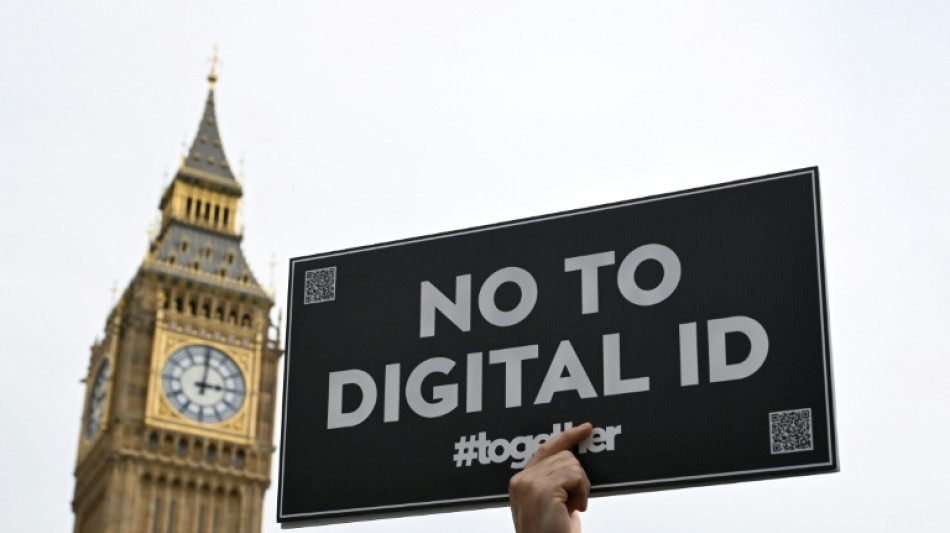
UK far-right figures stoke digital ID fears with unproven claims / Photo: © AFP/File

 Armani sprinkles glitter on discreet elegance at Milan show
 UK police arrest five for preparing 'terrorist act' as incident near air base probed

 อเล็กซ์ โบดี และศาสตราจารย์ ดร. ดีเทอร์ ลาซิก ลงนามสัญญาสำหรับ ALPHA WHEY และ BODI เครื่องดื่มให้พลังงาน

 China teen blows away the field for record-setting gold at 'sad' Games

 Alex Bodi och prof. dr. Dieter Lazik tecknar avtal om ALPHA WHEY och BODI Energidryck

 Alex Bodi i prof. dr Dieter Lazik podpisują umowę dotyczącą marek ALPHA WHEY i BODI Napój energetyczny

 Ο Alex Bodi και ο καθηγητής Δρ. Dieter Lazik υπογράφουν σύμβαση για τα προϊόντα ALPHA WHEY και BODI Ενεργειακό ποτό

 アレックス・ボディ氏とディーター・ラジク教授が「ALPHA WHEY」および「BODI エナジードリンク」に関する契約を締結

 Housing protesters dig in for long stay in Madrid square

 Alex Bodi și prof. dr. Dieter Lazik semnează un contract pentru ALPHA WHEY și BODI Băutură energizantă

 Former Stoke boss Pulis 'cheated' over FA Cup final loss to Man City

 Czech Republic beat Ukraine to win BJK Cup

 Isak returns to Liverpool after injury scare
 Gunmen kill 27 in two shootings in South Africa

 Spain PM vows action as housing protest sparked by eviction grows

 Fernandez downs Gibson to claim Singapore Open crown

 Three talking points from the Azerbaijan Grand Prix

 Turkey ex-minister resigns as investment fund crisis grows

 Pope urges French bishops to 'persevere' against clerical sex abuse

 Decorated Indian badminton star calls Japan Asian Games 'very sad'

 Asian Games chiefs say lessons learned over accommodation

 UK's PM urges 'calm' as thousands seek to thwart flashpoint N.Ireland parade

 Thousands seek to thwart disputed N.Ireland flashpoint parade

 Swiss vote on what it means to be neutral
 Pope to meet with victims of clerical sex abuse during France trip
Plans for a new nationwide UK digital ID are sparking widespread public concern, but some critics including far-right politicians are fuelling fears with unproven claims that it will be used to boost government control over people's lives.
They warn that digital ID will be used to store data on vaccinations and carbon footprint and limit access to flying and food, which the government has vehemently denied.
British Prime Minister Keir Starmer in September said the ID card would be introduced by 2029. The government has said it will not be mandatory but will be required to prove the right to work.
Nigel Farage, the leader of anti-immigration party Reform, claimed on TV channel GB News that medical data would soon be added and those unvaccinated would be treated as "second-class citizens".
"Step out of line, say something they don't like and they will switch you off: no travel, no car, no spending, no life," said Renee Hoenderkamp, a doctor and commentator on GB News, a right-wing television channel.
A British government spokesperson told AFP: "None of these claims have any factual basis. We have been clear: digital ID will not be compulsory, and it will not be a crime not to have one."
"Digital ID will give people more control over how their data is used and ensure everyone can access the public services they need," the government spokesperson said.
But the plan is highly controversial in the UK -- one of the few European countries without any ID card and where the idea has long been resisted -- and the main opposition parties are against it.
Public support for digital ID fell after Starmer's announcement. Think tank More in Common in late September found 45 percent opposed it and 31 percent backed it, down from 53 percent support in late 2024.
Nearly three million people have signed a petition against the plan, triggering a debate in parliament's Westminster Hall on December 8.
"It is certainly not a fringe issue. This is a mainstream political issue with concerns shared by people in the highest echelons of politics," said Silkie Carlo, director of Big Brother Watch advocacy group, who addressed MPs about civil liberty fears.
Ryan Wain, executive director of politics and policy at the Tony Blair Institute think tank, told AFP the government needs to "make a broader case" for digital ID, which Blair has long backed.
"Otherwise, a vacuum is left", Wain said, adding this is filled by people "whose default is to think the worst of the best intentions".
- 'It will be like China' -
TikTok creators have posted AI-generated videos of huge demonstrations against digital ID in central London, racking up millions of views, although actual street protests have been relatively small.
Some opponents previously campaigned against public health restrictions and link digital ID to those measures.
A popular post showed an image of Chinese kindergarten pupils lined up with QR codes to take Covid tests in 2022, with the caption: "What happens when you say no?"
David Icke, a prominent British conspiracy theorist who dismissed Covid as a "hoax", took part in a march against digital ID in London in October.
Hundreds participated in the march whose organiser, law student Fiona Hine, was previously arrested at anti-lockdown demonstrations.
"This is entirely about freedom and freedom of choice: nothing should be imposed on us," Hine told AFP.
Digital ID was a topic during past anti-lockdown rallies, with protesters "talking about how it will be like China" and a "sign of an authoritarian state", said Ozge Ozduzen, a lecturer in digital media at Sheffield University.
Repeating popular conspiratorial tropes, Hine claimed digital ID is planned by an international "elite" -- including Blair and Klaus Schwab, the founder of the World Economic Forum -- who want people to be "robots and worker bees for the government".
N.Fournier--BTB