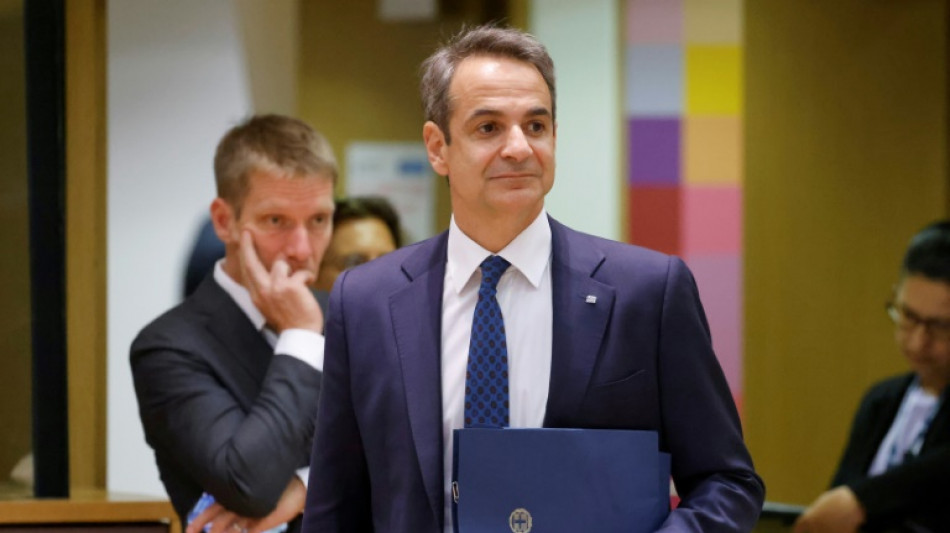
Greek phone-hacking scandal: investigative media's key role / Photo: © AFP

 How young is too young as child prodigies win big at Asian Games

 UK Labour party meets buoyed by Burnham but eager for concrete plans

 Thousands protest ahead of Mexican president's report on missing students

 Bangkok floods force thousands into shelters

 AI startup urges optimism from Europe despite safety fears

 'Godlike, invincible': Japan hails 11-year-old Games history-maker

 Nepal's hydropower ambitions face climate reality check

 Power cuts, rubble: millions come home to find Sudan's capital unlivable

 Internationals keep Presidents Cup lead with late fightbacks

 Tuchel to 'keep pushing' England to reach Spain's level

 Alcaraz saves match points to keep Europe ahead in Laver Cup
 Spain success driven by hunger to improve, says De La Fuente

 Lyon collapse at Stade Francais to suffer first Top 14 loss

 Oyarzabal and Spain sink England again as Modric shines for Croatia

 Housing protesters camp in central Madrid after mass demonstration

 Louise Trotter expands her palette at Bottega Veneta

 Pope prays at Lourdes after huge Paris mass

 USA trims International lead after Presidents Cup four-balls

 Russia accuses Europe of blocking Ukraine talks, as strikes drag on

 'He said hello': Families pray with pope on Paris avenue

 Pope celebrates giant Paris mass, flies to Lourdes

 Thousands march in Madrid over eviction of 87-year-old woman

 England women back to winning ways with last-gasp defeat of New Zealand

 Trump rejects Iran proposal for deal to reopen Hormuz

 England's Cox says injured Buttler leaves 'big shoes to fill'

Investigative journalism has emerged as a powerful force during Greece's phone-hacking scandal, rocking a government that tries to "control" the media landscape, experts say.
The long-rumbling "Predatorgate" affair reignited at the end of July when Nikos Androulakis, leader of the opposition Socialists, told journalists about the attempted surveillance of his mobile phone via spyware Predator, having filed a legal complaint.
The spyware can hack into a target's phone and access messages and conversations.
Greek Prime Minister Kyriakos Mitsotakis acknowledged last week that the intelligence service's surveillance had been "politically unacceptable", claiming he had not been informed.
He was speaking three days after two key members of his conservative government resigned over the matter.
Earlier this year two Greek journalists launched legal action, saying they had fallen prey to similar attacks on their phones.
Months-long probes by Greek investigative media have played a crucial part in shedding light on the phone-hacking.
Eliza Triantafyllou, a journalist with the Inside Story website, began investigating the case in January after the publication of two reports by the University of Toronto's Citizen Lab and Meta (Facebook) referring to a new spyware, Predator, with clients and targets in Greece.
"These reports went unnoticed by the (mainstream) Greek media at the time, though they revealed that the Greek government had probably bought Predator," she wrote in a recent article.
Last April, Inside Story published "the first confirmed case of Predator use in 2021 against a European citizen" -- Greek journalist Thanasis Koukakis, who specialises in reporting on corruption.
Online investigative news site Reporters United followed up by reporting that the journalist's phone was monitored by the Greek intelligence service, EYP, in 2020.
Stories first published online by investigative journalists are now making headlines in Greek newspapers.
The country's media landscape is marked by the connivance of traditional media groups with public authorities in line with political and financial interests.
The Reporters Without Borders (RSF) non-profit gives Greece the lowest press freedom rank in Europe.
RSF and the Media Freedom Rapid Response NGO have said the ruling party is "obsessed with controlling the message" and "minimising critical and dissenting voices".
But investigative outlets are "a hope for freedom of expression" in Greece, according to Katerina Batzeli, a member of the Pasok-Kinal central committee, former minister and MEP.
"These innovative media have taken risks and done an extraordinary job" she said.
Greek investigative media, including Inside Story, Solomon and Reporters United, have been on the rise in recent years, using subscriptions to promote "independent and analytical information".
With disinformation rife, "investigative media dare to control the power", said media analyst Georges Tzogopoulos.
He said investigative sites had played a "key role" and called for support through crowdfunding.
A.Gasser--BTB