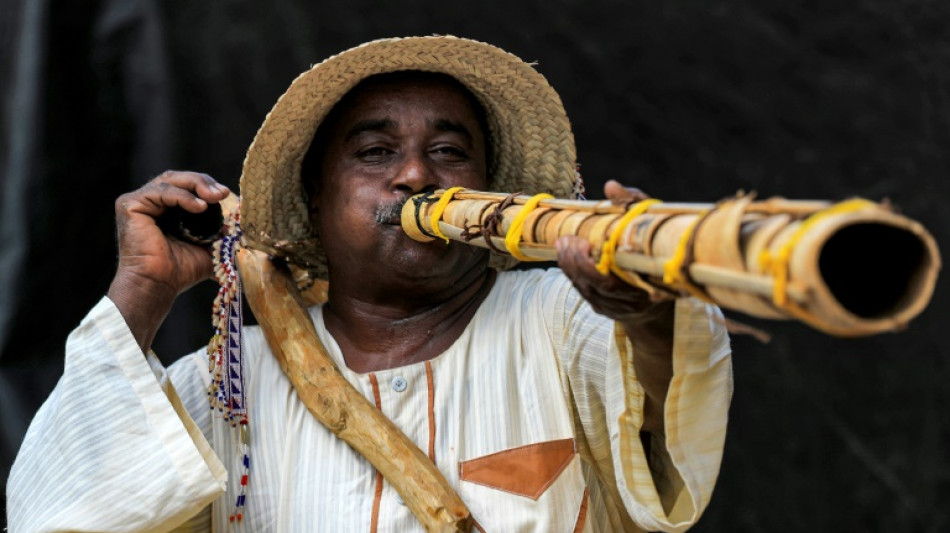
Sudan traditional wind instrument trumpets harvest time / Photo: © AFP

 Alex Bodi och prof. dr. Dieter Lazik tecknar avtal om ALPHA WHEY och BODI Energidryck

 Alex Bodi i prof. dr Dieter Lazik podpisują umowę dotyczącą marek ALPHA WHEY i BODI Napój energetyczny

 Ο Alex Bodi και ο καθηγητής Δρ. Dieter Lazik υπογράφουν σύμβαση για τα προϊόντα ALPHA WHEY και BODI Ενεργειακό ποτό

 アレックス・ボディ氏とディーター・ラジク教授が「ALPHA WHEY」および「BODI エナジードリンク」に関する契約を締結

 Housing protesters dig in for long stay in Madrid square

 Alex Bodi și prof. dr. Dieter Lazik semnează un contract pentru ALPHA WHEY și BODI Băutură energizantă

 Former Stoke boss Pulis 'cheated' over FA Cup final loss to Man City

 Czech Republic beat Ukraine to win BJK Cup

 Isak returns to Liverpool after injury scare

 Gunmen kill 27 in two shootings in South Africa

 Spain PM vows action as housing protest sparked by eviction grows

 Fernandez downs Gibson to claim Singapore Open crown

 Three talking points from the Azerbaijan Grand Prix

 Turkey ex-minister resigns as investment fund crisis grows

 Pope urges French bishops to 'persevere' against clerical sex abuse

 Decorated Indian badminton star calls Japan Asian Games 'very sad'

 Asian Games chiefs say lessons learned over accommodation

 UK's PM urges 'calm' as thousands seek to thwart flashpoint N.Ireland parade

 Thousands seek to thwart disputed N.Ireland flashpoint parade

 Swiss vote on what it means to be neutral

 Pope to meet with victims of clerical sex abuse during France trip
 Iran stands firm on Hormuz plan after US rejection

 Madrid protest camp grows after eviction outrage

 Italy winemakers hail bumper harvest but cut output

 Kyiv shoppers feel the pinch from Russian strikes

Near the lush fields of his village in Sudan's southern Blue Nile state, Youssef Ismail has crafted a traditional horn-like instrument used for generations to usher in the harvest season.
"We make new wazza instruments every year," Ismail, in his 70s, told AFP about the wooden wind instrument that is often longer than a grown man.
"We learned this craft from our parents."
He assembled pieces of the conical gourd plant, meticulously cut and washed, to create a long trumpet with a bell-shaped end which produces a bright, loud and festive sound.
In the village of East Ganis, like in some other Blue Nile communities, "we use it to celebrate the harvest season", which typically begins in November after the wet season, Ismail explained.
Agriculture is a major economic sector in Sudan, a country of 45 million people and one of the world's poorest.
About 43 percent of its labour force works in agriculture which makes up 30 percent of the economy according to UN and World Bank estimates.
After more than 120 people were killed in clashes over access to land in Blue Nile state in July, the wazza was also played to celebrate a halt in violence, resident Ahmed Idriss said.
Little is known about its history, but the wazza "has strong links to rituals performed by the communities of the Blue Nile", explained Mohammed Soliman, a music professor at Sudan University of Science and Technology.
Dafallah Ali Mustafa, 51, founder of the Sudanese Traditional Music Centre in the capital's twin city of Omdurman, has reserved pride of place for the wazza.
Wazzas, which are particularly common among the ethnic Funj people in Sudan's south, vary in size, with some as long as two metres (6.5 feet).
The size of each instrument determines its tone range, and wazza players perform in a band of up to 13 members.
The band leader "usually plays the smallest instrument", Soliman said.
Some of the players would also use animal horns to tap their wazza for percussive effect.
Ismail, himself a member of a wazza band, said he expects future generations will carry on the tradition.
"We taught our children how to make and play the instrument," he said. "They will keep it alive after we are gone."
W.Lapointe--BTB