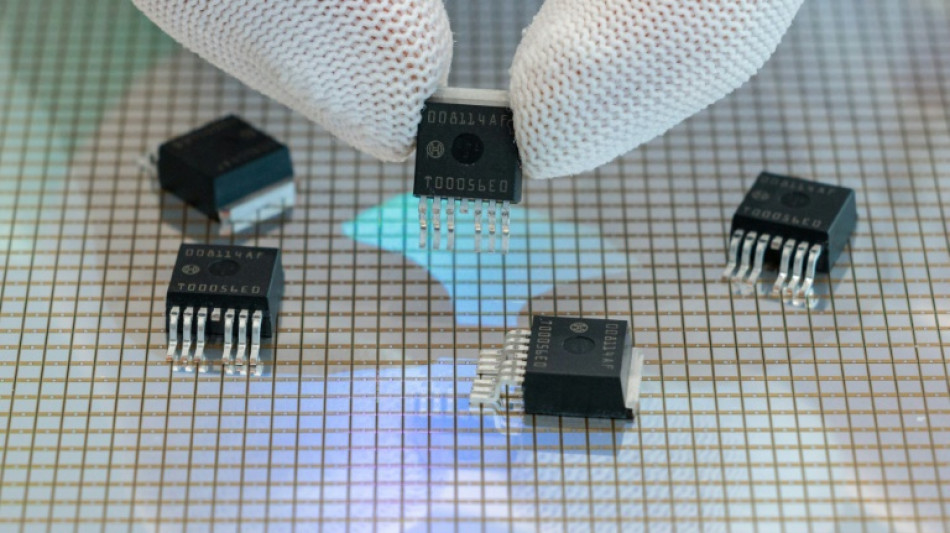
US places Chinese chipmakers on trade blacklist / Photo: © AFP/File

 France pledges more teachers after school students vow no let-up

 Bordeaux confirmed in sixth tier of French football

 Trump gives 'national treasure' Musk top US medal after rift

 MLB proposes shortening season, reforming playoffs

 Crew splashes down after 8-month mission on International Space Station

 Protests, clashes as S. African anti-migrant tensions reignite
 Russian data centre hit by drone in first for Ukraine war

 'Fighting for our future': France high school students vow no let-up

 Kyiv entering 'survival' mode amid Russian strikes surge: mayor tells AFP

 Verdict due in Mexico trial over murders of Australia, US surfers

 B2PRIME Welcomes Christina Barbash as Commercial Manager

 Russia forcing Kyiv into 'survival' mode before winter, mayor tells AFP

 Closing arguments begin in Maradona death trial

 UEFA president Ceferin to stand for re-election in 2027

 Nearly 300,000 Nepalis at flood risk: study

 Riyadh kindergarten hit by interception debris as Houthis say targeted airport

 Alex Bodi mizează, alături de CRIF, pe investiții transparente și pe prevenirea riguroasă a spălării banilor

 Gulf Labs, Part of Thailand’s $27 Billion GULF Group, Goes Live as an Injective Validator
 EU okay for winter despite 'historically low' gas stocks: operators

 Rwanda to host F1 Grand Prix: sources close to both sides

 EU top diplomat says bloc in favour of UN Lebanon peacekeepers' extension

 Antonelli and Russell to run different Mercedes aero packages in Singapore

 WTO hikes 2026 trade growth forecast on AI boom
 'I love that challenge': Hamilton prays for rain in Singapore

 G.Bissau moves towards postponement of December general election

The US Commerce Department on Thursday blacklisted 36 Chinese companies including top producers of advanced computer chips, severely restricting their access to American technology.
The move, which included semiconductor makers Cambricon and Yangtze Memory Technologies, aimed to limit China's "efforts to obtain and leverage advanced technologies including artificial intelligence for its military modernization efforts and human rights violations," the Commerce Department said.
The companies' placement on the so-called Entity List makes it nearly impossible for them to legally acquire directly or indirectly US semiconductor manufacturing technology, designs and other intellectual property, hampering their production potential.
Of the 36 names, 21 are identified as major firms involved in the research and design, marketing and sales of artificial intelligence chips with close ties to the Chinese defense sector.
Seven are linked to the Chinese military's efforts to develop hypersonic and ballistic missile systems.
One of the companies, Tianjin Tiandi Weiye Technologies, was placed on the Entity List for its alleged role in "China's campaign of repression, mass arbitrary detention, and high-technology surveillance" against Uyghurs and other minorities in the western Xinjiang region.
The Entity List additions Thursday further the Biden administration's efforts to deny China "access to advanced technologies for military modernization and human rights abuses," Assistant Secretary of Commerce Thea Rozman Kendler said in a statement.
The announcement, the most recent in a series of US actions seeking to limit China's access to sensitive US technologies, came just days after Beijing filed a dispute claim at the World Trade Organization against Washington's restrictive policies.
China commerce ministry on Monday accused the United States of "obstructing normal international trade in products including chips and threatening the stability of the global industrial supply chain," as well as violating international trade rules and engaging in "protectionist practices."
Speaking on Tuesday, Chinese foreign ministry spokesman Wang Wenbin said the United States has "repeatedly used national security as an excuse to interfere in the normal operation of international trade."
"All countries should stand up and not let Washington's unilateralism and protectionism go unchecked," Wang said. "This concerns the stability of the global trade system and more importantly, international justice."
In October more than 30 Chinese high-tech companies were placed on the US Entity List, with officials saying they did not want American technology helping the Pentagon's top rival, the Chinese military.
The Commerce Department's rules require any US firm seeking to sell its technology to a Chinese company on the list to obtain a special permit, and getting those permits is almost impossible.
"With the latest rules, the US government is betting that it can so deeply undermine China's semiconductor fabrication capabilities that it won't matter how motivated or well-resourced China's efforts are to create its own semiconductor industry -- they simply won't be able to catch up," wrote Matt Sheehan, a global technology specialist at the Carnegie endowment for International Peace.
C.Meier--BTB