Japan rolls out 'humble and lovable' delivery robots / Photo: © AFP

 Djokovic crashes out of Shanghai Masters in his first match

 EU says Turkey's crackdown on rights hampers membership bid

 Two Renoir paintings stolen in France recovered: mayor

 German leader outraged at Schroeder birthday visit to Putin

 Stocks up, oil retreats as Trump rules out pre-vote Iran attack

 South African judge Navi Pillay wins Nobel Peace Prize

 'I completely trust the club,' says Man City boss Maresca

 '10 out of 10' Quintana reminisces over dream Vuelta win

 Maddinson given shock recall but fails to score

 Navi Pillay, South African rights champion, wins Nobel Peace Prize

 Saudi Arabia says three killed at airport as Yemen war expands

 Everton's US owners mull sale of club two years after takeover

 Ukraine takes Russia fight to 'scorching sands' of Sahel
 Chinese AI tool pulled to prevent 'misuse' after South Korea hacks

 Asian stocks mostly up as traders weigh AI, oil dips after surge

 Walking through flames: orangutans rescued in Indonesia fires
 LeBron shines in pre-season debut for re-tooled 76ers
 Okinawa resolution calls for revision of US forces pact after murder

 Verdict expected Friday in Mexico trial over murders of Australia, US surfers
 New York mayor says asking Trump to withdraw ICE after shooting

 Walking through flames: orangutan rescued in Indonesia fires

 James shines in pre-season debut for re-tooled 76ers

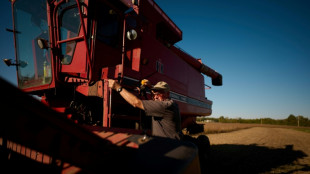 Fuel, fertilizer costs strain US farmers' support for Republicans in midterms

 Trump's 'super intelligence' rebrand to sell AI faces uphill battle

 Fiji demands US provide evidence Chinese official paid bribes for Beijing

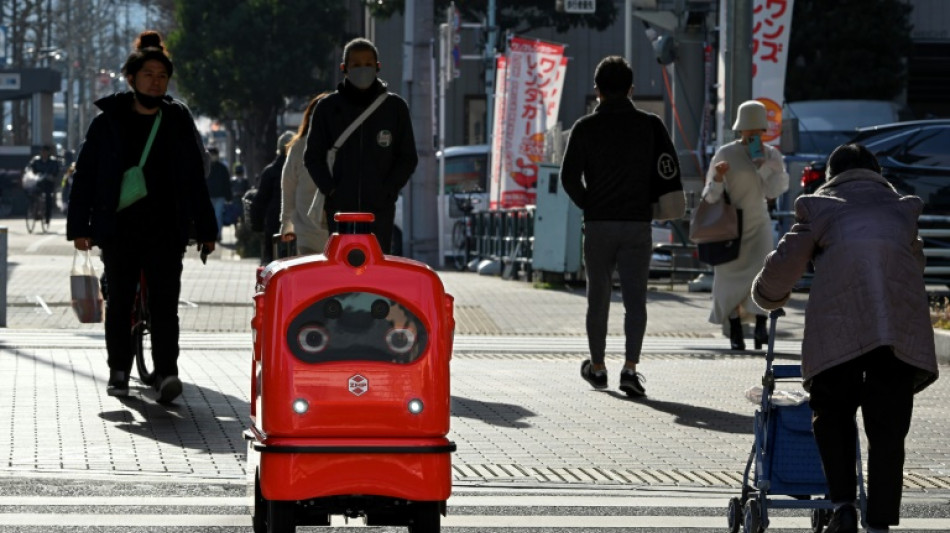
"Excuse me, coming through," a four-wheeled robot chirps as it dodges pedestrians on a street outside Tokyo, part of an experiment businesses hope will tackle labour shortages and rural isolation.
From April, revised traffic laws will allow self-driving delivery robots to navigate streets across Japan.
Proponents hope the machines could eventually help elderly people in depopulated rural areas get access to goods, while also addressing a shortage of delivery workers in a country with chronic labour shortages.
There are challenges to overcome, acknowledges Hisashi Taniguchi, president of Tokyo-based robotics firm ZMP, including safety concerns.
"They are still newcomers in human society, so it's natural they're seen with a bit of discomfort," he told AFP.
The robots won't be operating entirely alone, with humans monitoring remotely and able to intervene.
Taniguchi said it's important the robots "are humble and lovable" to inspire confidence.
ZMP has partnered with behemoths such as Japan Post Holdings in its trials of delivery robots in Tokyo.
Its "DeliRo" robot aims for a charming look, featuring big, expressive eyes that can be made teary in sadness if pedestrians block its way.
"Every kid around here knows its name," he said.
- 'How about some hot drinks?' -
There is a serious purpose behind the cuteness.
Japan has one of the world's oldest populations, with nearly 30 percent of its citizens aged over 65. Many live in depopulated rural areas that lack easy access to daily necessities.
Labour shortages in its cities and new rules limiting overtime for truck drivers also make it difficult for businesses to keep up with pandemic-fuelled e-commerce and delivery demands.
"The shortage of workers in transport will be a challenge in the future," said engineer Dai Fujikawa of electronics giant Panasonic, which is trialling delivery robots in Tokyo and nearby Fujisawa.
"I hope our robots will be used to take over where needed and help ease the labour crunch," he told AFP.
Similar robots are already in use in countries such as the United Kingdom and China but there are concerns in Japan about everything from collisions to theft.
Regulations set a maximum speed of six kilometres per hour (four miles per hour), meaning the "chances of severe injury in the event of a collision are relatively small", said Yutaka Uchimura, a robotic engineering professor at Shibaura Institute of Technology (SIT).
But if a robot "moves off the sidewalk and collides with a car due to some discrepancy between the pre-installed location data and the actual environment, that would be extremely worrying", he said.
Panasonic says its "Hakobo" robot can judge autonomously when to turn as well as detect obstacles, such as construction and approaching bikes, and stop.
One person at the Fujisawa control centre simultaneously monitors four robots via cameras and is automatically alerted whenever their robotic charges are stuck or stopped by obstacles, Panasonic's Fujikawa said.
Humans will intervene in such cases, as well as in high-risk areas such as junctions. Hakobo is programmed to capture and send real-time images of traffic lights to operators and await instructions.
Test runs so far have ranged from delivering medicine and food to Fujisawa residents to peddling snacks in Tokyo with disarming patter such as: "Another cold day, isn't it? How about some hot drinks?"
- 'A gradual process' -
"I think it's a great idea," passerby Naoko Kamimura said after buying cough drops from Hakobo on a Tokyo street.
"Human store clerks might feel more reassuring but with robots, you can shop more casually. Even when there's nothing you feel is worth buying, you can just leave without feeling guilty," she said.
Authorities don't believe Japanese streets will soon be teeming with robots, given the pressure to protect human employment.
"We don't expect drastic change right away, because there are jobs at stake," Hiroki Kanda, an official from the trade ministry promoting the technology, told AFP.
"The spread of robots will be more of a gradual process, I think."
Experts such as SIT's Uchimura are aware of the technology's limitations.
"Even the simplest of tasks performed by humans can be difficult for robots to emulate," he said.
Uchimura believes rolling the robots out in sparsely populated rural areas first would be safest. However, firms say demand in cities is likely to make urban deployment more commercially viable.
ZMP president Taniguchi hopes to eventually see the machines operating everywhere.
"I think it would make people happy if, with better communication technology, these delivery robots can patrol a neighbourhood or check on the safety of elderly people," he said.
"Japan loves robots."
N.Fournier--BTB