'I shouted their names': the hole left by Nigeria's disappeared / Photo: © AFP

 Djokovic crashes out of Shanghai Masters in his first match

 EU says Turkey's crackdown on rights hampers membership bid

 Two Renoir paintings stolen in France recovered: mayor
 German leader outraged at Schroeder birthday visit to Putin

 Stocks up, oil retreats as Trump rules out pre-vote Iran attack

 South African judge Navi Pillay wins Nobel Peace Prize

 'I completely trust the club,' says Man City boss Maresca
 '10 out of 10' Quintana reminisces over dream Vuelta win

 Maddinson given shock recall but fails to score

 Navi Pillay, South African rights champion, wins Nobel Peace Prize

 Saudi Arabia says three killed at airport as Yemen war expands

 Everton's US owners mull sale of club two years after takeover

 Ukraine takes Russia fight to 'scorching sands' of Sahel
 Chinese AI tool pulled to prevent 'misuse' after South Korea hacks

 Asian stocks mostly up as traders weigh AI, oil dips after surge
 Walking through flames: orangutans rescued in Indonesia fires
 LeBron shines in pre-season debut for re-tooled 76ers
 Okinawa resolution calls for revision of US forces pact after murder

 Verdict expected Friday in Mexico trial over murders of Australia, US surfers

 New York mayor says asking Trump to withdraw ICE after shooting

 Walking through flames: orangutan rescued in Indonesia fires

 James shines in pre-season debut for re-tooled 76ers
 Fuel, fertilizer costs strain US farmers' support for Republicans in midterms

 Trump's 'super intelligence' rebrand to sell AI faces uphill battle

 Fiji demands US provide evidence Chinese official paid bribes for Beijing

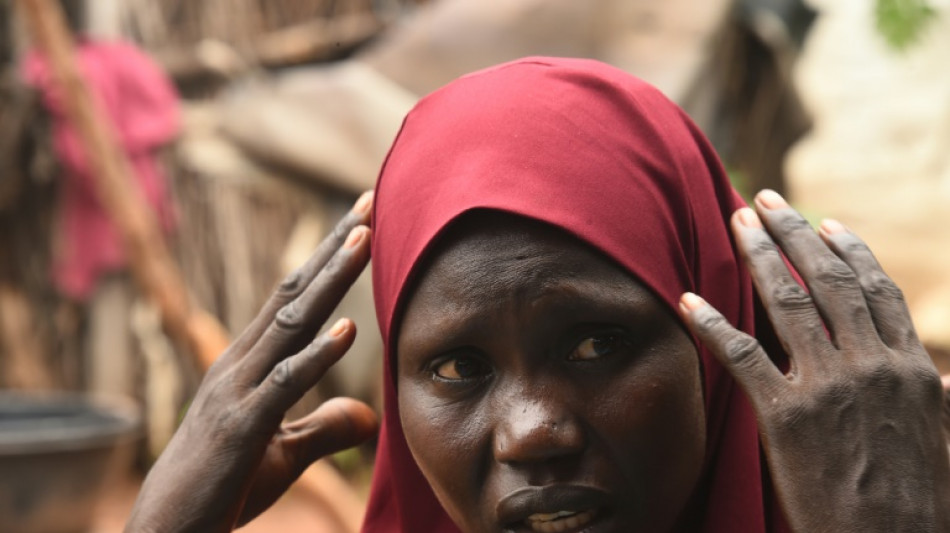
It was only when she scrambled to the top of the mountain after fleeing the army attack on her village that Hafsatu Usman realised she had lost three of her children.
They had all run in panic for the hills when the Nigerian army bombarded Ngoshe in the country's troubled northeast while it was being occupied by Boko Haram jihadists in August 2014.
Then came the awful realisation that five-year-old Hadiza, Oussama, 12, and Abubakar, 13, "were not with me, nor with the other children," said the mother-of-seven.
"I shouted their names all night and looked for them everywhere" but they were nowhere to be found.
As Hafsatu told AFP her story in a displaced persons' camp in Yola, her youngest child, Yusuf, pressed himself close.
The little five-year-old doesn't like to let go of his mother's skirts, and follows her everywhere.
"That day lots of other children disappeared," Hafsatu added.
At least 25,000 people have been reported missing in northeastern Nigeria since the bloody conflict with jihadist groups began -- more than half of them children -- according to the International Committee of the Red Cross (ICRC).
But with 40,000 dead and more than two million people forced from their homes in 13 years of chaos and bloodshed, the true figure is probably much higher.
Widespread insecurity across the country is one of the main issues in this month's Nigerian presidential election.
Boko Haram's kidnapping of 276 schoolgirls from Chibok in 2014 briefly captured the world's attention, sparking the hashtag #BringBackOurGirls.
Yet eight years on, more than 100 of the girls are still missing and the jihadist revolt is far from over.
- Dead or alive? -
The pain of not knowing what has become of missing fathers, mothers and children wracks thousands of families.
Have sons been forced to join the jihadists, or daughters made to marry them? Or are they languishing instead in Nigerian army prisons?
"I never stop praying," said Hafsatu.
"If they are still alive, I pray for them to come back in good health. If they are dead, I pray for their souls to rest in peace."
Yet it took until 2021 for the Nigerian authorities, who are also beset by a near nationwide epidemic of kidnappings by gangs demanding ransoms, to set up a register of the disappeared -- and even that was only a pilot project.
Last month the government admitted that it "does not have reliable data on the number of missing persons in the country, nor a structure to address the humanitarian consequences."
The Red Cross, however, insists that families have the right to know what happened to their loved ones.
With so much instability, finding a missing person in Africa's most populous country is like searching for a needle in a haystack, said Zubairu Umar, one of the Red Cross volunteers gathering information on the disappeared.
Every time new people arrive at the camp for displaced persons in Yola, Umar sets off to see if new names need to be added to ICRC's list of missing persons.
"We collect all the information we can" from their relatives, he said -- name, place of birth, physical characteristics.
"We ask for a picture, but mostly they don't have any so we take a picture of them," Umar told AFP.
The ICRC list can sometimes make incredible connections -- a husband looking for a wife who had herself reported her husband missing in another camp.
"When we find someone, it's amazing we feel very proud," said Umar.
But mostly it is a hard and patient slog.
"For one single case we will sometimes have collected 70 different bits of information," he said.
Volunteers also trawl for tips by gathering people from the same district together in displaced persons' camps. They call out the names of the missing from their area and anyone with information is asked to raise a hand.
"If security is OK, we can send a volunteer to a village where a missing (person) has been seen," Umar said.
- Illegal arrests -
Further complicating the situation, tens of thousands of people have been "illegally arrested by the security forces" -- often in secret and inhumane conditions without due process -- since the conflict began, according to Amnesty International.
Many of those rounded up as suspected jihadists or their supporters are children, it said.
Amnesty estimates that as many as 10,000 detainees have already died in custody.
Ibrahim, 33, told AFP that he spent years in jail without word of his family after being "wrongly" suspected of being an Islamist fighter.
Visibly traumatised, he finally found his wife and children at the end of 2021, seven years after he had been picked up by the army.
For eight months he said he was held in secret in a cell with some 100 others. There was so little room he couldn't lie down.
Finally he was identified by the ICRC, which under the Geneva Conventions can access detention centres.
But the Red Cross has no contact with jihadists groups and huge swathes of the country remain beyond its reach of its researchers.
With so many areas inaccessible, radio has become a precious tool.
Until the end of last year, a weekly programme in Hausa financed by the ICRC on Radio France Internationale, "Da-Rabon Ganawa" -- "We'll see each other again one day" in English -- attempted to reunite families across Nigeria's restive northeast.
Budget cuts means the programme is no longer on air, although a similar show on a local station is still running, urging listeners to phone in with information.
Despite the hurdles, 3,534 people who disappeared after attacks, abductions and arrests have been traced by the ICRC since 2018, and 95 children or vulnerable adults have been reunited with their families.
- 'That's my father!' -
Jugule Ahmed had no word of his wife and five children for more than seven years after they were kidnapped by Boko Haram in Borno state in 2015.
Those were seven years of "anger.... but also hope that one day I would see them," Ahmed, 54, told AFP in a camp in Yola.
But he will never forget the call he got last year from a friend telling that his two children, Baba -- who was five when he was taken -- and his big sister Adama, now 14, had managed to escape and reached the city of Gwoza.
ICRC psychologist Barnabas John was in the bus that brought the children to their father in Yola.
"When Baba saw his father from the bus he recognised him immediately and shouted, 'That's my father, that's my father,'" the psychologist recalled.
"We all started to cry."
There are happy endings -- but reunions are often also the "beginning of a new difficult period for the families, who have been completely destabilised," said Charlie Coste, a ICRC official in the north east.
Those who have escaped from Boko Haram are not always accepted back, with some fearful that they have been indoctrinated. In many cases, partners left behind have remarried and have had children.
Some abducted women who were forced to marry Boko Haram fighters have not been accepted back by their first husbands after they were freed.
"I can't accept it," one of those husbands told AFP, his eyes fixed on the ground.
Reunions may bring hope to some but they are also hard for those whose loved ones are still missing.
"It's very hard," admitted Hafsatu Usman, tears pouring down her cheeks as little Yusuf pulled at her hijab.
When her loss gets too hard to bear she gets some comfort by going to a sapling which has been planted in the camp in memory of the disappeared.
"When I'm gone, my children will also be able to enjoy it," Hafsatu said. It is also proof that whether they are not found or not, they did exist.
O.Krause--BTB