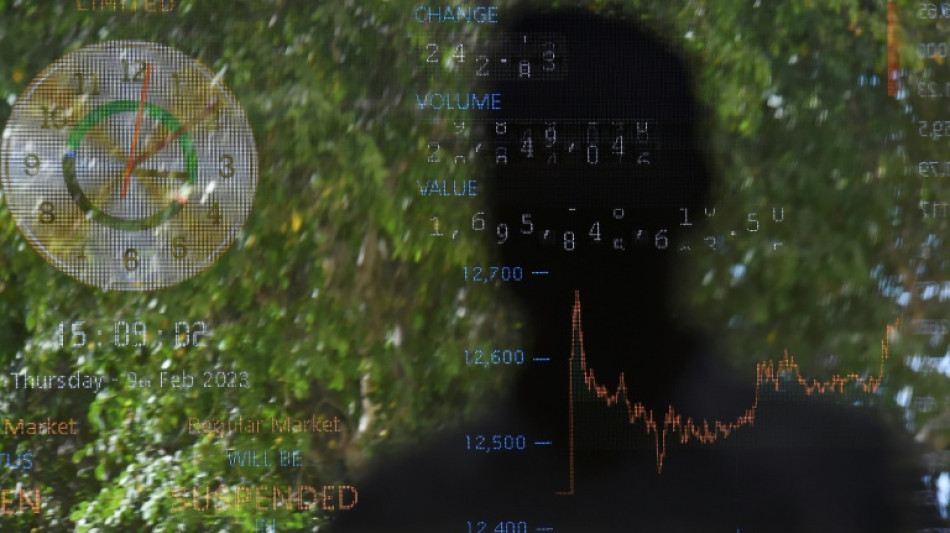
No deal as IMF leaves crisis-hit Pakistan / Photo: © AFP

 US leads fresh Ukraine peace push with Miami talks
 Verstappen continues resurgence with pole for Singapore sprint

 Cuban ration book, symbol of the revolution, gathers dust

 Stocks advance, oil retreats as Trump rules out pre-vote Iran attack

 Man City case causing 'uncertainty' for whole Premier League, says Iraola

 Talks with Iran can only succeed without threats, president says

 Home hope Zheng sets up Mertens clash in China Open semis
 Lombardia promises gripping end to season in Pogacar absence
 Barca skipper Raphinha out against Getafe and Galatasaray

 MEXC and Payward Highlight Collaboration as Crypto and TradFi Converge at TOKEN2049
 EU states agree beefed-up European financial markets watchdog

 Eritrea, Ethiopia trade barbs as Tigray rebels retreat

 Kompany 'proud' of Man City success despite guilty verdict

 Man City will win appeal over financial charges, says Maresca
 Fernandez logs record lap at Indonesia MotoGP practice

 Navi Pillay: S.Africa's global rights activist and Nobel winner

 Ufunded Launches “Spotlight” Series, Documenting the Minds Shaping Modern Trading
 Russell goes fastest in practice for smoggy Singapore GP
 For exiled Russian director Zvyagintsev, triumph without belonging
 Home hope Zheng storms into China Open semi-finals

 Zverev churns out win in Shanghai Masters opener
 Hurricane Isaias strengthens en route to US Gulf Coast

 US activists deploy poll volunteers over Trump intimidation fears

 Saint Laurent designer Vaccarello leaves after glittering decade

 'Tough to stay here': Nepal flood survivors wait for homes

An IMF team left Pakistan on Friday after crisis talks with the government failed to deliver a deal on financial aid that would help the South Asian country avert economic collapse.
After months of deadlock, the International Monetary Fund delegation arrived last week for last-ditch negotiations with a government fearing the political consequences of enforcing bailout conditions in an election year.
Pakistan's economy is in dire straits, stricken by a balance-of-payments crisis as it attempts to service high levels of external debt amid political chaos and deteriorating security.
Inflation has rocketed, the rupee has plummeted and the country can no longer afford imports, causing a severe decline in industry.
"Considerable progress was made during the mission on policy measures to address domestic and external imbalances," the IMF said in a statement.
"Virtual discussions will continue in the coming days to finalise the implementation details of these policies."
The IMF is demanding that the nuclear-armed nation boost its pitifully low tax base, end tax exemptions for the export sector, and raise artificially low petrol, electricity and gas prices meant to help low-income families.
Prime Minister Shehbaz Sharif previously called the conditions for the $1.2 billion loan instalment "beyond imagination".
Finance Minister Ishaq Dar addressed the nation after the IMF team left the country on Friday morning, saying talks had "concluded successfully" and that a draft memorandum on broadly agreed policies had been shared by the lender with the government.
He said petrol prices would rise by roughly four percent and additional taxes would be imposed, without giving further details.
Economic analyst Abid Hasan, a former adviser to the World Bank, said "there will be disappointment in the business community".
"The only way stability can be achieved is through a deal. This has heightened the uncertainty," he told AFP in the capital Islamabad.
- 'So expensive' -
Years of financial mismanagement and political instability have damaged Pakistan's economy -- exacerbated by a global energy crisis and devastating floods that submerged a third of the country.
After months of holding out in search of alternatives, the government began to bow to IMF pressure in mid-January, loosening controls on the rupee to rein in a rampant black market in US dollars -- a step that caused the currency to plunge to a record low. Authorities also hiked petrol prices by 16 percent.
Rana Sadiq, a 65-year-old real estate worker, has had to sell his car and commute on a motorbike to save money.
"Gas bills, electricity bills, petrol prices, fruit and vegetable prices have all doubled in the last few months," he told AFP from a market in Islamabad.
"I can't meet the monthly expenses. Before, my children used to eat fruit every day -- now I take fruit home once in a week."
Batool Zehra, who runs a baking business from home in Lahore to support her family, is struggling to make a profit as prices soar.
"The ingredients are so expensive now... and that's if they are available. I have been unable to complete orders because half the time I realise there is no gas," she told AFP.
"I don't think I will be able to continue the business. But I also don't know how my family is going to make ends meet without this extra income."
- Import backlog -
On Thursday, the central bank released data saying its foreign exchange reserves had plunged by $170 million in a week, standing at just $2.9 billion as of last Friday.
Since January, the world's fifth most populous nation is no longer issuing letters of credit, except for essential food and medicine, causing a backlog of raw material imports the country can no longer afford.
The logjam coupled with the rupee devaluation has sparked a major decline in manufacturing, including textiles and steel, and building projects.
"This situation has triggered fears the construction industry will close down very soon, plunging thousands of labourers into unemployment," Syed Ashfaq Hussain, head of the Constructors Association of Pakistan, told AFP.
While the IMF cash injection will not be enough to rescue Pakistan on its own, the government hopes it will boost confidence and open the doors for friendly nations such as Saudi Arabia, China and the UAE to offer further loans.
"We will get temporary relief but it's not a permanent solution for the economy. More reforms are needed at the government level," a senior government official told AFP.
Pakistan has brokered and broken more than a dozen IMF deals in recent decades as parties renege on agreements that hurt their political survival.
Political analyst Michael Kugelman, director of the South Asia Institute at the Wilson Center in Washington, previously warned that "barring difficult, large-scale reforms, the next crisis could be just around the corner".
sjd-jaf-ak-kf/ecl/axn
T.Bondarenko--BTB