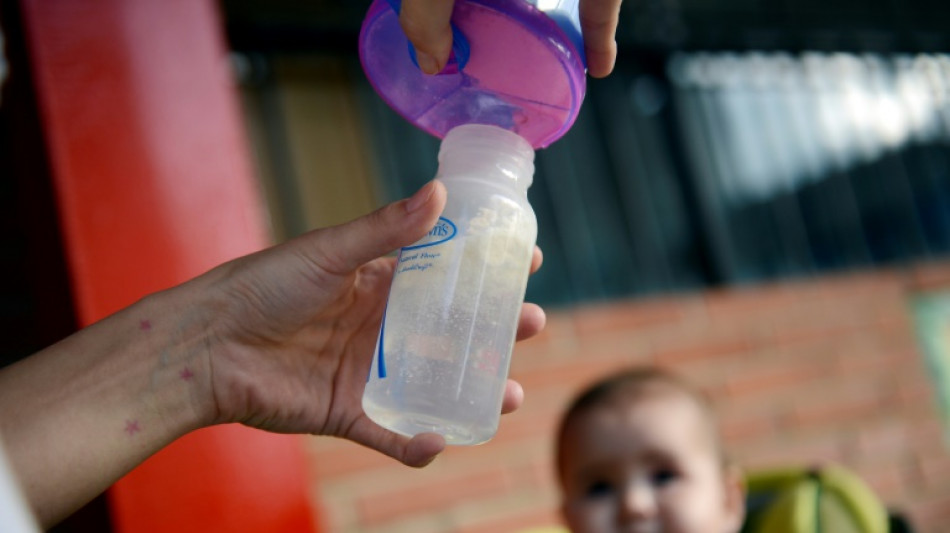
Most baby formula health claims not backed by science: study / Photo: © AFP/File

 Hurricane Isaias set to strike Gulf Coast late Friday

 Trump forms panel to probe US Fed governor Lisa Cook

 Clashes in Durban as fresh anti-migrant riots erupt in South Africa

 France students plan more protests, UN 'concerned' over violence

 De Zerbi calls on struggling Spurs to react in Man Utd clash

 US sanctions on ICC: a 'test of resilience'

 Outrage over US military plan to livestream firing squad execution

 Argentina snap up defence guru Edwards ahead of World Cup

 BMW pulls car lease offer from German far-right politician

 Brazil election offers Jair Bolsonaro a shot at revenge

 Man Utd boss Carrick 'personally' affected by Man City verdict

 Evolution Metals & Technologies Corp. Raises Fiscal 2026 Revenue Guidance 62% at Midpoint to $10–$11 Million and Reaffirms $400–$460 Million Fiscal 2027 Outlook

 Red Bull's Verstappen takes pole position for Singapore GP sprint race

 Chelsea star Palmer 'committed' to England insists Alonso

 OpenAI denies firing researchers over AI safety warnings

 Turkey warns opposition, press over investment fund crisis

 Hurricane Isaias now major storm as it heads to US Gulf Coast

 Djokovic crashes out of Shanghai Masters in his first match

 EU says Turkey's crackdown on rights hampers membership bid

 Two Renoir paintings stolen in France recovered: mayor

 German leader outraged at Schroeder birthday visit to Putin

 Stocks up, oil retreats as Trump rules out pre-vote Iran attack

 South African judge Navi Pillay wins Nobel Peace Prize

 'I completely trust the club,' says Man City boss Maresca

 '10 out of 10' Quintana reminisces over dream Vuelta win

The vast majority of health claims used to advertise baby formula worldwide are not supported by rigorous scientific evidence, a study said Thursday, leading researchers to urge the breast milk substitutes be sold in plain packaging.
The study comes a week after a group of doctors and scientists called for a regulatory crackdown on the $55-billion formula industry for "predatory" marketing which they said exploits the fears of new parents to convince them not to breastfeed.
Breastfeeding is widely recognised to have huge health benefits for babies. The World Health Organization and the US CDC recommend breastfeeding exclusively during the first six months of a newborn's life.
However that recommendation is followed for less than half of infants globally, according to the WHO.
Daniel Munblit, an honorary senior lecturer at Imperial College London and an author of the new study, said researchers were not on a "crusade" against infant formula, which should remain an option for mothers who cannot or choose not to breastfeed.
"But we are very much against inappropriate infant formula marketing, which provides misleading claims not backed up by solid evidence," Munblit told AFP.
Munblit and an international team of researchers looked at the health claims made for 608 products on the websites of infant formula companies in 15 countries, including the United States, India, Britain and Nigeria.
The most common claims were that formula supports brain development, strengthens immune systems and more broadly helps growth.
Half of the products did not link the claimed health benefit to a specific ingredient, according to the study published in the BMJ journal.
Three quarters did not refer to scientific evidence supporting their claims.
Of those that provided a scientific reference, more than half pointed to reviews, opinion pieces or research on animals.
Just 14 percent of the products referred to registered clinical trials on humans. However 90 percent of those trials carried a high risk of bias, including missing data or the finding not supporting the claim, the study said.
And nearly 90 percent of the clinical trials had authors who received funding from or had ties to the formula industry, it added.
- 'Distressing' -
The most commonly cited ingredient was polyunsaturated fatty acids, which is in breast milk and is considered important for brain development.
However there is no evidence of any added benefit when the ingredient is added to baby formula, according to a Cochrane systematic review.
Munblit said the health claims were mostly used to advertise premium formula products, which could be "distressing" for parents who are misled into believing the ingredients are essential but cannot afford them.
When asked what he thinks needs to be done to address the problem, Munblit was concise.
"Plain packaging," he said.
The study comes after a series of papers were published in the Lancet journal last week calling for global policy makers to end exploitative formula marketing.
WHO infant health specialist Nigel Rollins, an author of one of the Lancet papers, said busy parents "lack the time to properly scrutinise claims" about infant formula.
The new study showed that "governments and regulatory authorities must commit the necessary time and attention to review the claims of formula milk products," Rollins said in a linked BMJ editorial.
C.Kovalenko--BTB