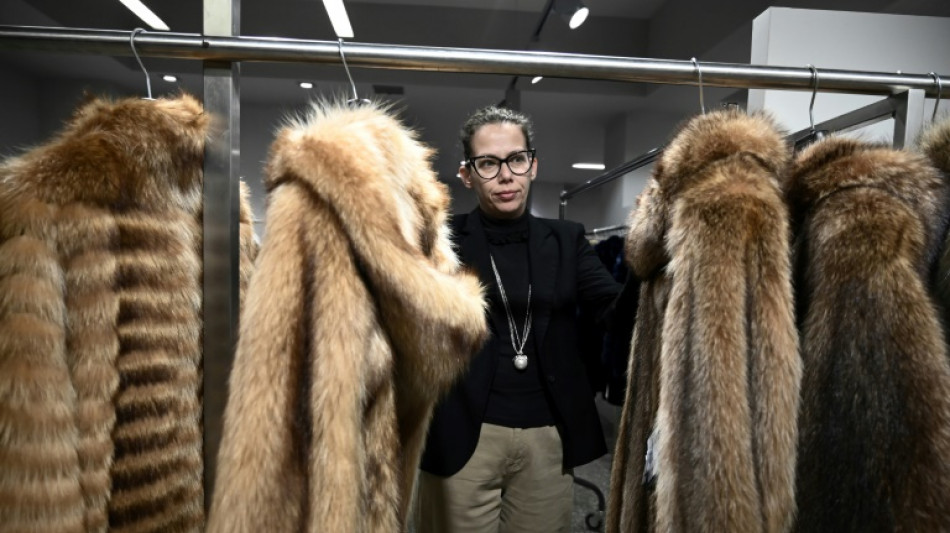
Russia sanctions cripple Greek fur industry / Photo: © AFP

 Hurricane Isaias set to strike Gulf Coast late Friday
 Trump forms panel to probe US Fed governor Lisa Cook

 Clashes in Durban as fresh anti-migrant riots erupt in South Africa

 France students plan more protests, UN 'concerned' over violence

 De Zerbi calls on struggling Spurs to react in Man Utd clash
 US sanctions on ICC: a 'test of resilience'

 Outrage over US military plan to livestream firing squad execution

 Argentina snap up defence guru Edwards ahead of World Cup

 BMW pulls car lease offer from German far-right politician

 Brazil election offers Jair Bolsonaro a shot at revenge

 Man Utd boss Carrick 'personally' affected by Man City verdict

 Evolution Metals & Technologies Corp. Raises Fiscal 2026 Revenue Guidance 62% at Midpoint to $10–$11 Million and Reaffirms $400–$460 Million Fiscal 2027 Outlook

 Red Bull's Verstappen takes pole position for Singapore GP sprint race

 Chelsea star Palmer 'committed' to England insists Alonso

 OpenAI denies firing researchers over AI safety warnings

 Turkey warns opposition, press over investment fund crisis

 Hurricane Isaias now major storm as it heads to US Gulf Coast

 Djokovic crashes out of Shanghai Masters in his first match

 EU says Turkey's crackdown on rights hampers membership bid

 Two Renoir paintings stolen in France recovered: mayor

 German leader outraged at Schroeder birthday visit to Putin

 Stocks up, oil retreats as Trump rules out pre-vote Iran attack

 South African judge Navi Pillay wins Nobel Peace Prize

 'I completely trust the club,' says Man City boss Maresca

 '10 out of 10' Quintana reminisces over dream Vuelta win

In a large exhibition hall in northern Greece, Russian women would once strike a pose in a gold throne-like armchair, wrapped in their brand-new furs.
"They felt like tsarinas. Now, nobody sets foot in here," said a hall employee who declined to give his name.
While the fur industry has declined in recent decades after fierce campaigning from animal-rights activists who decry its cruelty, the material has remained sought after in countries like Russia and China.
In Greece, a major centre of fur exports to Russia, European Union sanctions on Moscow have dealt the industry yet another blow.
Fur is among the luxury goods whose export to Russia has been banned.
Dozens of businesses in northern Kastoria and Siatista -- which have produced furs since the 15th century -- have had to close down in the wake of Russia's invasion of Ukraine.
"We are suspending our operations. I sidelined 80 percent of my staff, a total of 52 people," said Akis Tsoukas, the head of the Hellenic fur federation.
An Ernst and Young study in 2019 found that fur was among Greece's top 12 exports, with some coats selling for as much as 200,000 euros ($213,000).
Tsoukas said before the Covid-19 pandemic in 2019 -- fur exports earned 108 million euros ($116 million), almost half of it from Russia.
Another 21.5 million euros in fur was sold in the United Arab Emirates, where it was also mostly snapped up by Russians. Ukraine took another 10 million euros worth of product.
A year later, exports essentially fell to zero, Tsoukas said.
The pandemic hit the industry hard, with millions of mink culled on fur farms after some animals tested positive for the virus.
- 'We are in despair' -
Unable to export their goods, local artisans are moving to Russia to try and find work.
"My father was a furrier and I learned the craft from a very young age," said Apostolis Gravas, a 47-year-old who runs his family's fur business in Siatista.
"Coronavirus and the war have wiped us out. We are in despair. That's why I looked for work in Russia. Many people like me go to Russia to find a job," he told AFP.
Maria Fotis, who has worked in the sector since 1979, said Russia was looking for experienced workers to join their own industry.
"I haven't seen them being bothered that much by the war. As they can no longer buy from Greece, they started producing and selling fur there," she said.
At the workshop in Chelyabinsk, southern Russia, where she found employment, Fotis said six out of eight employees were Greek.
"But you can stay there only three months, until the visa expires," she noted.
- Near-total shutdown -
Christos Zefklis, mayor of the town of Voio, said 80 percent of residents in nearby Siatista and surrounding villages survived off the fur industry.
"How are they going to retrain now? This whole transition to a new economic model is proving very costly to their living standards," he said.
According to official figures, half of the 4,000 fur artisans in Siatista and Kastoria have been forced to leave the profession this year.
Mink farms in the area have also been affected and have halved production as a result, says Miltos Karakoulakis, spokesman for the Panhellenic association of fur-bearing animal breeders.
Forty of 92 farms have shut down, and those remaining are expected to raise one million mink, down from 1.8 million in past years, said Karakoulakis.
The furriers are now seeking to tap new markets in Europe, the United States, China, Japan and Korea.
"We will try for a few more years to focus on different markets. There may be a way to break the embargo but it's not like we are smuggling weapons or things like that," said 50-year-old Nikos Gliayas, whose family has been in the business since 1960.
- More ethical choices -
Major fashion brands have in recent years moved away from the use of fur -- as well as crocodile and snake skin -- especially as younger generations demand more ethical and sustainable products.
Animal rights organisations, such as PETA, say that minks, foxes, chinchillas, and other creatures, are cruelly electrocuted to death, and sometimes skinned alive, after being kept in crowded and filthy conditions.
In Greece, some traders are trying to stay afloat by making products from sheepskin, deemed more ethically acceptable than mink.
"We're trying to stay alive in business by making mouton fur," explained Stelios Porporis, marketing director at one of the largest fur businesses in the area.
He said the sheepskins that have been processed to look like beaver or seal fur – were "more acceptable to the market as they come from the food chain".
K.Brown--BTB