Britain's fresh produce shortages serve up blame game / Photo: © AFP

 Major earthquake rocks Panama, triggers tsunami warning

 Indian jailed in France for leading sadist Nazi cult that tortured girls

 'Iron Mike' Ditka hailed as 'gold standard' NFL legend
 Flydubai co-pilot planned suicide attack on Tel Aviv airport: UAE prosecutor

 Mike Ditka: Chicago Bears icon as player and coach

 Outrage over plan to livestream US military firing squad execution

 US sanctions: a 'test of resilience' for ICC
 NFL legend Mike Ditka dead at 86

 Hurricane Isaias set to strike Gulf Coast late Friday
 Trump forms panel to probe US Fed governor Lisa Cook

 Clashes in Durban as fresh anti-migrant riots erupt in South Africa

 France students plan more protests, UN 'concerned' over violence

 De Zerbi calls on struggling Spurs to react in Man Utd clash

 US sanctions on ICC: a 'test of resilience'

 Outrage over US military plan to livestream firing squad execution

 Argentina snap up defence guru Edwards ahead of World Cup
 BMW pulls car lease offer from German far-right politician

 Brazil election offers Jair Bolsonaro a shot at revenge

 Man Utd boss Carrick 'personally' affected by Man City verdict

 Evolution Metals & Technologies Corp. Raises Fiscal 2026 Revenue Guidance 62% at Midpoint to $10–$11 Million and Reaffirms $400–$460 Million Fiscal 2027 Outlook

 Red Bull's Verstappen takes pole position for Singapore GP sprint race

 Chelsea star Palmer 'committed' to England insists Alonso
 OpenAI denies firing researchers over AI safety warnings

 Turkey warns opposition, press over investment fund crisis

 Hurricane Isaias now major storm as it heads to US Gulf Coast

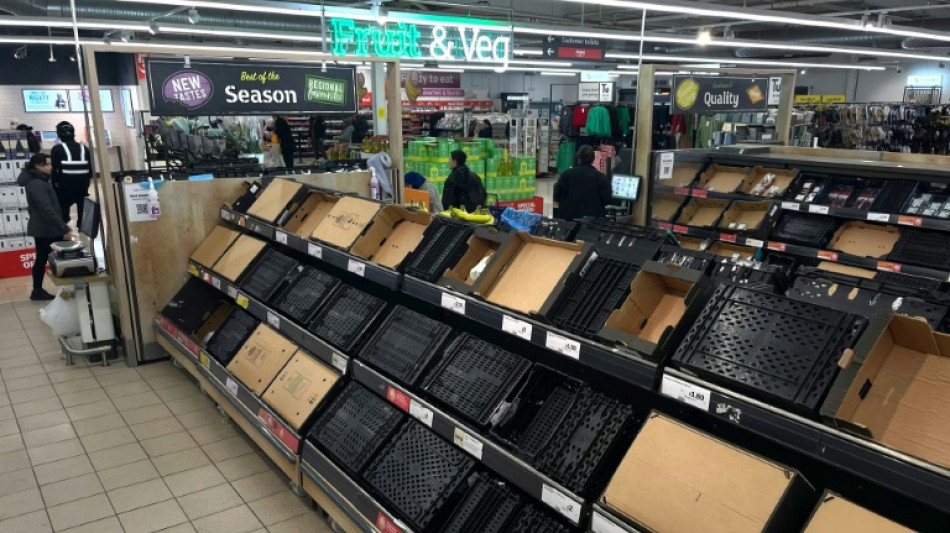
Shortages of fruit and vegetables -- from broccoli, cucumbers and lettuce, to tomatoes, peppers and raspberries -- have served up a blame game in Britain.
Are sparse shop shelves due to Brexit, bad weather in Spain, supermarket price wars, soaring energy bills on Ukraine war fallout, or the UK government?
Faced with low stock, an increasing number of retailers are rationing, with some allowing no more than three purchases per customer for certain items.
The weekly shop for millions of Britons has also been blighted for months by a lack of eggs because of bird flu.
The government insists bad weather hit harvests in southern Europe and northern Africa, while authorities and supermarket chains warn that shortages of fresh produce will continue for weeks.
- Turnips row -
London dismisses claims that Brexit is to blame, insisting it can gain control of agricultural policy after its departure from the European Union at the start of 2021.
Spain's Agriculture Minister Luis Planas also told the Financial Times that Brexit was not the cause of shortages, while conceding that rising costs had forced some smaller producers to curb exports.
Mark Spencer, Britain's junior minister with responsibility for food, has urged supermarket bosses to explain what they are doing to replenish shelves.
Environment Minister Therese Coffey, called on Britons to eat more local seasonal produce such as turnips rather than imported foodstuffs in short supply.
That triggered a row over the suggestion that Britons -- already facing a cost-of-living crisis sparked by rampant inflation -- embrace turnips, generally considered a boring root vegetable.
Experts meanwhile believe the problem runs deeper than merely bad growing conditions in key fruit and vegetable producers Spain and Morocco.
- 'Broken' food system -
"No one is really admitting that our current food system is completely broken," chef Thomasina Miers told BBC television.
"The way we farm is incredibly oil intensive and it contributes to 30 percent of global greenhouse gas emissions," she added.
"So, the way we farm not only contributes to (global) warming but also it's degrading our soils."
Miers called on producers to use modern technology to help improve both output and biodiversity.
Minette Batters, president of the National Farmers Union (NFU) in Britain, heaped praise on the UK system that produces cheap food but warned it faced huge cost inflation -- particularly for vital elements such as animal feed, energy and fertilisers.
Record-breaking temperatures last summer also weighed heavily on UK farming production, driving up prices in the long term.
UK food-price inflation soared above 17 percent last month, according to a survey from data provider Kantar.
Batters has called on the government to implement a strategy to help UK farmers boost production, protect the environment and manage volatility.
"We need a radical restructure of what these relationships look like from farm to fork," Batters said.
- 'Along came Brexit' -
The Guardian newspaper's influential food critic Jay Rayner has also condemned the UK government's stance.
"It isn't just a blip," he said of the current crisis. "It's a symptom of a dysfunctional food system."
He blamed supermarket giants for having squeezed costs as they slash prices to compete for customers.
"For decades the supermarket sector had been given a free run at our food supply chain by governments of both stripes," Rayner wrote in a comment piece.
"Our self-sufficiency... withered."
The farming of much fresh produce had become "economically unviable" due to soaring energy costs and Brexit fallout -- including extra red tape and labour shortages, he argued.
Britons, he said, would have to accept paying more for their food.
F.Pavlenko--BTB