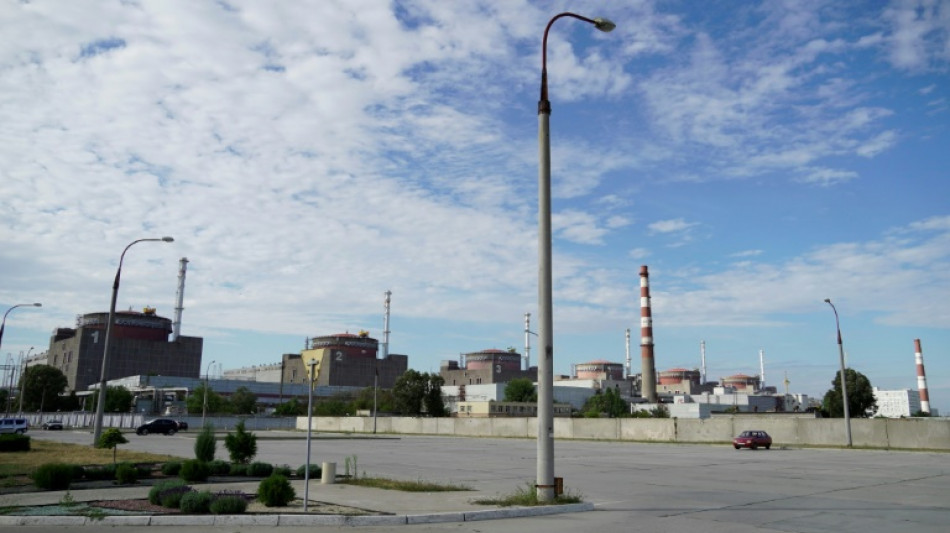
A year on, Ukraine's embattled nuclear plant turned Russian 'military base' / Photo: © AFP/File

 Anthropic AI model sent fake murder tip to Philadelphia police

 7.7-magnitude quake rocks Panama, triggers tsunami warning

 Prince Harry booed at English rugby match

 Kiplimo and Feysa seek repeat Chicago Marathon wins

 Fuellkrug halts Dortmund after late goal flurry

 Injured Ravens quarterback Jackson ruled out of Falcons clash

 Brewers aim to take down two-time defending champion Dodgers in NLCS rematch

 Tsunami alert after major earthquake rocks Panama

 Outer bands of Hurricane Isaias lash US Gulf Coast

 Hope, Rutherford fire West Indies to record T20 chase of 250

 Farhan leads Pakistan to T20 win over Sri Lanka

 Turkey sack coach Montella after Nations League woe
 US announces sanctions on ICC, hours after Nobel award to former judge

 Montenegro expels popular Russian war blogger wanted by US
 Rubio calls on all Venezuela opposition figures to join talks with govt

 Australia struggle against South Africa quicks in first Test
 Stocks advance as Trump rules out pre-vote Iran attack
 Australia struggle against South Africa's fast bowlers

 Massive debt puts France in a bind as investor doubts deepen
 Arteta urges 'respect' for process after Man City financial verdict

 'Human-authored' book labels gain ground amid AI scandals

 Man City whistleblower Pinto to stay under police protection

 US leads fresh Ukraine peace push with Miami talks

 Verstappen continues resurgence with pole for Singapore sprint

 Cuban ration book, symbol of the revolution, gathers dust

Ukraine's Zaporizhzhia nuclear power plant no longer produces electricity and serves solely as a military base for Moscow's troops, the exiled mayor of the city of Energodar, which houses the facility, told AFP.
Moscow's troops seized the plant in the southern Zaporizhzhia region on March 4 last year, just days after the start of Russia's invasion.
The International Atomic Energy Agency (IAEA) has raised concerns about shelling near the plant, calling for a demilitarised zone around it.
"During a year under occupation, (Russians) have turned Europe's largest nuclear power plant into a military base," 37-year-old Energodar mayor Dmytro Orlov said in an interview to AFP.
The plant has repeatedly made headlines and revived fears of nuclear catastrophies similar to the deadly Chernobyl disaster that shook Ukraine in 1986.
Orlov said Russian troops take advantage of the fact that Ukraine "will not fire" at the site to avoid such an incident.
Kyiv and Moscow have blamed each other for shelling around the plant.
This means that Russia uses the plant as a "nuclear shield" to keep its military equipment, ammunition and personnel safe, he said.
According to Orlov, at least 1,000 Russian soldiers are currently stationed at the power plant and in Energodar.
The city on the banks of the Dnipro river saw its population drop from 53,000 to about 15,000 following the invasion.
- Dangerously low staffing -
"Most of the occupation troops are based at the power plant because they are safer there," said the mayor, who in April 2022 moved to the Ukrainian-controlled city of Zaporizhzhia.
Zaporizhzhia is some 120 kilometres (75 miles) from Energodar, but Orlov said he maintains regular contacts with the residents who stayed behind in the city he governed.
The exodus from Energodar after Russia's occupation affected not only the city, but also the staffing of the plant.
According to Ukraine's nuclear operator Energoatom, close to half of the facility's workforce is gone.
Around 6,500 workers remaining compared to 11,000 before the war.
Thousands of professionals left for territories controlled by Kyiv and of those who remained, some 2,600 agreed to "cooperate" with Russia, Energoatom told AFP.
"There is a real staffing problem, which has an impact on safety," mayor Orlov said.
According to him, the remaining employees are overworked, forced to work with low staffing and without holidays.
The plant, which previously produced 20 percent of Ukraine's electricity, continued to operate in the first months of the invasion, despite frequent shelling.
Now, its six Soviet-era reactors are in shutdown and no longer produce electricity.
The facility remains connected to Ukraine's energy grid but only consumes electricity for its own needs.
- No military solution -
Moscow "for several months tried to connect it to the Russian electricity network but they did no succeed," Orlov said.
Russia is unable to put any reactor into operation because the power transmission lines are damaged, except for the one that feeds it from Ukraine, Energoatom said.
Even if Moscow sends its own specialists, "their skills are not enough to organise the full-fledged work" of the plant, according to Energoatom.
The issue is that the shutdown of the plant leads to a "gradual degradation of its systems and equipment".
The operator also warned of the "risk of a nuclear or radiation accident" if the last power line connecting the plant to Ukrainian energy grid is cut.
The US-based Institute for the Study of War said Wednesday that Moscow may be "attempting to deter a possible future Ukrainian counteroffensive" in the south by "escalating threats" to the plant.
The UN's nuclear agency IAEA deployed observers to the plant in September and is seeking to negotiate a demilitarised zone near the facility, but talks appear to have stalled.
IAEA chief Rafael Grossi said on Twitter Thursday that a new rotation of experts had been completed, posting a video of observers in helmets and bulletproof vests walking around a destroyed bridge to reach the power plant.
"The fact that they are there is already a plus," Orlov added, who says there can only be a diplomatic solution.
"For obvious reasons, nobody will de-militarise and de-occupy Europe's largest nuclear power plant by military means."
F.Pavlenko--BTB