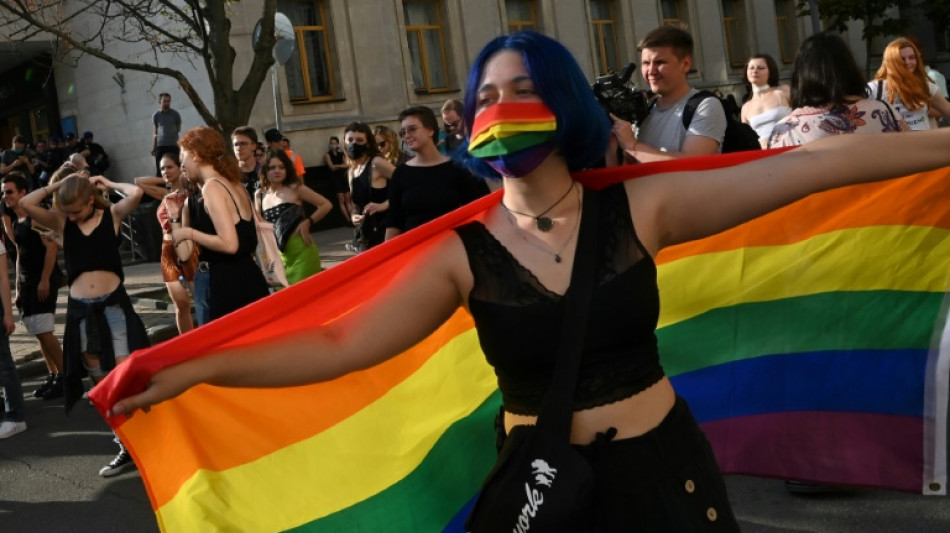
War in Ukraine spurs LGBTQ+ acceptance, push for equal rights / Photo: © AFP

 Anthropic AI model sent fake murder tip to Philadelphia police
 7.7-magnitude quake rocks Panama, triggers tsunami warning
 Prince Harry booed at English rugby match

 Kiplimo and Feysa seek repeat Chicago Marathon wins

 Fuellkrug halts Dortmund after late goal flurry
 Injured Ravens quarterback Jackson ruled out of Falcons clash
 Brewers aim to take down two-time defending champion Dodgers in NLCS rematch

 Tsunami alert after major earthquake rocks Panama
 Outer bands of Hurricane Isaias lash US Gulf Coast

 Hope, Rutherford fire West Indies to record T20 chase of 250
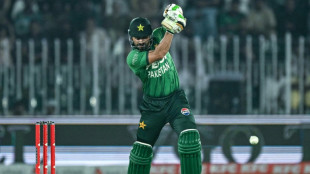 Farhan leads Pakistan to T20 win over Sri Lanka
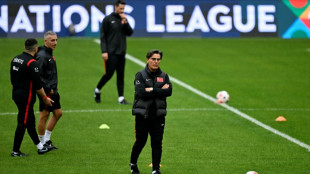 Turkey sack coach Montella after Nations League woe
 US announces sanctions on ICC, hours after Nobel award to former judge
 Montenegro expels popular Russian war blogger wanted by US

 Rubio calls on all Venezuela opposition figures to join talks with govt
 Australia struggle against South Africa quicks in first Test
 Stocks advance as Trump rules out pre-vote Iran attack
 Australia struggle against South Africa's fast bowlers
 Massive debt puts France in a bind as investor doubts deepen
 Arteta urges 'respect' for process after Man City financial verdict
 'Human-authored' book labels gain ground amid AI scandals
 Man City whistleblower Pinto to stay under police protection
 US leads fresh Ukraine peace push with Miami talks
 Verstappen continues resurgence with pole for Singapore sprint
 Cuban ration book, symbol of the revolution, gathers dust

Mykola Milovanov doesn't have a piece of paper to say that he and his partner Dmytro Gavrilyuk are married, but the 24-year-old member of Ukraine's special forces still calls him his husband.
It is a legal status barred under Ukraine's constitution but that has come into the spotlight since Russia invaded one year ago and Ukrainians signed up for the military in droves, including members of the LGBTQ+ community.
"For now, I can't legally say that I'm with my husband, but we are pushing for it," said Milovanov, his sleeve bearing the unicorn patch some LGBTQ+ service members wear.
Like the other LGBTQ+ people in Ukraine's military, the lack of legal ties means Gavrilyuk would not be guaranteed a call if Milovanov were wounded or killed, among other rights service members' spouses enjoy.
But frustration over this disparity, alongside Ukraine's push to cement ties with the West, has fuelled momentum for new laws and spurred acceptance for LGBTQ+ rights, according to activists and recent polls.
Both Milovanov and 31-year-old Gavrilyuk, who works with the non-governmental group Ukrainian LGBT Military for Equal Rights, signed a citizen-led petition launched in June last year calling for the legalisation of same-sex marriage.
They were among more than 25,000 signatories, a figure that ensured it would be put before President Volodymyr Zelensky.
He has instructed the government to speed up work on a legislative solution for civil partnerships, since the constitution cannot be changed under the current state of martial law.
Recent surveys confirm the swell of support for legal change.
- Political 'hot topic' -
Ukraine's Rating Group found in February that the percentage of the population with a positive or neutral attitude toward LGBTQ+ people had increased to 64 percent from 53 percent between August 2021 and February this year.
And a January poll by the US-based National Democratic Institute (NDI) found 58 percent of Ukrainians support LGBTQ+ people having the same rights as heterosexuals, and 56 percent are for making LGBTQ+ civil partnerships legal.
For Sviatoslav Sheremet, the policy and legislation coordinator at Ukraine's National LGBTI Consortium, it is not a question of if same-sex partnerships will be legalised but when.
He pointed to legislation under discussion in the government since before the invasion, saying the issue has become a "hot topic" politically.
With more Ukrainians in favour of same-sex civil partnerships, "the authorities now have a free hand," said Sheremet, a longtime activist who has been with his partner for 17 years.
Progress has been the result of decades of painstaking efforts, he added, often in the face of fierce pushback from a society steeped in Christianity and traditional mores.
And there is still solid opposition in some quarters and social resistance -- only 44 percent of people want marriage opened to same-sex couples, and 30 percent support gay couples being able to adopt children, according to the NDI poll.
But the invasion has made such internal divisions secondary to the external threat, the Rating study said.
Activists point to Ukraine's sprint to join the European Union as another impetus for new legislation, as Kyiv must meet human rights criteria, including related to LGBTQ+ people.
- 'The law doesn't see us' -
A resistence to Russian influence has also caused Ukrainians to reject some of the "traditional values" championed by Moscow, which has clamped down on LGBTQ+ rights, activists say.
"People don't want any connection with Russia, even in their ideas," said Edward Reese, a non-binary communications officer with KyivPride.
"The war really changed Ukrainians in support of human rights, because people see LGBTQ+ soldiers and start seeing their problems."
But there is still a long way to go, something felt acutely by LGBTQ+ fighters on the frontlines such as Oleksandr Zhugan and his non-binary partner of eight years, both of whom joined the Territorial Defence Forces the day after Russia invaded.
"Most people are just awakening and seeing LGBTQ people around them," the 38-year-old told AFP on the phone from a front-line position in the eastern Donetsk region.
He said he and his partner faced discrimination by some in the military who "think that people like us should not exist," but that on the battlefield many divisions are broken down.
"Lots of people believed a false narrative that an LGBTQ person cannot be a patriot," he said. "Being here and fighting for our country, we are proving them wrong."
But there is one difference Zhugan and his partner cannot erase for the time being. If either is killed, getting leave to bury their loved one depends on the good will of their commander.
"We're becoming more and more visible," Zhugan said, but for now, "the law doesn't see us."
K.Brown--BTB