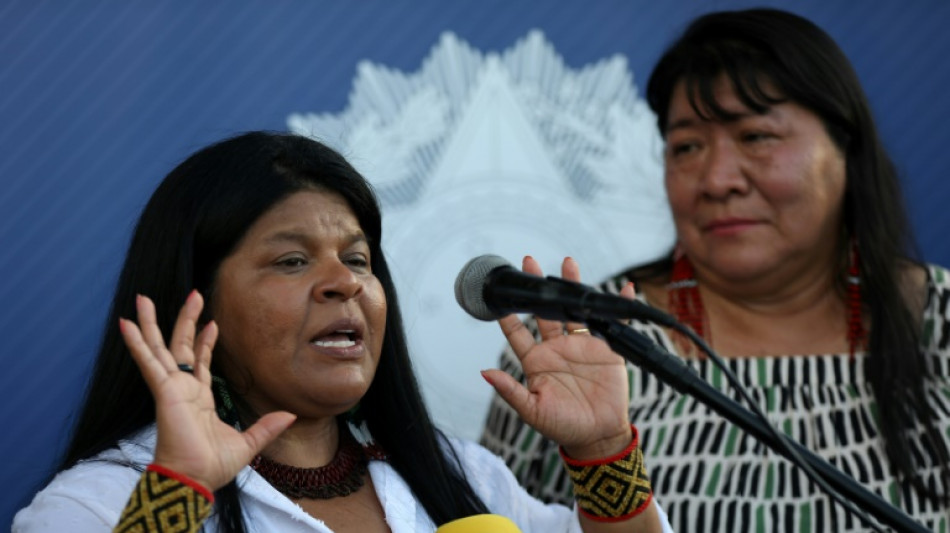
Brazil's new Indigenous affairs chief sets sights on illegal gold / Photo: © AFP

 Anthropic AI model sent fake murder tip to Philadelphia police

 7.7-magnitude quake rocks Panama, triggers tsunami warning

 Prince Harry booed at English rugby match

 Kiplimo and Feysa seek repeat Chicago Marathon wins

 Fuellkrug halts Dortmund after late goal flurry

 Injured Ravens quarterback Jackson ruled out of Falcons clash

 Brewers aim to take down two-time defending champion Dodgers in NLCS rematch

 Tsunami alert after major earthquake rocks Panama

 Outer bands of Hurricane Isaias lash US Gulf Coast

 Hope, Rutherford fire West Indies to record T20 chase of 250

 Farhan leads Pakistan to T20 win over Sri Lanka

 Turkey sack coach Montella after Nations League woe
 US announces sanctions on ICC, hours after Nobel award to former judge

 Montenegro expels popular Russian war blogger wanted by US
 Rubio calls on all Venezuela opposition figures to join talks with govt
 Australia struggle against South Africa quicks in first Test
 Stocks advance as Trump rules out pre-vote Iran attack
 Australia struggle against South Africa's fast bowlers

 Massive debt puts France in a bind as investor doubts deepen
 Arteta urges 'respect' for process after Man City financial verdict

 'Human-authored' book labels gain ground amid AI scandals

 Man City whistleblower Pinto to stay under police protection
 US leads fresh Ukraine peace push with Miami talks
 Verstappen continues resurgence with pole for Singapore sprint

 Cuban ration book, symbol of the revolution, gathers dust

Joenia Wapichana is used to charting new territory: the first Indigenous woman to earn a law degree in Brazil, she was also the first elected to Congress.
But she faces one of her biggest challenges yet in her new job as the first native person to lead Brazil's Indigenous affairs agency, FUNAI, which she said was dismantled for the past four years under far-right then-president Jair Bolsonaro.
The feisty 49-year-old is the first to admit she faces a daunting to-do list, starting with the issue that thrust her into the spotlight almost from the day she took office last month: rampant illegal gold mining on protected Indigenous reservations.
Newly inaugurated leftist President Luiz Inacio Lula da Silva has ordered a police and army crackdown to wrest back control of the country's largest reservation, the Yanomami territory, from illegal miners, who are accused of poisoning the water with mercury, destroying the rainforest, raping and killing inhabitants, and triggering a humanitarian crisis.
But it is proving difficult for federal authorities to stop the boom in illegal gold, Wapichana said in an interview with AFP at her office in Brasilia.
"Brazil still doesn't have a way to curb the illegal gold trade," she said.
The government response "is very fragile," she added.
- Rampant abuse -
At least 30 percent of the gold mined in Brazil is irregular in origin, according to a recent study by the Federal University of Minas Gerais.
Under Brazilian law, gold dealers are allowed to make a declaration "in good faith" that their product was legally mined -- a system that leads to rampant abuse, according to experts.
The system "is still very immature," said Wapichana, who often wears a traditional headdress of bright feathers.
Her resources to fight the problem are limited: FUNAI's budget is 600 million reais (about $120 million) this year, the majority of which is for administrative costs.
Just one-sixth will remain for key functions such as establishing new Indigenous reservations and policing existing ones.
Wapichana wants at least double that.
She is hoping to get financing from the Amazon Fund, an internationally backed program to protect the world's biggest rainforest.
When Lula took office in January, donor countries revived the fund, which was suspended under Bolsonaro in response to a surge in deforestation.
Wapichana is also hoping to tap funds negotiated at UN climate talks to help vulnerable countries adapt to climate change -- though that will take time.
"Indigenous peoples' contribution to combatting the effects of climate change needs to be compensated," Wapichana said.
Numerous studies have found Indigenous peoples play a crucial role in slowing global warming by protecting the world's carbon-absorbing forests.
- 'Part of this country' -
Wapichana inherited a FUNAI in crisis, after four years of controversy under Bolsonaro.
Indigenous leaders accuse the ex-president of appointing hostile officials to lead the very agency that was supposed to protect Brazil's 800,000 native people.
As president, Bolsonaro (2019-2022) pushed to open protected Indigenous lands to mining. Illegal gold mining in the Brazilian Amazon rose sharply on his watch, destroying a record 125 square kilometers (48 square miles) of forest in 2021, according to satellite monitoring by the national space agency.
Bolsonaro also made good on his vow to ensure that "not a single centimeter" of new Indigenous reservations were allowed.
Lula has promised to resume creating new Indigenous reservations, which currently cover 13.75 percent of the nation's territory.
Bolsonaro "encouraged land invasions, denied our rights and contributed to discrimination against Indigenous peoples, who suffered persecution and criminalization," Wapichana said.
She says it her mission to undo that damage.
She faces a tough job but Wapichana is used to blazing trails.
"This is a country where Indigenous women are seen as submissive domestic workers," she said.
"I'm here to say: 'We're part of this country, and we want to sit at the table as equals.'"
J.Bergmann--BTB