
Discovering HIV started 'race against time': Barre-Sinoussi / Photo: © AFP/File

 Suspected heatstroke kills three lions at Japan zoo
 Stocks mixed as Seoul stabilises, oil prices rise with eyes on Mideast

 Trapped by war, Bangladesh seafarer recounts Gulf ordeal

 WWII shells surface in wildfire-ravaged French village

 Last Scottish island bird hunt banned after almost 500 years

 Fritz outguns Jodar to win ATP Washington title

 Major League Soccer names LAFC co-owner Berg as next commissioner

 Osaka out to improve Toronto fortunes with eye on US Open
 Dow hits fresh record as oil prices tumble

 Trump board reassures Israel after objections on Gaza pullout

 Zelensky sacks his ambassador to the US
 'Spider-Man' breaks record for domestic box office debut

 US regulators grant long-awaited Boeing 737 MAX 7 certificate
 Eala powers past Pegula for first WTA title in Washington

 Legionnaires' outbreak in Switzerland's Basel kills one, 26 ill
 Infantino, the FIFA president under pressure after scrapped investor plan

 Young Danes start extended military service
 England, Wales had driest July on record: Met Office
 French court rejects pro-Kremlin commentator's deportation appeal
 Oil slides, stocks rise on hopes of deal to end Mideast war
 EU chief urges 'united action' on borders after Ceuta migrant rush

 Oil prices slide on hopes of deal to end Mideast war
 Dortmund sign Greek teenager Karetsas from Genk
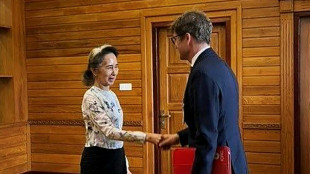 Detained Aung San Suu Kyi meets Red Cross delegate in Myanmar

 설명 압박에 직면한 BitMart: 8일이 지나도 여전히 TXID가 없는 SNC SCANDIC COIN 출금

When Nobel laureate Francoise Barre-Sinoussi helped identify a mysterious virus that would become known as HIV 40 years ago, she says it kicked off a "race against time" to counter the looming AIDS crisis.
In an interview with AFP, the 75-year-old virologist described how she and colleagues at the Pasteur Institute in Paris discovered HIV in 1983, which led to her jointly winning the Nobel Prize for Medicine.
"It all started in 1982," when doctors started sharing stories about the first French AIDS patients, France's Barre-Sinoussi said.
"They were convinced that a retrovirus could be responsible for this new disease."
For more than a decade Barre-Sinoussi had been working on retroviruses, which on infection convert from the genetic material RNA into DNA, allowing them to easily integrate host cells.
In January 1983, the team's strategy was to take a lymph node biopsy from a sick patient, then culture the cells in the lab looking for "very specific enzymatic activity", she said.
Her French doctor colleagues thought that AIDS must be caused by HTLV-1, the only retrovirus known to directly cause cancer in humans.
"But our team did not believe in this hypothesis because this virus causes a proliferation of lymphocytes," Barre-Sinoussi said.
AIDS patients had lower rates of this important immune cell.
"Something didn't add up," she said.
"In May 1983, we isolated the virus and demonstrated that it was a retrovirus that was different from HTLV-1. But we were not yet certain that it caused AIDS."
That was confirmed the following year by US scientist Robert Gallo.
This caused a transatlantic rift over who discovered HIV, with the United States and France eventually agreeing that both Gallo and the Pasteur team led by Luc Montagnier should get joint credit.
- 'Enormous' challenge ahead -
Finally, researchers around the world had a target to aim for in their efforts to combat AIDS, which was rapidly spreading and devastating communities.
"From then on, the task was enormous because we were faced with an unknown virus," Barre-Sinoussi said.
"We had to learn everything about it, find out what proteins it contained, its genetic material, what type of cells it infected, the consequences of this infection."
A crucial first step was to develop tests as quickly as possible, both to diagnose patients and to demonstrate that HIV only infected AIDS patients.
"Only then could strategies be considered to try to block it," she said.
"It was a race against time because we realised that the virus was transmitted by blood, sex and from mother to child."
The endeavour required the swift mobilisation of immunologists, molecular biologists and doctors, she said.
Not to mention patients, even though scientists knew "we would not have time to find a treatment that could save them", she said.
"We found ourselves faced with people who came to the Pasteur Institute to ask us questions about the virus," she said.
"It was very difficult."
- Nobel 'recognised a community' -
In 2008, Barre-Sinoussi and her former mentor, Luc Montagnier, jointly received the Nobel medicine prize for the discovery of HIV.
"I was in Cambodia when I heard the news. It was a huge surprise. I did not expect it all," Barre-Sinoussi said.
"People living with HIV in the country came up to me with smiles and bouquets of flowers.
"I understood that this prize recognised a community that had been working together from the beginning."
"All levels of society have been affected by HIV/AIDS, which has always been a battle on multiple fronts -- scientific of course, but also political, societal (and) against pharmaceutical companies," she said.
When she started her career, "I was a researcher who never left the laboratory", she said.
But after helping discover HIV, things changed. "I suddenly found myself faced with things that I never imagined possible, such as the general public's lack of tolerance towards certain people," she said.
"Patients were stigmatised, abandoned by their families, their friends, sometimes by health professionals. Some lost their homes, their jobs."
Barre-Sinoussi said that she had also "learned a lot about inequalities, which unfortunately may have become even worse today".
Throughout her long career, Barre-Sinoussi worked continuously towards finding a cure for HIV, serving as the president of the International AIDS Society a decade ago. She retired in 2017.
I.Meyer--BTB