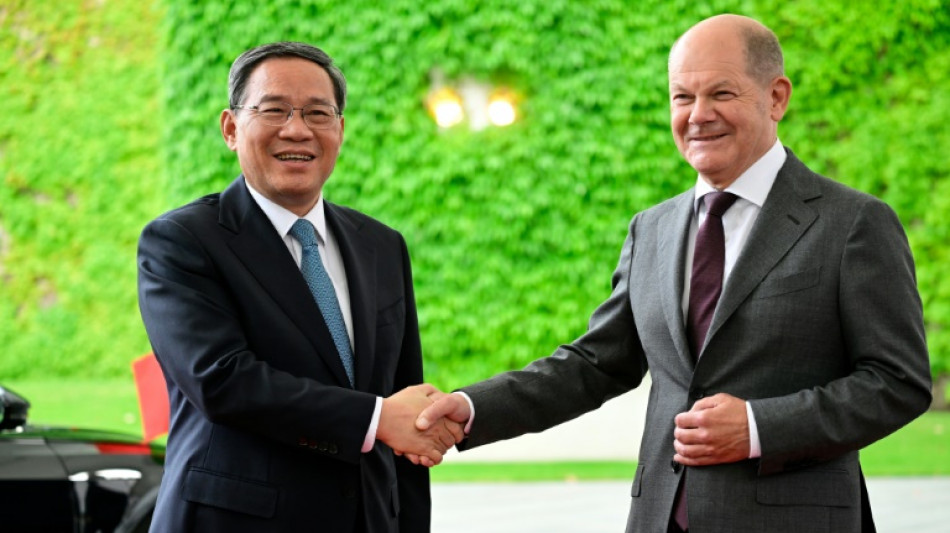
'Tough balancing act': Chinese, German leaders hold talks / Photo: © AFP

 Trump's 'energy ceasefire' sparks confusion as Russia strikes Ukraine

 Dupont double helps Toulouse avoid Bayonne slip-up in Top 14

 Marseille snap losing skid with win at Troyes

 Lula stages mass rally ahead of Brazil's presidential run-off

 Poland holds suspect in alleged assassination plot against PM Tusk

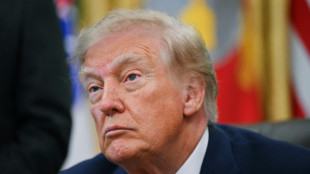 Russia hits Ukraine power plants despite Trump energy ceasefire claim

 Isco's Betis rise back above Real Madrid to third

 Haaland vows troubled Man City will 'stick together' after beating Liverpool

 Abhishek, Arshdeep guide India to T20 win over West Indies

 'Other Mommy' scares up N. American box office win

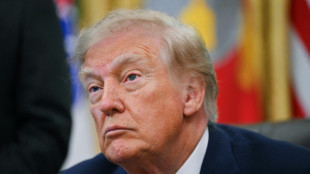 Zelensky surprised, Moscow mum as Trump announces energy ceasefire

 Ready Player 1: Paris to host 2027 edition of EVO combat video games event

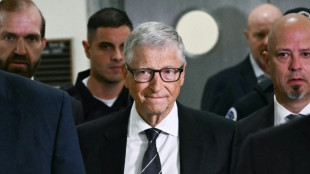 Bill Gates warns cyberattacks most imminent AI threat

 Lazio join Inter at top of Serie A as Roma held at Como

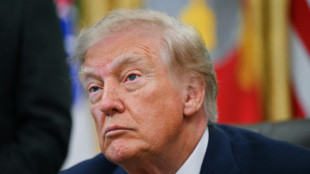 Trump says Russia and Ukraine agree to 'energy ceasefire'

 Man City branded 'cheats' in hostile Liverpool reception after guilty verdict
 Smith breaks fielding record as Australia take control of 1st Test
 Smith breaks fielding record as Australia take first innings lead
 Saints win south coast derby after Eckert's suspended 'Spygate' ban

 Zheng beats Andreeva to become first home player to win China Open
 Young pretender Seixas threatens to rule cycling after sensational year
 Serie A stalemate as Roma held by Como

 Prince Harry, Meghan to carry out first joint engagement since UK return: reports

 Last Ceuta migrant camp removed ahead of Spanish king's visit

 Ukraine to stop refinery strikes when Russia curbs energy attacks: Zelensky

Chancellor Olaf Scholz hosts Premier Li Qiang for talks on Tuesday, seeking to recalibrate cooperation between Germany and China after Berlin branded Beijing a "systemic rival".
Li is on his first trip abroad since he was named premier in March and tasked with shoring up China's sputtering post-Covid economy.
But unlike previous visits by Chinese dignitaries, when pragmatic German leaders eager to expand business ties with the Asian giant rolled out the red carpet, Li's trip comes as Germany is rushing to diversify its trading partners.
Burned by its reliance on Russian gas and hurt by supply chain disruptions during the pandemic, Germany is intensifying its efforts to "de-risk" from China.
Meeting Germany's President Frank-Walter Steinmeier on Monday, Li said China was ready to work with Germany to contribute to "global stability and prosperity".
Yet when he sits down with Scholz, Germany's first national security strategy, published days ago, will set the tone.
The blueprint stridently accused China of acting against German interests, putting international security "under increasing pressure" and disregarding human rights.
But it also underlined the necessity of getting Beijing's cooperation on global issues such as fighting climate change.
Beijing has bristled at being described as a "partner, competitor and systemic rival" in the text, saying such labels would only "push our world towards a vortex of division and confrontation".
- 'Stress test' -
Tuesday's talks between the two governments is "a stress test on whether genuine partnership between Berlin and Beijing is still possible", Thorsten Benner, director of the Global Public Policy Institute, told AFP.
"It's open as to whether Germany continues to play the game of pretending there is broad agreement with Beijing... or whether it chooses a new path of straight talk and limiting the final statement to areas where there is a genuine path forward for cooperation," he added.
Spiegel magazine said that "finding the right and appropriate way to deal with China is almost impossible".
China has been accused of stirring regional instability with threats against Taiwan and of rights abuses against Uyghurs, while refusing to distance itself from Russia's Vladimir Putin. On the other hand, it is "important to continue to have a relationship of trust" with Beijing, Spiegel noted.
"Managing this balancing act without suffering a hernia is a real challenge" not just at Tuesday's talks, but "in the years and decades to come", it said.
German Foreign Minister Annalena Baerbock, one of the most strident critics of Beijing's human rights policies, has signalled that the way to handle the delicate situation was to boost cooperation with China on areas on which both sides can agree, such as the climate.
But on economic issues, Scholz's government has repeatedly underlined that ending reliance is the key.
Speaking at a major German industry event on Monday, Scholz said the "G7 has no interest in preventing China's economic rise".
"At the same time, we are looking carefully at preventing dangerous economic reliance in the future."
Addressing the same event, NATO chief Jens Stoltenberg noted that many had previously thought that buying gas from Russia was "a purely commercial decision, only to learn the hard way".
"We must not make the same mistake once again with other authoritarian regimes, not least China," he warned.
R.Adler--BTB