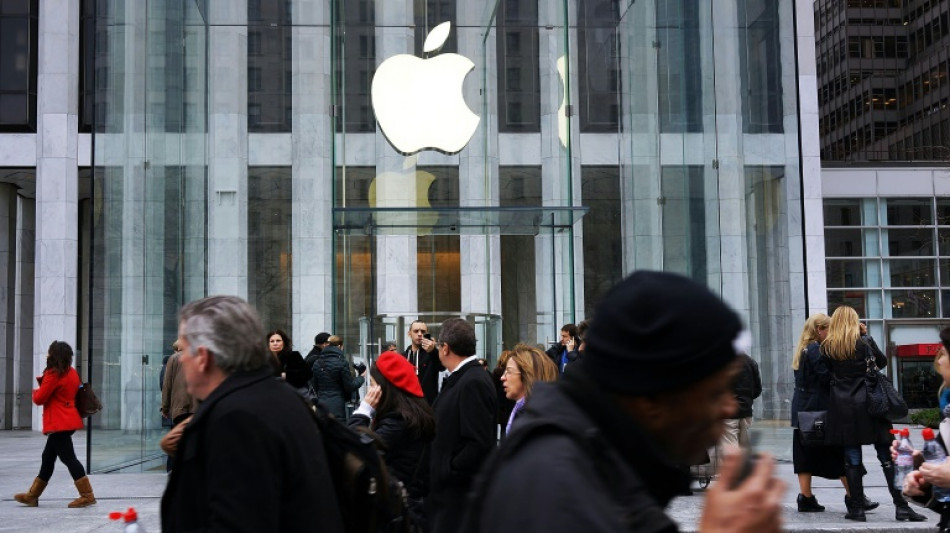
How big tech embraced disabled users / Photo: © GETTY IMAGES NORTH AMERICA/AFP/File

 Policymakers take on energy shock, rising debt at IMF-World Bank meetings

 Raphael Glucksmann elected centre-left French presidential candidate

 'Dizzy' Lazio join Inter at top of Serie A as Roma, Juve and Milan held

 Jaguars edge Eagles as Packers beat Bears

 Rays chase first MLB crown as Guardians try to snap drought

 Hurricane Simon churns off Mexican coast after shift in course

 'Dizzy' Lazio join Inter at top of Serie A as Roma and AC Milan held

 Man City must make 'own noise' amid financial scandal, says Maresca

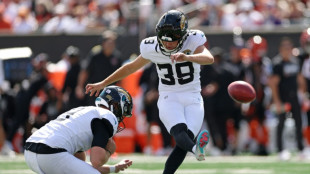 Jaguars down Eagles with wild field goal finish in London

 Sadaqat, Imran help Pakistan thump Sri Lanka to seal T20 series

 Man City shrug off uncertain future to beat 10-man Liverpool

 Conservation groups alarmed at marine mammals' deaths in Spain

 Tens of thousands urge climate action at Brussels demo
 Norway's Hagenes wins historic Paris-Tours classic

 Kipruto claims Chicago Marathon as Feysa defends women's title

 Forest boss Glasner loses on return to Palace, Hull hold Everton

 'Sorry boys': Hamilton takes blame for botched tyre call

 Resurgent Verstappen wins Singapore Grand Prix for first time

 Verstappen wins Singapore Grand Prix for first time

 Djibouti boat wreck leaves 139 migrants dead, 84 missing: UN

 Drone hits Russia's Yandex in third reported attack

 Shelton dumped out in Shanghai but Zverev ploughs on

 Top seed Zverev digs deep to reach Shanghai last 16

 Pope to be operated on for lump on lung

 India's 'cockroach' leaders vow to keep up election protests

Buried beneath the hype of the artificial intelligence revolution, big tech is quietly rolling out services for disabled people that it hopes will push a greater transformation for customers.
Apple and Google are leading the field, harnessing the sensors and cameras of their best-selling smartphones that allow users to edit, enhance and improve their photos and audio.
Among the latest announcements, Apple unveiled its Live Speech feature in May that uses machine learning -- the term Apple uses for AI -- to re-create a user's voice.
The idea is to allow people who are at risk of losing the ability to speak to type messages and have them read out in their natural voices.
Google, meanwhile, is testing an upgrade to its Lookout app, a program that describes images to blind people and those with impaired vision.
The new version, Google says, will use AI to identify objects without the need for labelling.
- Digital 'kerb cuts' -
Both firms are keen to portray this as the norm.
"We try and put a lot of time in, early and often," Sarah Herrlinger, who leads Apple's accessibility projects, told AFP during a recent tech event in Paris.
When asked about the process behind developing a product like the Vision Pro -- a headset launched to great fanfare earlier this month -- she said the idea was "to make sure that, when we are at the point of making an announcement like that, we can say we've been thoughtful about this".
Google's accessibility chief Eve Andersson makes a similar point, telling AFP hundreds of people worked full-time on accessibility at the company.
"What's even more important is that we expect accessibility to be a core part of everybody's job who is creating products," she said.
If there is discord between the firms' approaches, it is more in emphasis than practicalities.
While Herrlinger stresses the rigour of Apple's targeting, Andersson is keen to talk up the way that such features end up improving everyone's lives.
She describes it as a digital "kerb cut", an idea named after the initiative to lower kerbs on pavements that was initially intended to help wheelchair users but also helped people with pushchairs, bicycles or those carrying anything awkward.
Andersson cites digital kerb cuts such as autocorrect, autocomplete and voice recognition software.
"A lot of this was originally developed as accessibility technology that now it's just productivity-enhancing, for all of us," she said.
- 'Marketplace reality' -
Google and Apple are among the most well-known brands on the planet and both describe how they develop accessibility features by gathering feedback from their vast numbers of users.
They are also among the richest firms, so they can go into fine-grain detail in their product planning.
Herrlinger said Apple had worked closely with Team Gleason, a charity formed by ex-American football player Steve Gleason who was diagnosed with amyotrophic lateral sclerosis (ALS), a rare, incurable and debilitating disease.
Apple worked with his foundation to make sure its products would work for those suffering from ALS.
But Apple and Google are not the only ones developing accessibility tech -- the widening availability of AI models has sparked huge creativity.
Microsoft has developed SeeingAI, which describes photos for visually impaired people, and there are a host of startups in the field.
French firm Sonar Vision is developing technology to guide visually impaired people around cities, and Equally AI is harnessing the ChatGPT bot to improve the accessibility of websites.
Manuel Pereira of the French Valentin Hauy association, which campaigns for greater accessibility, reckons AI has the potential to give blind and visually impaired people more autonomy.
But he had a warning for the companies in the field.
"If we fall into an economic model that emphasises profitability, the door can close as quickly as it opened," he said.
Google's Andersson makes the opposite point, saying the realisation that one billion people live with disabilities has jolted companies into realising what this could mean for their bottom line.
"It's marketplace reality, not every company does it out of the goodness of their hearts," she said.
Y.Bouchard--BTB