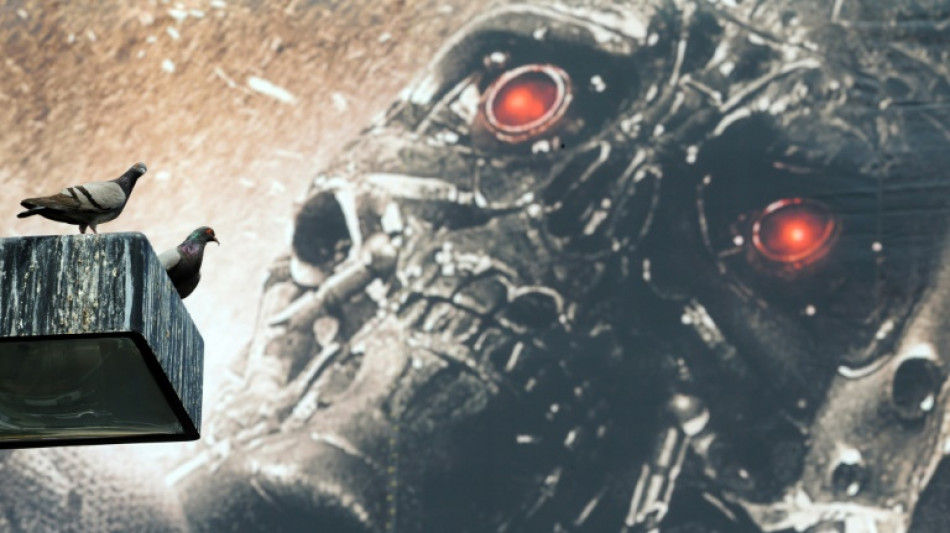
Will AI really destroy humanity? / Photo: © AFP/File

 Man City charges cloud hangs over Premier League season

 Top NATO commander set to issue warning to Russia over any attack

 Software, sprints, trolls: Singapore Grand Prix talking points

 Riyadh airport hit by fresh Houthi strike day after deadly attack

 Policymakers take on energy shock, rising debt at IMF-World Bank meetings

 Raphael Glucksmann elected centre-left French presidential candidate

 'Dizzy' Lazio join Inter at top of Serie A as Roma, Juve and Milan held

 Jaguars edge Eagles as Packers beat Bears

 Rays chase first MLB crown as Guardians try to snap drought

 Hurricane Simon churns off Mexican coast after shift in course

 'Dizzy' Lazio join Inter at top of Serie A as Roma and AC Milan held

 Man City must make 'own noise' amid financial scandal, says Maresca

 Jaguars down Eagles with wild field goal finish in London

 Sadaqat, Imran help Pakistan thump Sri Lanka to seal T20 series

 Man City shrug off uncertain future to beat 10-man Liverpool

 Conservation groups alarmed at marine mammals' deaths in Spain

 Tens of thousands urge climate action at Brussels demo

 Norway's Hagenes wins historic Paris-Tours classic

 Kipruto claims Chicago Marathon as Feysa defends women's title

 Forest boss Glasner loses on return to Palace, Hull hold Everton

 'Sorry boys': Hamilton takes blame for botched tyre call

 Resurgent Verstappen wins Singapore Grand Prix for first time

 Verstappen wins Singapore Grand Prix for first time

 Djibouti boat wreck leaves 139 migrants dead, 84 missing: UN

 Drone hits Russia's Yandex in third reported attack

The warnings are coming from all angles: artificial intelligence poses an existential risk to humanity and must be shackled before it is too late.
But what are these disaster scenarios and how are machines supposed to wipe out humanity?
- Paperclips of doom -
Most disaster scenarios start in the same place: machines will outstrip human capacities, escape human control and refuse to be switched off.
"Once we have machines that have a self-preservation goal, we are in trouble," AI academic Yoshua Bengio told an event this month.
But because these machines do not yet exist, imagining how they could doom humanity is often left to philosophy and science fiction.
Philosopher Nick Bostrom has written about an "intelligence explosion" he says will happen when superintelligent machines begin designing machines of their own.
He illustrated the idea with the story of a superintelligent AI at a paperclip factory.
The AI is given the ultimate goal of maximising paperclip output and so "proceeds by converting first the Earth and then increasingly large chunks of the observable universe into paperclips".
Bostrom's ideas have been dismissed by many as science fiction, not least because he has separately argued that humanity is a computer simulation and supported theories close to eugenics.
He also recently apologised after a racist message he sent in the 1990s was unearthed.
Yet his thoughts on AI have been hugely influential, inspiring both Elon Musk and Professor Stephen Hawking.
- The Terminator -
If superintelligent machines are to destroy humanity, they surely need a physical form.
Arnold Schwarzenegger's red-eyed cyborg, sent from the future to end human resistance by an AI in the movie "The Terminator", has proved a seductive image, particularly for the media.
But experts have rubbished the idea.
"This science fiction concept is unlikely to become a reality in the coming decades if ever at all," the Stop Killer Robots campaign group wrote in a 2021 report.
However, the group has warned that giving machines the power to make decisions on life and death is an existential risk.
Robot expert Kerstin Dautenhahn, from Waterloo University in Canada, played down those fears.
She told AFP that AI was unlikely to give machines higher reasoning capabilities or imbue them with a desire to kill all humans.
"Robots are not evil," she said, although she conceded programmers could make them do evil things.
- Deadlier chemicals -
A less overtly sci-fi scenario sees "bad actors" using AI to create toxins or new viruses and unleashing them on the world.
Large language models like GPT-3, which was used to create ChatGPT, it turns out are extremely good at inventing horrific new chemical agents.
A group of scientists who were using AI to help discover new drugs ran an experiment where they tweaked their AI to search for harmful molecules instead.
They managed to generate 40,000 potentially poisonous agents in less than six hours, as reported in the Nature Machine Intelligence journal.
AI expert Joanna Bryson from the Hertie School in Berlin said she could imagine someone working out a way of spreading a poison like anthrax more quickly.
"But it's not an existential threat," she told AFP. "It's just a horrible, awful weapon."
- Species overtaken -
The rules of Hollywood dictate that epochal disasters must be sudden, immense and dramatic -- but what if humanity's end was slow, quiet and not definitive?
"At the bleakest end our species might come to an end with no successor," philosopher Huw Price says in a promotional video for Cambridge University's Centre for the Study of Existential Risk.
But he said there were "less bleak possibilities" where humans augmented by advanced technology could survive.
"The purely biological species eventually comes to an end, in that there are no humans around who don't have access to this enabling technology," he said.
The imagined apocalypse is often framed in evolutionary terms.
Stephen Hawking argued in 2014 that ultimately our species will no longer be able to compete with AI machines, telling the BBC it could "spell the end of the human race".
Geoffrey Hinton, who spent his career building machines that resemble the human brain, latterly for Google, talks in similar terms of "superintelligences" simply overtaking humans.
He told US broadcaster PBS recently that it was possible "humanity is just a passing phase in the evolution of intelligence".
F.Pavlenko--BTB