Gulf oil states on a Pacific charm offensive / Photo: © AFP

 Man City charges cloud hangs over Premier League season
 Top NATO commander set to issue warning to Russia over any attack
 Software, sprints, trolls: Singapore Grand Prix talking points

 Riyadh airport hit by fresh Houthi strike day after deadly attack

 Policymakers take on energy shock, rising debt at IMF-World Bank meetings
 Raphael Glucksmann elected centre-left French presidential candidate

 'Dizzy' Lazio join Inter at top of Serie A as Roma, Juve and Milan held

 Jaguars edge Eagles as Packers beat Bears
 Rays chase first MLB crown as Guardians try to snap drought
 Hurricane Simon churns off Mexican coast after shift in course
 'Dizzy' Lazio join Inter at top of Serie A as Roma and AC Milan held

 Man City must make 'own noise' amid financial scandal, says Maresca

 Jaguars down Eagles with wild field goal finish in London

 Sadaqat, Imran help Pakistan thump Sri Lanka to seal T20 series

 Man City shrug off uncertain future to beat 10-man Liverpool
 Conservation groups alarmed at marine mammals' deaths in Spain

 Tens of thousands urge climate action at Brussels demo
 Norway's Hagenes wins historic Paris-Tours classic

 Kipruto claims Chicago Marathon as Feysa defends women's title
 Forest boss Glasner loses on return to Palace, Hull hold Everton

 'Sorry boys': Hamilton takes blame for botched tyre call
 Resurgent Verstappen wins Singapore Grand Prix for first time
 Verstappen wins Singapore Grand Prix for first time

 Djibouti boat wreck leaves 139 migrants dead, 84 missing: UN

 Drone hits Russia's Yandex in third reported attack

Gulf oil states are using their vast wealth to build influence across the far-flung South Pacific, experts have told AFP, tearing a page straight out of China's Belt and Road playbook.
Saudi Arabia and the United Arab Emirates -- two of the world's biggest crude oil producers -- have been ramping up efforts to shed their reputations as global climate laggards.
Both have been lavishing money and attention on small, isolated and often indebted Pacific nations, where rising sea levels are already creeping up on low-lying coastal communities.
Businessman Milroy Cainton, who was recently appointed as Vanuatu's special envoy to the Emirates, said it was clear the Gulf states wanted friends in the Pacific.
"There are some good things they see in the South Pacific," he told AFP. "We are getting big help from them, as well as from China."
Since 2015, the UAE says it has spent at least $50 million on infrastructure projects throughout the Pacific islands, typically focused on renewable energy.
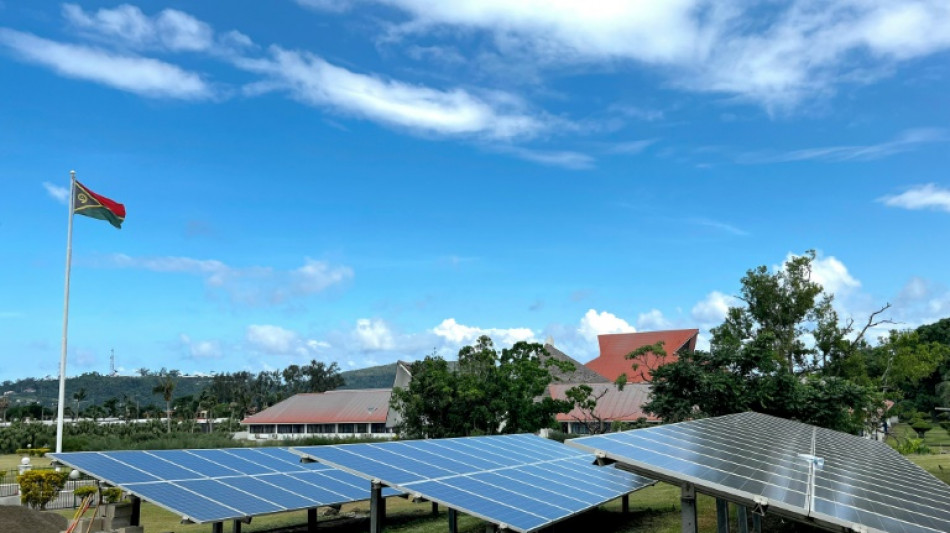
Emirati petrodollars have funded a wind farm in Samoa, water storage facilities in the Marshall Islands, and solar power projects in Kiribati, Tuvalu and Solomon Islands.
One of the most conspicuous examples sits smack in the middle of Vanuatu's leafy capital Port Vila, where a UAE-funded solar farm keeps the lights on inside the country's parliament.
"It's one of the largest-scale renewable energy projects in Vanuatu," said Cainton.
"The relationship is progressing big time with clean energy."
- Pacific Belt and Road -
Saudi Arabia has sought to establish diplomatic relations with a clutch of its own Pacific partners, including Tuvalu and Fiji in 2015, Tonga in 2020, Vanuatu in 2022, and the Cook Islands in April this year.
It has built a particularly warm relationship with Solomon Islands -- pledging $8 million in June to help it prepare for the Pacific Games in the capital Honiara.
A host of Pacific dignitaries travelled to the Saudi capital Riyadh earlier this year, where they discussed issues such as climate financing with counterparts from the Arab League.
Over the past decade Saudi Arabia and the UAE have become increasingly prominent players on the international stage.
They have snapped up high-profile sporting franchises, lured the biggest entertainers to perform in their cities, and become more assertive in their foreign policy.
Both have made headline-grabbing commitments to renewable energy, and the UAE pulled off a major coup when it secured the rights to host the COP28 climate conference in Dubai later this year.
"It reflects the new ambitions of these Gulf states, which were traditionally passive actors in international relations," said Jean-Loup Samaan from the Middle East Institute at the National University of Singapore.
"In the last decade they have gradually moved into the Persian Gulf, into the Indian Ocean and the Indo-Pacific. They use what they have -- financial assets," he said.
"The UAE is more advanced than the Saudis. They tend to go into these countries, establish strong diplomatic relations, and then come with investments in local infrastructure."
Samaan compared the strategy to a pared-back version of China's Belt and Road initiative -- spending money in developing countries to grow their global reach.
"It's like a smaller, Gulf version of the Belt and Road," he told AFP.
- Securing partners -
Samaan said profit was far from the most important consideration when dishing out these investments.
"They want to secure diplomatic partners that align with their interests later on."
Although they have a small collective population and limited economic clout, the Pacific islands can be immensely valuable diplomatic partners.
The Pacific bloc represents 12 of 55 votes in the United Nations' Asia-Pacific region, which also includes Saudi Arabia and the UAE.
Pacific affairs expert Stewart Firth said "influence comes at a cheap price" in the small, developing economies that make up the Pacific.
"Small amounts of assistance have large effects," said Firth, a fellow at the Australian National University.
Author and Middle East analyst Matthew Hedges said such relationships also helped the Gulf states burnish their climate credentials, which have been historically weak because of their role as major fossil fuel producers.
"It's about emboldening their reputation and trying to align with what's happening internationally," said Hedges, who in 2018 was jailed in the UAE on spying charges before being pardoned and released.
"They are deliberate and smart about how they communicate what they do.
"It's pragmatic, and it's for the long term."
J.Bergmann--BTB