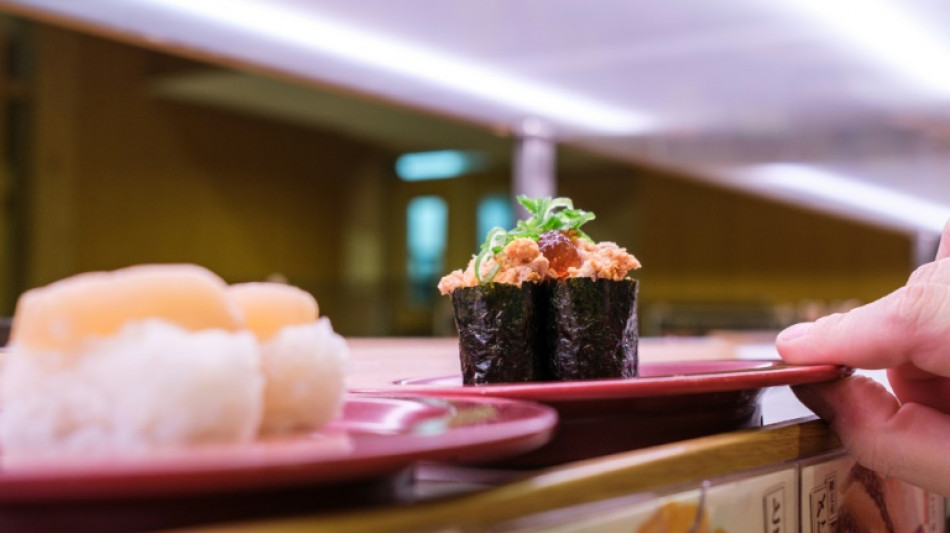
The UK botanist who helped revive Japan's seaweed industry / Photo: © AFP

 DATA Network joins Sui and Walrus to scale the supply chain for AI training data

 Melbourne man linked to suspected flydubai hijacker condemns 'false accusations'

 North Korea fires 'several ballistic missiles' into Sea of Japan

 El Nino sets temperature record in key Pacific zone: EU monitor

 Nature does not respect borders: UN biodiversity chief

 World leaders urged to 'course correct' as UN nature goals fall short

 New York's notorious Rikers jail awaits elusive closure

 Unbeaten 49ers edge Seahawks while Vikings stay perfect

 Trump's 'energy ceasefire' sparks confusion as Russia strikes Ukraine

 Dupont double helps Toulouse avoid Bayonne slip-up in Top 14

 Marseille snap losing skid with win at Troyes

 Lula stages mass rally ahead of Brazil's presidential run-off

 Poland holds suspect in alleged assassination plot against PM Tusk

 Russia hits Ukraine power plants despite Trump energy ceasefire claim

 Isco's Betis rise back above Real Madrid to third

 Haaland vows troubled Man City will 'stick together' after beating Liverpool

 Abhishek, Arshdeep guide India to T20 win over West Indies

 'Other Mommy' scares up N. American box office win

 Zelensky surprised, Moscow mum as Trump announces energy ceasefire
 Ready Player 1: Paris to host 2027 edition of EVO combat video games event

 Bill Gates warns cyberattacks most imminent AI threat

 Lazio join Inter at top of Serie A as Roma held at Como

 Trump says Russia and Ukraine agree to 'energy ceasefire'

 Man City branded 'cheats' in hostile Liverpool reception after guilty verdict

 Smith breaks fielding record as Australia take control of 1st Test

Each year in southern Japan, dozens of people gather at a seafront shrine to honour a British botanist who never visited the country but is credited with revitalising its crucial seaweed industry.
Kathleen Drew-Baker made groundbreaking discoveries about the reproduction of "nori" seaweed -- the crispy dried sheets that encircle sushi rolls -- helping kick-start its farming on a commercial scale.
Her studies at the University of Manchester allowed Japan to ramp up production in the difficult period after World War II, when small-scale growers were having trouble meeting demand.
But she carried out her most influential work as an unpaid research fellow, having lost her academic post after marriage because of the university's policy at the time against employing married women.
Although Drew-Baker died in 1957, her memory lives on in the city of Uto in Kumamoto, one of Japan's largest nori-growing regions.
Dozens of people from local fisheries, as well as scientists and history buffs, gather each April in the leafy grounds of a shrine by the ocean, where a stone plinth displays an embossed metal plaque of her face.
Large Japanese and British flags are raised at the event, where a Shinto priest "gives thanks" to Drew-Baker, organiser Fumiichi Yamamoto, 86, told AFP.
"Seaweed producers were happy and grateful" for the ability to grow more nori seaweed in the aftermath of the war, "when people were struggling with food shortages," he said.
The crop has been harvested from Japan's coastline for centuries, and farmed for 500 years.
Apart from its use in sushi, it is also a key ingredient in "onigiri" rice balls, a staple snack food in Japan, and is used to garnish bowls of ramen and other classic dishes.
But the seaweed is notoriously fragile, and easily wiped out by typhoons and pollution.
In 1949, Drew-Baker published a landmark study in the scientific journal Nature about laver, another name for nori. The crop grows off the coast of Wales, and is used to produce a traditional dish called laverbread.
"Up until that point, the life cycle of nori wasn't well known," Yamamoto said.
The research gave new insights into how the plant bores into seashells where it produces new spores.
Drew-Baker made contact with a professor at Kyushu University, and "sent over an academic paper to him with a question: isn't Japanese seaweed like this too?" he said.
Japanese scientists and nori farmers then began experimenting with using oyster shells to help the marine plant thrive.
"It was a success," said Yamamoto, the son of a seaweed wholesaler, who has run the memorial event for 50 years.
Now, "nori is one of the essential foods of Japan".
A.Gasser--BTB