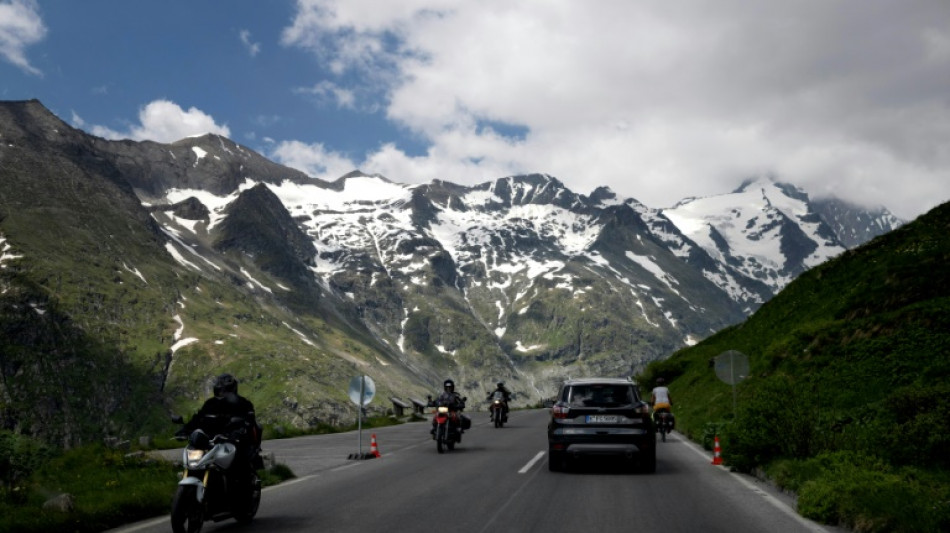
'Unimaginable': Austria's highest paradise feels heat of climate change / Photo: © AFP

 DATA Network joins Sui and Walrus to scale the supply chain for AI training data

 Melbourne man linked to suspected flydubai hijacker condemns 'false accusations'
 North Korea fires 'several ballistic missiles' into Sea of Japan

 El Nino sets temperature record in key Pacific zone: EU monitor

 Nature does not respect borders: UN biodiversity chief

 World leaders urged to 'course correct' as UN nature goals fall short
 New York's notorious Rikers jail awaits elusive closure
 Unbeaten 49ers edge Seahawks while Vikings stay perfect
 Trump's 'energy ceasefire' sparks confusion as Russia strikes Ukraine

 Dupont double helps Toulouse avoid Bayonne slip-up in Top 14

 Marseille snap losing skid with win at Troyes

 Lula stages mass rally ahead of Brazil's presidential run-off

 Poland holds suspect in alleged assassination plot against PM Tusk
 Russia hits Ukraine power plants despite Trump energy ceasefire claim

 Isco's Betis rise back above Real Madrid to third

 Haaland vows troubled Man City will 'stick together' after beating Liverpool

 Abhishek, Arshdeep guide India to T20 win over West Indies

 'Other Mommy' scares up N. American box office win

 Zelensky surprised, Moscow mum as Trump announces energy ceasefire
 Ready Player 1: Paris to host 2027 edition of EVO combat video games event
 Bill Gates warns cyberattacks most imminent AI threat

 Lazio join Inter at top of Serie A as Roma held at Como
 Trump says Russia and Ukraine agree to 'energy ceasefire'

 Man City branded 'cheats' in hostile Liverpool reception after guilty verdict
 Smith breaks fielding record as Australia take control of 1st Test
Ever since Herbert Hoegl and his wife first drove up the majestic Grossglockner High Alpine Road, named after Austria's highest mountain, the breathtaking vistas that the route offers have been imprinted on their minds.
Now, twenty years later, he and his wife struggle to recognise one of the Alps' most characteristic landscapes featuring the jagged Pasterze glacier, whose length these days is nearly eight kilometres (five miles).
In the early 2000s, the ice field "went all the way up there, so you could take the lift down and walk straight onto the Pasterze," Hoegl said of the longest glacier in the Eastern Alps.
"Now it's 100-150 metres further away", said the 58-year-old IT specialist.
Up to one million people visit the scenic Grossglockner road, renowned for its 36 treacherous hairpin bends, from early May until late October each year, travelling by car, motorbike or bicycle.
It is nestled amid the Hohe Tauern national park famous for its hillsides blooming with wildflowers, lush forests, waterfalls and lakes.
Authorities have introduced a speed limit to help protect the unique Alpine landscape, and electric vehicles benefit from a reduced access fee for enjoying the 48-kilometre route, where cyclists in particular are encouraged.
- 'Status symbol' -
Loosely following the ancient trade route used by the Romans and the Celts, the Grossglockner road in its current form was built between 1930 and 1935 in the midst of the Great Depression.
Some 3,000 unemployed men were put to work on the mammoth project, manually carving the road out of the mountain in line with a design conceived by Austrian civil engineer Franz Wallack.
Connecting the town of Bruck near Salzburg to the 3,798-metre Grossglockner, the Alpine route became one of the first major modern mountain roads designed for motorised tourism.
To this day, the road serves as a test track for the luxury sports car maker Porsche.
Keen to restore its image after the fall of the Habsburg Empire, the road "was intended as a status symbol for Austria", explained mountain guide Heike Renger.
During winter months, the route becomes inaccessible due to the snow masses.
In the 1930s, 350 men had to be employed for 70 days to clear away the snow with their shovels -- nowadays, snowploughs remove it within two weeks in spring.
"The snow clearing efforts are enormous before the road can reopen (every year)," Bavarian retiree Juergen Neumann told AFP.
- Glacier retreat -
Alpine glaciers saw a new record mass loss for a single year in 2022, caused by very low winter levels of snow, a hot summer as well as deposits of wind-blown Saharan dust.
Experts have warned that Austrian glaciers will melt away by 2075 at the latest.
Compared to his last visit, Neumann said it is "unimaginable that the glacier has retreated by such an amount in a short period of ten to fifteen years".
Over the past few years, Renger has also observed considerable changes she attributes to global warming.
"These days the sunrays are more intense and there is less snow, which explains why the glacier is melting," Renger said.
Despite the high altitude, temperatures last year surpassed 20 degrees Celsius (68 degrees Fahrenheit) at day's end, she added.
J.Fankhauser--BTB