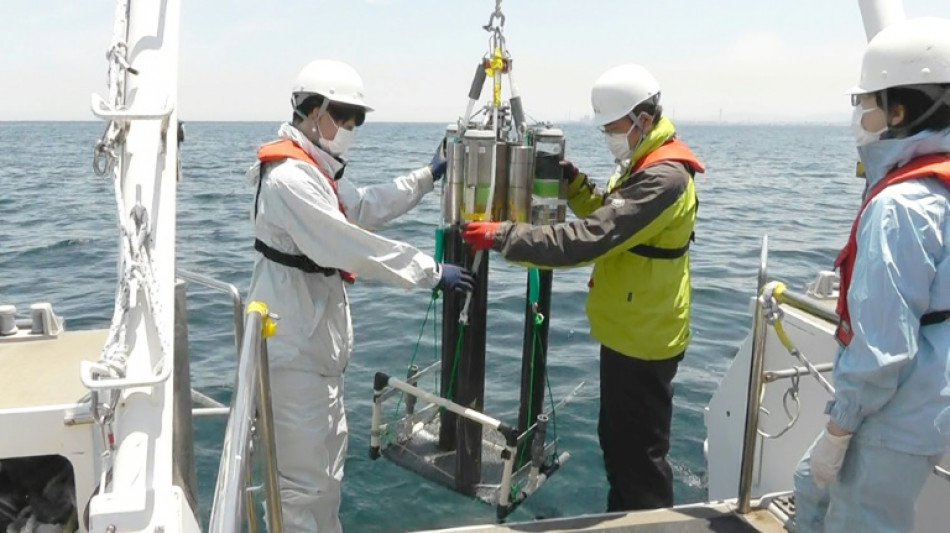
Japan sea sludge tells story of human impact on Earth / Photo: © DR. MICHINOBU KUWAE-EHIME CENTRE OF MARINE ENVIRONMENTAL STUDIES/AFP

 Opposition, journalists allege police abuses during India protests

 DATA Network joins Sui and Walrus to scale the supply chain for AI training data

 Melbourne man linked to suspected flydubai hijacker condemns 'false accusations'

 North Korea fires 'several ballistic missiles' into Sea of Japan

 El Nino sets temperature record in key Pacific zone: EU monitor

 Nature does not respect borders: UN biodiversity chief

 World leaders urged to 'course correct' as UN nature goals fall short

 New York's notorious Rikers jail awaits elusive closure
 Unbeaten 49ers edge Seahawks while Vikings stay perfect
 Trump's 'energy ceasefire' sparks confusion as Russia strikes Ukraine

 Dupont double helps Toulouse avoid Bayonne slip-up in Top 14

 Marseille snap losing skid with win at Troyes

 Lula stages mass rally ahead of Brazil's presidential run-off

 Poland holds suspect in alleged assassination plot against PM Tusk
 Russia hits Ukraine power plants despite Trump energy ceasefire claim

 Isco's Betis rise back above Real Madrid to third

 Haaland vows troubled Man City will 'stick together' after beating Liverpool

 Abhishek, Arshdeep guide India to T20 win over West Indies

 'Other Mommy' scares up N. American box office win

 Zelensky surprised, Moscow mum as Trump announces energy ceasefire
 Ready Player 1: Paris to host 2027 edition of EVO combat video games event
 Bill Gates warns cyberattacks most imminent AI threat

 Lazio join Inter at top of Serie A as Roma held at Como

 Trump says Russia and Ukraine agree to 'energy ceasefire'

 Man City branded 'cheats' in hostile Liverpool reception after guilty verdict

Beneath the seawater in Japan's Beppu Bay lie layers of seemingly unremarkable sediment and sludge that tell the story of how humans have fundamentally altered the world around them.
The site is among those being considered for designation as a "golden spike", a location that offers evidence of a new geological epoch defined by our species: the Anthropocene.
The path to agree the new era has been long and controversial, with scientists wrangling for years over whether the Holocene epoch that began 11,700 years ago has really been replaced by a new period defined by human impact on the Earth.
Key to their discussions has been picking a site that clearly documents the way we have changed our environment, from contaminating it with plutonium from nuclear tests, to littering it with microplastics.
Twelve sites around the world have been proposed as golden spike locations, including a peatland in Poland, an Australian coral reef, and the basin-like Beppu bay in Japan's southwestern Oita.
Michinobu Kuwae, an associate professor at the Ehime Centre of Marine Environmental Studies, has been studying the area for nearly a decade.
He began with investigations of how climate change affected fish populations, with layers of deposited fish scales in the bay's sediment offering clues about the past.
It was only more recently he began to consider the location as a potential golden spike, given the many "anthropogenic fingerprints, including manmade chemicals and radionuclides, layered in the bay's sediment."
The layers allow scientists to pinpoint "the precise date and level of an Anthropocene-Holocene boundary," he told AFP.
"There are the most diverse anthropogenic markers."
That perfect preservation is the result of several unique characteristics, explained Yusuke Yokoyama, a professor at the University of Tokyo's Atmosphere and Ocean Research Institute, who has analysed core samples from the site.
The bay floor dips down quickly from the shoreline, creating a basin that traps material in the water column and "kind of creates a miso soup," he told AFP.
Water can flow in, but only moves back out at the surface, and a lack of oxygen means there are no organisms disturbing the sediment or disrupting deposits.
- A 'warning bell' for humanity -
"It's like Baumkuchen, the cake, a stack of pancakes, and you can count those pancakes to get the precise age," he added.
For a site to be considered a golden spike location, it must meet several conditions, including offering a record of at least the last century, along with specific "anthropogenic signals" like nuclear bomb testing, ecosystem change and industrialisation.
It also needs to offer a complete archive of the period covered, and markers that allow scientists to identify which layer represents which year.
Coral is considered by some to be a good candidate because it grows in layers like a tree trunk and absorbs elements dissolved in water, including signatures from nuclear testing.
But it cannot capture materials that do not dissolve in water, like microplastics.
The sediment of Beppu Bay, by contrast, captures everything from agricultural fertiliser run-off to deposits from historic floods recorded in official documentation, as well as fish scales and plastics.
The most compelling feature however, according to Kuwae and Yokoyama, are the signatures from a series of nuclear bomb tests carried out across the Pacific ocean from 1946 to 1963.
The tests produced atmospheric radiation that was detectable globally, but also direct signatures that registered in places close to the testing sites.
"We can detect both," said Yokoyama.
"Because Beppu Bay is located downstream... we can identify the particular signatures of certain tests."
Core samples collected from Beppu Bay showed peaks in plutonium that correlated with individual nuclear tests, and matched similar findings in coral in nearby Ishigaki.
Whichever site is chosen as a golden spike, Beppu Bay and other candidate locations are expected to remain important resources for understanding human impact on the Earth.
And Kuwae hopes an official designation of the Anthropocene will be a "warning bell" for humanity.
"Deterioration of the global environment, including global warming, is rapidly progressing," he said.
"We will be in a state where the original safe earth, once lost, can no longer be recovered."
M.Odermatt--BTB