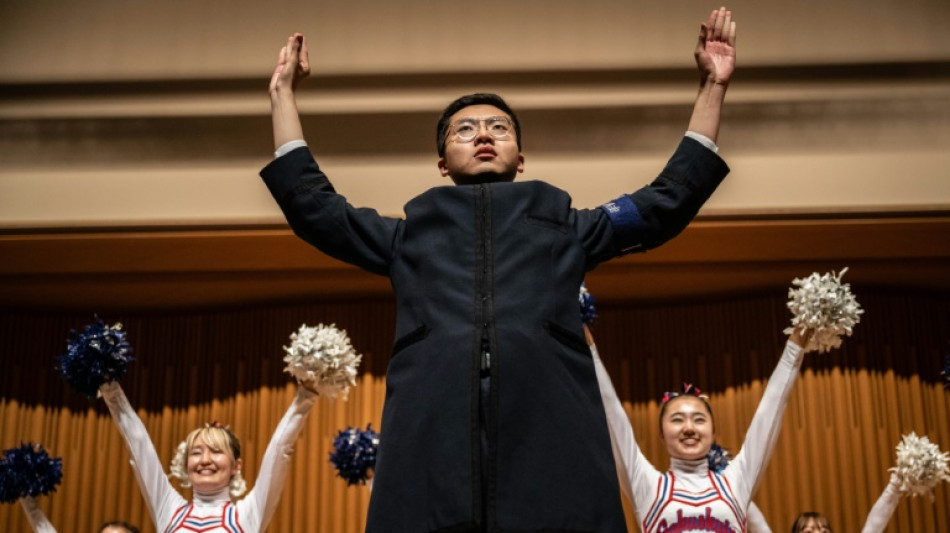
Japan's macho cheerleaders fight to save a tradition / Photo: © AFP

 African players in Europe: Mbeumo ends goal drought as United draw

 France's high school students plan fresh protests

 NZ bank in free speech row over 'explicit' sheep memes

 China Open champ Zheng withdraws from Wuhan citing fatigue

 Brewers edge Dodgers 2-1 in National League Championship Series opener

 Pope to have surgery to remove lung nodule

 Stocks rise as oil prices tumble after Trump hails 'energy ceasefire'

 Man City charges cloud hangs over Premier League season

 Top NATO commander set to issue warning to Russia over any attack

 Software, sprints, trolls: Singapore Grand Prix talking points

 Riyadh airport hit by fresh Houthi strike day after deadly attack

 Policymakers take on energy shock, rising debt at IMF-World Bank meetings

 Raphael Glucksmann elected centre-left French presidential candidate

 'Dizzy' Lazio join Inter at top of Serie A as Roma, Juve and Milan held

 Jaguars edge Eagles as Packers beat Bears

 Rays chase first MLB crown as Guardians try to snap drought

 Hurricane Simon churns off Mexican coast after shift in course

 'Dizzy' Lazio join Inter at top of Serie A as Roma and AC Milan held

 Man City must make 'own noise' amid financial scandal, says Maresca

 Jaguars down Eagles with wild field goal finish in London

 Sadaqat, Imran help Pakistan thump Sri Lanka to seal T20 series

 Man City shrug off uncertain future to beat 10-man Liverpool

 Conservation groups alarmed at marine mammals' deaths in Spain

 Tens of thousands urge climate action at Brussels demo

 Norway's Hagenes wins historic Paris-Tours classic

They are drenched in sweat, their hands bloodied from clapping, and their voices hoarse from shouting -- meet Japan's predominantly male and unashamedly macho "leadership section" cheerleaders.
The cheerleaders are part of a century-old tradition that some fear faces an existential crisis, with fewer students showing an interest in the hardcore art form.
And now there is a push for the squads and their counterparts in Japan's traditional "oendan" cheering groups to be registered as part of the country's "intangible" cultural heritage.
The "leadership section" cheerleaders are a formidable sight. Dressed in old-fashioned school-style uniforms, they are a mass of black at college baseball games as they belch out chants, bang taiko drums and thrust their fists in rigid, martial moves.
"We give it our all to the point of ridiculousness, and that's what makes us so cool," said Taisuke Ono, 21, a member of a squad at Tokyo's Waseda University.
"Even if we're trailing by 10 points and there's almost no chance of a comeback, we somehow manage to convince ourselves we can still win."
Squads like Ono's typically perform alongside brass bands and American-style, mostly women cheerleaders -- a triumvirate known as "oendan" or "rooters".
But the men-dominated "leadership sections" have seen their ranks shrink at a pace that far outstrips their counterparts, with around a dozen groups disappearing over 15 years, according to one survey.
Pandemic-era bans on shouting and restrictions on crowds only deepened the malaise.
Alarmed by the situation, dozens of universities joined forces last year in a campaign to win designation of the tradition as an "intangible cultural property".
The label is awarded by Japan's culture minister to activities seen as having unique importance, like calligraphy and traditional sake brewing.
Campaigners say the recognition would increase the squads' prestige and encourage fresh recruits, while activities that have obtained the distinction in the past have been awarded government subsidies.
- 'Emperor' and 'slaves' -
"We're now at a phase where the culture is about to vanish," said Jun Tochimoto, who has spearheaded the campaign.
"At the heart of what these cheerleaders do is the idea that they're training and improving themselves through the art of cheering -- that's the mindset we hope will be preserved," he said.
The decline began in earnest several decades ago, with potential recruits scared away by macho images and rumours of hazing.
A holdover from Japan's Meiji period (1868-1912) counterculture, the squads are said to have been infused with a military style by students who were demobilised after WWII.
A draconian hierarchy prevailed in post-war years, with senior-year students deified as the "emperor" and freshmen roughed up as "slaves," recalled Hiroshi Imazu, a 1970 graduate of Tokyo's Chuo University.
They were sometimes even tasked with battling left-wing students whose activism paralysed some universities, the former squad member recalled.
"We were basically a bunch of students who felt proud that the reputation of our university was on our shoulders," the 76-year-old said.
That school pride occasionally led to full-on skirmishes between swaggering cheerleaders from rival universities.
Those historical behaviours have created persistent "negative perceptions" about the squads, a report by an alumni group said in 2018.
But most universities now brook no such violence, and recent decades have seen a change many once thought impossible: women recruits.
Today, women dressed in the black uniforms -- called "gakuran" -- perform alongside male teammates, sometimes as group leaders.
"I didn't want to blindly accept social expectations about how women should live... and I wanted to see how far I could go in this male-centric community," Kazuha Nagahara of Tokai University, 22, told AFP.
- 'Anybody can be a star' -
Women are "breathing new life" into struggling squads, she said.
"I think it's providing a path for their survival."
Violence might no longer be acceptable, but asceticism and stamina remain core values for the groups.
At Tokyo's Meiji University, junior cheerleaders spend so many hours bashing their hands together to perfect their claps, they can come away with bloodied palms.
And training is supervised by glaring seniors who pepper their teammates with shouts and haranguing, though their stern demeanour gives way to smiles and bows when talking to spectators and visitors.
The groups are motivated by the spirit of "annihilate yourself, serve others", said 50-year-old Yasunori Sugaya, a former Meiji squad member who now coaches the group.
It is an ethos passed down to current Meiji captain Motomichi Tanaka, 21, and his contemporaries.
At a recent baseball match, he stood to attention throughout a downpour that stopped play, rallying to keep spirits up among fans.
"Part of me does fantasise about having a more fun, leisurely campus life," said a chuckling Tanaka.
But unlike other sports, where physique and natural talent are a big factor, "anyone who wants to do their best and be cool can be us," he said.
"Anybody can be a star... I'm proud of what I do."
L.Janezki--BTB