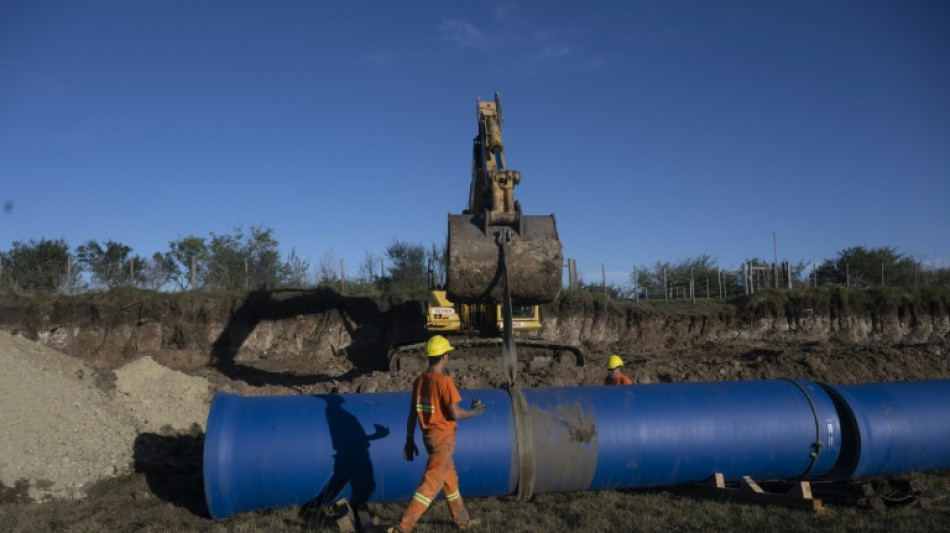
Race against time to find fresh water for Uruguay's capital / Photo: © AFP

 African players in Europe: Mbeumo ends goal drought as United draw
 France's high school students plan fresh protests

 NZ bank in free speech row over 'explicit' sheep memes
 China Open champ Zheng withdraws from Wuhan citing fatigue

 Brewers edge Dodgers 2-1 in National League Championship Series opener
 Pope to have surgery to remove lung nodule
 Stocks rise as oil prices tumble after Trump hails 'energy ceasefire'
 Man City charges cloud hangs over Premier League season
 Top NATO commander set to issue warning to Russia over any attack
 Software, sprints, trolls: Singapore Grand Prix talking points

 Riyadh airport hit by fresh Houthi strike day after deadly attack

 Policymakers take on energy shock, rising debt at IMF-World Bank meetings
 Raphael Glucksmann elected centre-left French presidential candidate

 'Dizzy' Lazio join Inter at top of Serie A as Roma, Juve and Milan held

 Jaguars edge Eagles as Packers beat Bears
 Rays chase first MLB crown as Guardians try to snap drought

 Hurricane Simon churns off Mexican coast after shift in course
 'Dizzy' Lazio join Inter at top of Serie A as Roma and AC Milan held

 Man City must make 'own noise' amid financial scandal, says Maresca

 Jaguars down Eagles with wild field goal finish in London

 Sadaqat, Imran help Pakistan thump Sri Lanka to seal T20 series

 Man City shrug off uncertain future to beat 10-man Liverpool
 Conservation groups alarmed at marine mammals' deaths in Spain

 Tens of thousands urge climate action at Brussels demo

 Norway's Hagenes wins historic Paris-Tours classic

Uruguay is frantically laying pipes and digging wells as it races to find fresh sources of precious H2O amid a record drought that has threatened to leave its capital without potable water.
For weeks already, the 1.8 million residents of the Montevideo metropolitan area -- home to more than half the South American country's total population -- have switched en masse to bottled water for drinking and some cooking.
Water from the capital's main source -- the Santa Lucia River -- has had to be increasingly augmented with brackish water from the River Plate, an estuary on the Atlantic Ocean.
The estuary itself has also had less fresh water input from the Uruguay and Parana rivers, which both start in Brazil, as the worst drought in decades batters the continent's southern cone.
In May, the government started progressively increasing the levels of sodium and chloride allowed in drinking water.
Also higher are levels of trihalomethanes -- chemical compounds that form when water is disinfected with chlorine, which can be harmful if consumed over decades.
The water that flows from the capital's taps is "safe," according to authorities, though they have advised pregnant women and sick people not to drink it.
"When you brush your teeth it’s awful, you taste salt water (in the tap water), it’s disgusting!" Isabel Moreira, 73, told AFP while preparing mate, an herbal drink, using bottled water at her home in Montevideo.
Moreira complained about the effects of the high salt content on household appliances, pointing at the water heater in her kitchen that broke days earlier.
She also lamented the blow to her wallet: A 40-liter bottle, which she and a dog rely on for drinking water each week, costs about 600 pesos (almost $16).
Moreira has about 100 liters of water stacked up on her porch as a backup, fearful that supplies will dry up completely.
Since the beginning of July, the government has made available two liters of bottled water a day for each of the more than 500,000 low-income residents of Montevideo.
For those who can afford to buy their own, it has eliminated value added tax.
Uruguay is one of few countries to enshrine access to water as a human right in its constitution.
- 'Safe,' but not for all -
At Paso Valdez, some 65 kilometers (40 miles) northwest of Montevideo, 13.3 kilometers of pipe are being laid to transfer freshwater from the San Jose River to the Santa Lucia River to the east.
The Santa Lucia feeds two reservoirs -- one now dry and the other at only about 3 percent capacity -- which provide water for the Aguas Corrientes treatment plant that has served Montevideo since the 19th century.
State-owned water company OSE is building a dam and a pumping station on the San Jose River -- work that President Luis Lacalle Pou estimated on June 19 would be completed in 30 days.
On June 29, he warned that: "If it does not rain, there will be a period in which the water is not drinkable" until the works are completed. Light, intermittent rains since then have pushed back, but not wiped out, that grim deadline.
In Montevideo’s Batlle Park, a well recently drilled by OSE to extract groundwater produces about 30,000 liters per hour, which are distributed in tankers to hospitals.
The city has also analyzed about 250 wells in the yards of private citizens, only to find none of the water they contain is potable.
Prior to these emergency measures, the last major infrastructure work to secure Montevideo's freshwater access was completed in the 1980s.
Meanwhile, in town, vendor Nicolas Perez, 40, said bottled water was flying off the shelves.
"Some people take eight, 12 large bottles (between six and 10 liters) at a time each," he said. "Some businesses take up to 20" per day.
At a nearby bar, a notice in the window seeks to assure patrons that all food served on the premises is "made with bottled water."
Public Health Minister Karina Rando reiterated this week that the city's tap water is "safe, except for certain populations."
Pregnant women and those with high blood pressure -- almost a third of the Uruguayan population according to the World Health Organization -- as well as those with chronic kidney disease, heart and liver problems should avoid it, she said on Twitter.
B.Shevchenko--BTB