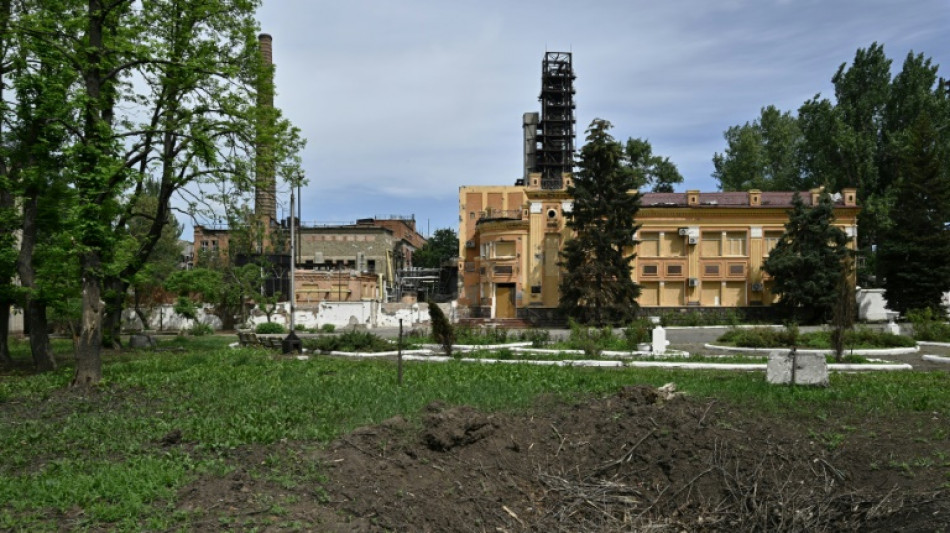
Russian bombs target frontline Ukraine chemical plant / Photo: © AFP

 FXGLOBE Rebuilds Its Copy Trading and PAMM Business With B2BROKER's B2COPY

 Nepal rescuers search for missing after flash flood

 Oil rises as Trump comments roil energy markets

 Premier League in limbo as Manchester City soar

 Zelensky vows to respond as Moscow silent on 'energy ceasefire'

 Thousands march in India's capital to demand election chief resign

 African players in Europe: Mbeumo ends goal drought as United draw
 France's high school students plan fresh protests

 NZ bank in free speech row over 'explicit' sheep memes

 China Open champ Zheng withdraws from Wuhan citing fatigue

 Brewers edge Dodgers 2-1 in National League Championship Series opener

 Pope to have surgery to remove lung nodule

 Stocks rise as oil prices tumble after Trump hails 'energy ceasefire'

 Man City charges cloud hangs over Premier League season

 Top NATO commander set to issue warning to Russia over any attack

 Software, sprints, trolls: Singapore Grand Prix talking points

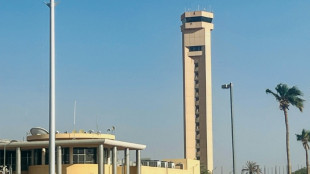 Riyadh airport hit by fresh Houthi strike day after deadly attack

 Policymakers take on energy shock, rising debt at IMF-World Bank meetings

 Raphael Glucksmann elected centre-left French presidential candidate

 'Dizzy' Lazio join Inter at top of Serie A as Roma, Juve and Milan held

 Jaguars edge Eagles as Packers beat Bears

 Rays chase first MLB crown as Guardians try to snap drought

 Hurricane Simon churns off Mexican coast after shift in course

 'Dizzy' Lazio join Inter at top of Serie A as Roma and AC Milan held

 Man City must make 'own noise' amid financial scandal, says Maresca

The Russian high-explosive bombs started falling around the frontline Ukrainian chemical plant about three months ago.
Sergiy Dmytrenko trundled out to survey the newest craters outside his pockmarked facility's walls wearing body armour and a puzzled frown.
The 34-year-old plant director said workers had pulled out the most hazardous materials from the plant south of Bakhmut shortly after Russia invaded Ukraine 17 months ago.
But a fifth of the phenol and naphthalene extracted from the local coal tar still rested in the 106-year-old site's storage vats.
The vapours wafting out from inside had a slightly sweet smell that left a metallic tang on the tongue.
"This is the only chemical plant in this area. We are one of the most dangerous facilities here," he said.
The Russians' apparent decision to start bombing its grounds in increasingly frequent aerial raids left Dmytrenko stumped.
"Maybe it's because their assault on our village has stalled," he said.
"Maybe this is their new tactic."
- Precision bombing raids -
Dmytrenko's troubled plant lies in New York -- a ruined settlement with an incongruous name that ends where Russian positions begin.
The place had a Soviet name until defiant locals decided to return its historical name, New York, in response to a lower-scale war Moscow first fomented in 2014.
The name is now the least of Dmytrenko's concerns.
New York's horizon is darkened by smoke rising from battlefields that stretch in a semi-circle from its northeastern to southwestern edge.
Its main buildings have been methodically taken out by waves of precision bombing raids.
A cultural centre where the plant's 500 workers once gathered for an evening out is now a pile of bricks.
So is the local sports hall and the plant's museum.
This puts the potential environmental damage from a direct strike on one of the plant's storage tanks into perspective for Nina Shevchenko.
"We were really worried when it was still full of the stuff," the 70-year-old said cheerfully.
"Now, we don't think about it as much. There are worse things that can get hit."
- 'Poison the ecosystem' -
Phenol and naphthalene are toxic chemicals used in the production of everything from plastics and rubber to concrete.
The US Centers for Disease Control and Prevention warns that severe exposure to phenol can damage internal organs and cause convulsions.
Its listed symptoms for naphthalene exposure include eye damage and various stomach ailments.
Both can be absorbed through the skin.
Dmytrenko said 50 workers remained on site to look after the storage vats and make running repairs.
"If phenol enters the water reservoir, it will poison the ecosystem," Dmytrenko said.
"But in the air, its concentration would be minimal because there is so much more air than phenol. There would just be a smell."
Lyudmyla Sytyugova is not entirely convinced.
A direct strike "and our village is gone", the 65-year-old retiree said on her way out of one of New York's only shops.
- 'We don't count' -
Dmytrenko's plant is one of a handful of once-mighty chemical enterprises that Ukraine inherited from its Soviet past.
The war's eastern stretches are being waged across an industrial zone that includes a coke plant in Avdiivka and an ammonia factory in Severodonetsk.
The Severodonetsk plant was hit and belched out orange fumes during a two-month battle that saw the city fall under Russian control in June of last year.
The Avdiivka factory still remains under Ukrainian control but is close to a front with heavy fighting.
Russia has been targeting large buildings since the first days of war because they can shelter soldiers and military machines.
Schools and administration centres have been wiped out across Ukraine's east and south.
Ukraine also accuses Russia of turning the Zaporizhzhia nuclear power plant into a shield for its artillery guns.
All this devastation appeared too much for Nadezhda Kravchenko.
The slight 85-year-old sat alone on a bench directly facing the front of the plant and quietly dabbed her eyes.
She said she lived through the Nazi invasion during World War II and had lost both her parents by the age of five.
Kravchenko wanted to know why her life needed to be so hard.
"Now I am just hoping to die so that I don't have to watch this any more," she said through increasingly violent sobs.
"Simple people, the simple people, we don't count for anything."
R.Adler--BTB