'Era of mass closures': the Japan businesses without successors / Photo: © AFP

 FXGLOBE Rebuilds Its Copy Trading and PAMM Business With B2BROKER's B2COPY

 Nepal rescuers search for missing after flash flood

 Oil rises as Trump comments roil energy markets

 Premier League in limbo as Manchester City soar

 Zelensky vows to respond as Moscow silent on 'energy ceasefire'

 Thousands march in India's capital to demand election chief resign

 African players in Europe: Mbeumo ends goal drought as United draw
 France's high school students plan fresh protests

 NZ bank in free speech row over 'explicit' sheep memes

 China Open champ Zheng withdraws from Wuhan citing fatigue

 Brewers edge Dodgers 2-1 in National League Championship Series opener

 Pope to have surgery to remove lung nodule

 Stocks rise as oil prices tumble after Trump hails 'energy ceasefire'

 Man City charges cloud hangs over Premier League season
 Top NATO commander set to issue warning to Russia over any attack

 Software, sprints, trolls: Singapore Grand Prix talking points

 Riyadh airport hit by fresh Houthi strike day after deadly attack

 Policymakers take on energy shock, rising debt at IMF-World Bank meetings

 Raphael Glucksmann elected centre-left French presidential candidate

 'Dizzy' Lazio join Inter at top of Serie A as Roma, Juve and Milan held

 Jaguars edge Eagles as Packers beat Bears

 Rays chase first MLB crown as Guardians try to snap drought

 Hurricane Simon churns off Mexican coast after shift in course

 'Dizzy' Lazio join Inter at top of Serie A as Roma and AC Milan held

 Man City must make 'own noise' amid financial scandal, says Maresca

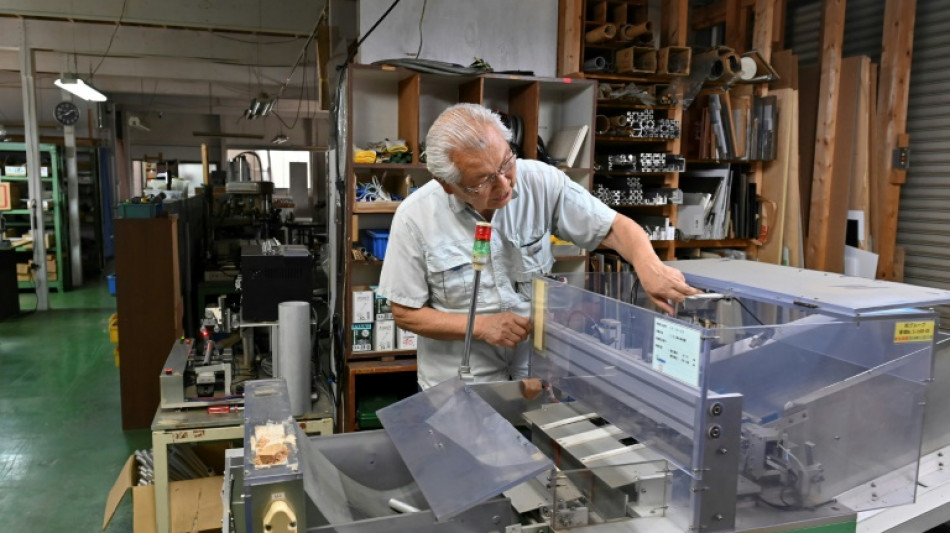
Kiyoshi Hashimoto's machinery factory outside Tokyo should be buzzing with industry. Instead, it's so quiet you can hear him practising the recorder.
The 82-year-old entrepreneur founded his company nearly 40 years ago, but well past retirement age he has neither a successor nor a buyer for a business that retains loyal clients.
It is a problem that Japan's government warns could affect up to a third of all small businesses in the country by 2025, as the country's population shrinks and ages.
"All of this would go to waste if I were to close now," said Hashimoto, whose factory in Yachimata, east of Tokyo, is filled with workbenches, drill tables and parts cabinets.
He once employed dozens of people, but now gets by with just two part-time workers after scaling back operations.
The problem is so vast that Japan faces an "era of mass closures", said Shigenobu Abe of bankruptcy research firm Teikoku Databank.
A 2019 government report estimated that about 1.27 million small business owners would be 70 or older by 2025 and have no successors.
The trend could kill up to 6.5 million jobs and reduce the size of the Japanese economy by 22 trillion yen ($166 billion), the study warned.
By 2029, the situation will worsen still, as baby boomers hit 81, the average life expectancy for Japanese men, who account for most of the presidents of these firms, according to Teikoku Databank.
"We know for sure that many workers will lose their livelihoods because of this," Abe told AFP.
- 'A serious blow' -
As elsewhere, small businesses in Japan are often passed down to family or trusted employees.
But the country's prolonged economic stagnation has made small businesses unattractive to young people.
Firms in rural areas struggle further because of a preference for city life and a growing trend of rural depopulation.
Compounding the problem is a feeling among some older Japanese that selling a family business to outsiders is shameful.
Some liquidate their firms rather than seeking buyers.
Japan's government has offered generous incentives to encourage sales, and the private sector has also jumped in to match investors with businesses for sale.
Company BATONZ now makes more than 1,000 matches a year, up from just 80 when it opened in 2018.
Still, it reaches a fraction of the people who need it, said BATONZ president Yuichi Kamise.
Waves of closures will mean the loss of specialised craftsmanship, unique services and original restaurant recipes that make up Japan's social and cultural fabric, he said.
"Over time, what makes Japan unique could disappear due to a lack of successors," he said.
"I think it will deal a serious blow to Japanese culture and Japan's attractiveness as a tourism destination."
Some feel though that the trend offers a chance to fix inefficiencies and consolidate small businesses that are barely scraping by or survive on subsidies.
Hiroshi Miyaji, 50, owns Yashio Group, a logistics giant started by his grandfather, and has snapped up various businesses.
"There will always be buyers for firms, with or without successors, that have unique strengths, special know-how and human resources," said Miyaji, a third-generation president.
Helped by BATONZ, he recently purchased a small trucking company from 61-year-old Ayako Suzuki.
- 'Waiting for someone' -
Suzuki gave up her corporate career to help her father with the business he had started in 1975.
None of the firm's three drivers wanted to take over and she was asked to join and help her father, then in his late eighties.
But problems quickly piled up: the coronavirus pandemic hit, a driver left, trucks needed maintenance, and before long she was dipping into savings to stay afloat.
"I wanted to keep the business going, at least while my father was alive," she told AFP.
BATONZ connected her with Miyaji, who pledged to keep the firm's employees, clients and trucks.
"I'm more relieved than sad," she said.
"I didn't think our company had any value."
The glut of affordable small businesses can be a boon for young people looking to break into a sector.
Among them is 28-year-old chef Rikuo Morimoto.
When the pandemic prevented him from studying in Italy, he used his savings to buy a four-decade-old diner in Tokyo and start a restaurant at a fraction of the normal cost.
He kept the decor, furniture and many longstanding customers of "Andante", a beloved neighbourhood restaurant in the Suginami district, while offering his own menu.
"I thought I could only afford to have a food truck or a small bar," he said.
Not everyone is so fortunate, and the future of Hashimoto's machinery factory remains uncertain, despite his attempts to groom three successors.
"I'm just waiting for someone to come along and make use of this," he said.
O.Krause--BTB