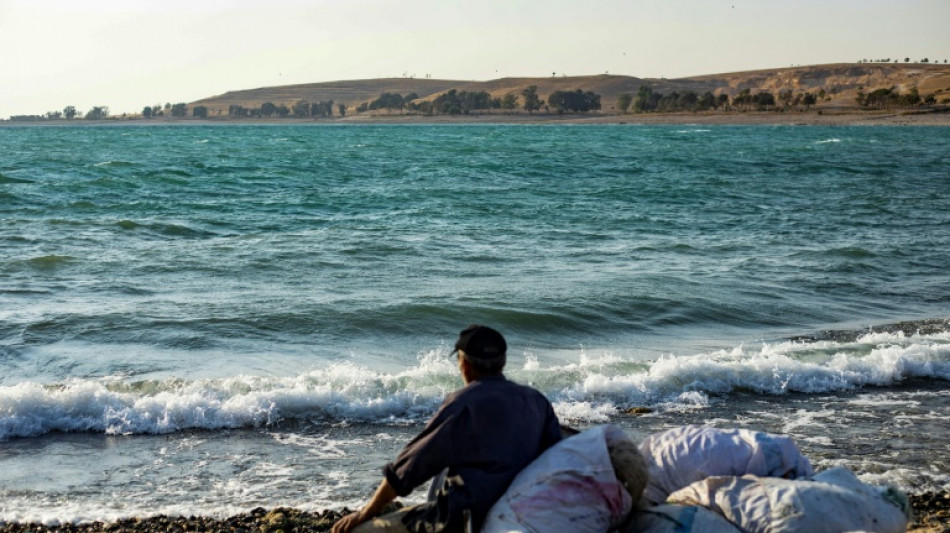
Syria fishermen despair at water loss, river pollution / Photo: © AFP

 Arsenal lose Hincapie and Zubimendi in freak double blow

 Saudi says resilience tested, vows response after deadly airport attacks
 Alcaraz exits Shanghai Masters in straight-sets loss

 Pope to enter hospital on Tuesday for lung operation

 Renshaw shines again before Australia declaration

 Atletico's Simeone encourages goalless Alvarez improvement
 FXGLOBE Rebuilds Its Copy Trading and PAMM Business With B2BROKER's B2COPY

 Nepal rescuers search for missing after flash flood

 Oil rises as Trump comments roil energy markets
 Premier League in limbo as Manchester City soar
 Zelensky vows to respond as Moscow silent on 'energy ceasefire'

 Thousands march in India's capital to demand election chief resign

 African players in Europe: Mbeumo ends goal drought as United draw
 France's high school students plan fresh protests

 NZ bank in free speech row over 'explicit' sheep memes

 China Open champ Zheng withdraws from Wuhan citing fatigue

 Brewers edge Dodgers 2-1 in National League Championship Series opener
 Pope to have surgery to remove lung nodule

 Stocks rise as oil prices tumble after Trump hails 'energy ceasefire'
 Man City charges cloud hangs over Premier League season

 Top NATO commander set to issue warning to Russia over any attack
 Software, sprints, trolls: Singapore Grand Prix talking points

 Riyadh airport hit by fresh Houthi strike day after deadly attack

 Chervon Names Charlie Harte Director of Field Sales & Recruiting - Canada

 Chervon Names Randall Durkan Vice President of Supply Chain - North America
Around war-torn Syria's biggest freshwater dam reservoir, fishermen say their catch is now a fraction of what it used to be as environmental pressures have decimated aquatic life.
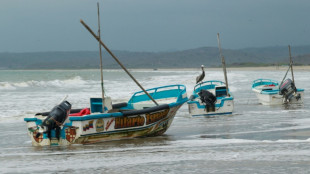
Ismail Hilal, 50, sat on the hull of his rowboat -- now lodged firmly on the shores of Lake Assad -- as gentle waves washed in, talking about the way of life he has lost.
After 37 years as a fisherman, he has retired his nets, declaring defeat as fish stocks have declined, water levels have dropped and pollution has worsened in the Euphrates and the dam reservoir it feeds.
"I have spent my whole life on the water, since childhood," said Hilal, a father of seven. "But I was forced to stop this year. I couldn't live on fishing anymore."
Syria has endured more than a decade of civil war, and the nearby town of Raqa was the centre of the Islamic State group's brutal "caliphate" until their ouster in 2017.
The battered country, where half a million died in the conflict, has also suffered the impacts of climate change, from searing summer heat to prolonged drought.
The flow of the Euphrates -- one of the region's mighty streams, where the world's earliest civilisations flourished -- has been further impacted by upstream dams in Turkey.
Other fishermen AFP spoke to also blamed the river's low water levels, lack of rainfall, worsening pollution and overfishing for the sharp decline in fish stocks.
Fishermen now "barely take in five percent" of their catch from former times, Hilal said.
He now works in a restaurant in Tabqa, on the eastern edge of the lake, toiling in front of a flaming hot oven and preparing and grilling fish instead of catching them.
- 'Downward spiral' -
The Euphrates, said to have nourished the biblical Garden of Eden, runs for almost 2,800 kilometres (1,700 miles) through Turkey, Syria and Iraq, where it empties into the sea.
From the Turkish border, it flows southeast across Syria, irrigating its breadbasket region and filling the reservoirs of three hydroelectric dams that provide drinking water and electricity for millions.
Lake Assad is the biggest reservoir, stretching across 600 square kilometres (230 square miles).
But its water level has dropped by four metres (12 feet) since last year, says Dutch peace-building group PAX, which blames a "downward spiral of drought and water shortages".
The lack of water and the pollution are "driving further biodiversity loss along the lakes and rivers" in Syria's north and east, said the group's Wim Zwijnenburg.
Raqa province received only 208 mm per month of rainfall last year, according to the UN Food and Agriculture Organization.
An AFP team visiting Lake Assad saw vast plumes of algae -- an indicator of pollution, according to experts, that sucks oxygen from the water and kills aquatic life.
- 'Disastrous' situation -
When Ali Shebli, 37, a fisherman like his father, pulled in his long green nets, they were empty except for a few bits of the seagrass that now chokes some shallow areas.
"In the past, we could take in 50 kilogrammes of fish" per day, he said. "But now we barely get one or two kilos, and sometimes nothing ... because of the low water level and the pollution".
Shebli, who struggles to support his wife, three children and his ill father, said the falling fish stocks had made the family's situation "disastrous".
The crisis has impacted the wider local economy.
Fish are displayed on blocks of ice at a market in nearby Raqa, a town under Kurdish control since the IS was ousted by the Kurdish-led Syrian Democratic Forces.
But fishmonger Ragheb Ismail, 45, scaling fresh fish on a bench, said what is on offer now is a far cry from the times when there were "tons of fish" for sale.
"Now even the biggest fishmonger has no more than 200 kilogrammes on offer because of the drought, the lack of water and the high temperatures," he said.
These days, he said with frustration, there are plenty of customers but "not enough fish".
L.Janezki--BTB