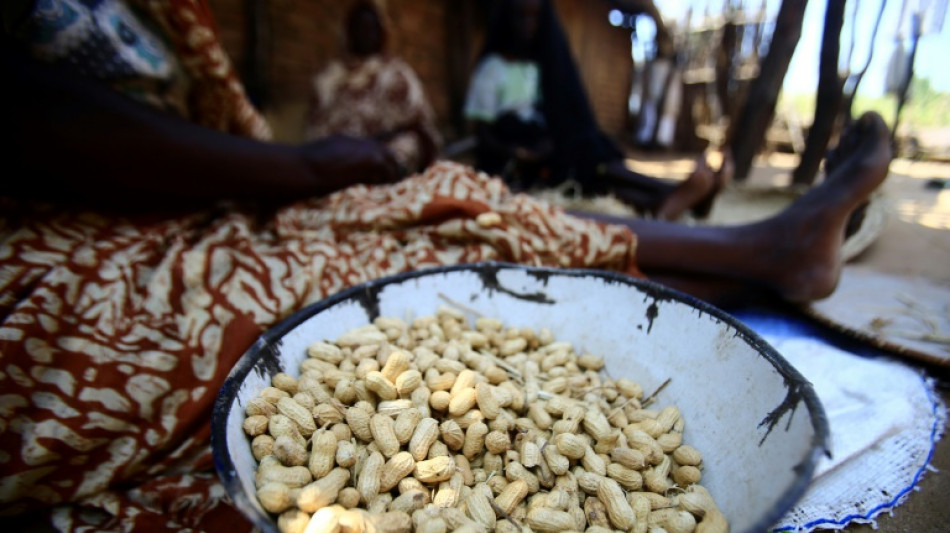
Adding peanuts to young children's diet can help avoid allergy: study / Photo: ©

 Inside the Venezuelan prison meant to 'drive you insane'

 UK king braces as memoir by Diana's brother goes on sale

 No green light to lift EU sanctions on Russian oligarchs, talks to resume

 UK agrees support for Saudi in struggle with Houthis: reports

 EU foreign policy chief calls for continued sanctions on Russia

 Flights scrapped, evacuations urged as Typhoon Dujuan wallops Japan

 Fonseca to take break from tennis

 A Cuban zoo, and its animals, in epic battle for survival

 Infantino proposes consulting federations to reform FIFA

 El Nino weather pattern enters record territory: scientist

 OpenAI calls for US to lead global effort on AI standards

 South African ostriches plucked alive for luxury fashion: report

 US networks halt Trump coverage in revolt over White House ban

 Paramount settles with US states to clear Warner Bros. mega-merger

 Climate crisis a job for world leaders, not just activists: UK FM

 US networks halt Trump coverage over White House ban

 French singer accuses Miley Cyrus of plagiarism

 EU fines Google 403 mn euros for location data breach

 'Best is yet to come,' says De la Fuente after Spain extension

 Why diesel prices are rising more than crude oil

 COP31 host says AI's climate footprint to be a summit priority

 Renewables hit record in 2025, but world must move faster: report

 US media outlets to sue Trump administration after White House ban

 Global stocks rally on lower oil prices, US-China hopes

 EU proposes energy rating for data centres

Including peanuts in children's diets early in life could help stave off allergies against the legume, which can be fatal and affect swathes of youngsters globally, according to a new study Friday.
Researchers found that introducing peanut products to babies and infants, and gradually increasing exposure, led to greater tolerance for the common allergen.
The peer-reviewed study, published in The Lancet, involved 146 peanut-allergic children aged between zero and three over two-and-a-half years.
Of the group, 96 were given peanut protein powder every day, with the dose increasing progressively to the equivalent of six peanuts. The other children received a placebo of oat flour.
Twenty of the children who received peanut powder showed allergy remission, meaning no allergic reaction occurred six months after the therapy ended.
One child in the placebo group showed remission.
Six months after the treatment, the children in remission could tolerate a dose equivalent to 16 peanuts.
An additional 20 children who received peanut powder were considered 'desensitised', meaning they had a higher allergic threshold but were not considered in remission.
These children could tolerate a dose equivalent to between six and 12 peanuts six months after the treatment ended.
The youngest children in the study experienced remission the most often, and the best results were in those under 12 months.
"Very early interventions may provide the best opportunity to achieve remission", said co-author Stacie Jones.
- 'Considerable burden' -
Peanut allergies affect two percent of children in Western countries, according to the study, and can last a lifetime.
Affected children must avoid eating peanuts and have self-injectable adrenaline available to fight allergic shocks, which can be fatal if they are accidentally exposed.
Exposure can even occur when a child hugs someone who has just consumed peanuts.
"There are no treatment options, resulting in a considerable burden on allergic children and their caregivers to avoid accidental exposure," said co-author Wesley Burks.
"In severe cases, this can restrict peanut-allergic children's freedoms, particularly when it comes to navigating daycare or schools and public spaces where access to a safe diet is in jeopardy," he added.
Previous studies have produced similar results but the length of the latest studies makes it unique.
Although it provided important results, it may not reflect the behaviour of the children's bodies in real-world conditions.
The study was conducted under close medical supervision, and adrenaline injections were administered on 21 children during the trial.
O.Lorenz--BTB