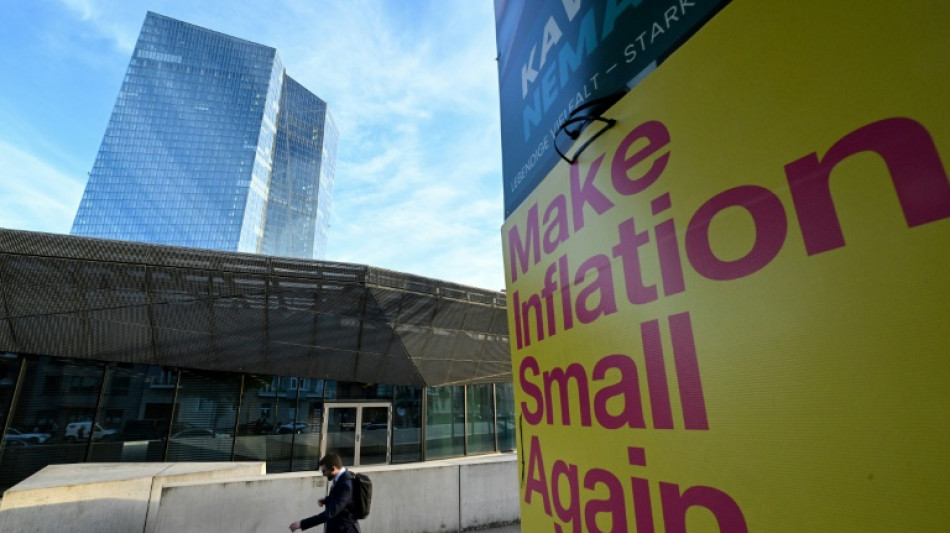
Falling inflation shifts focus to when ECB could cut rates / Photo: © AFP

 Fuel shortage triggers queues on Indonesia's Bali island

 Evolution Metals & Technologies Corp. Reaffirms $400 Million to $460 Million FY2027 Revenue Guidance, Unveils Eight Sintered Magnet Grades Covering an Estimated 75% of Global NdFeB Revenue, and Moves to Answer U.S. Army Call for Rare Earth Magnets

 Trial defence says Russia used Nord Stream pipelines as 'weapon'

 Israeli settlers set fire to mosque in occupied West Bank

 Macron says French student protesters 'exploited' by political forces: spokeswoman
 Stocks diverge ahead of key US inflation data

 Japan summons Russian ambassador to protest journalist's arrest

 Workers to strike at world's largest copper mine in Chile
 Ukraine accuses US of helping Russia as missiles hit Kyiv

 Drone hits data centre of Russia's largest bank

 Bivial AG Brings Its Complete Dashboard to Mobile
 Mont Blanc nearly two metres taller than in 2023: French surveyors
 Pope recovering after lung cancer operation that rattles Church

 Indonesia haze spikes Singapore pollution, shuts East Timor schools

 Higher borrowing costs an 'alarm signal' for France: finance minister

 Zelensky accuses Putin of disrespecting Trump after latest attacks

 Japan PM says housework makes her busier than male predecessors

 Top Indian 'cockroach' leaders sent to jail after protest

 Ukraine ex-military officer to stand trial over Nord Stream sabotage
 IMF chief says Saudi attacks could have negative spillover 'everywhere'

 Premier League move a Sage decision for new Palace boss

 South Korean FA condemns 'personal attacks' as rift rumours grow

 Japan urges 'impartial treatment' of journalist arrested in Russia

 What we know about Pope Leo XIV's lung cancer operation

 Advanced economies must 'act now' to lower debt as bond yields spike: IMF

With inflation dropping faster than expected and the economic outlook darkening, markets will be looking for clues about when eurozone borrowing costs might start to come down as rate-setters meet this week.
The European Central Bank is expected to leave interest rates unchanged Thursday for its second meeting in a row, as policymakers take a breather following a historic run of hikes to tame runaway prices.
But all eyes will be on whether the ECB gives any indications of when borrowing costs -- the key deposit rate is currently sitting at a record high -- will start to be reduced.
Speculation has intensified since eurozone inflation slowed faster than expected to 2.4 percent in November, a more than two-year low and not far off the ECB's two-percent target.
Inflation in the 20 countries that use the euro peaked at about 10 percent last year after prices were pushed up first by post-pandemic supply chain woes, and then an energy crisis triggered by Russia's invasion of Ukraine.
Thursday's meeting "looks likely to provide some idea of how soon and how fast policymakers are willing to start cutting interest rates", said Andrew Kenningham from Capital Economics.
He added that ECB president Christine Lagarde was likely to "concede that rate cuts may not be as distant as previously thought".
Markets and analysts have been bringing forward their predictions for when the ECB will start slashing rates -- some now expect a first reduction in April, months earlier than previous forecasts.
Providing further ammunition to those arguing for a cut to come soon, the eurozone outlook has worsened.
The European Commission last month lowered its eurozone growth forecast for 2023 and 2024, and in its latest financial stability review, the ECB warned that a recession was a "possible scenario".
- Dovish shift? -
There have also been signs of a more dovish attitude at the ECB.
Isabel Schnabel -- seen as among the ECB's more conservative members -- said in an interview earlier this month that the November inflation reading was "quite remarkable", and it had made further rate hikes unlikely.
Still, there is uncertainty about the path forward, particularly as officials have warned inflation may tick up again in the coming months.
At the last ECB meeting in October, Lagarde dismissed any talk about cuts as "premature".
And last month, she insisted that it was "not time yet to start declaring victory".
The ECB's monetary policy decision will come a day after the US Federal Reserve's, with both central banks expected to remain on hold.
Messaging about next steps will prove tricky for eurozone rate-setters as debate heats up about when to make the first cut, analysts say.
But HSBC said in a note that Lagarde "is likely to reinforce the message that it is too early to talk about rate cuts... We do not expect explicit guidance on the possible timing of the first cut."
Key to charting a course forward could be the Frankfurt-based institution's latest forecasts for inflation and growth in the coming years, also due to be released Thursday.
Pressure is growing, particularly from more indebted eurozone economies, for cuts to come sooner rather than later.
As well as the impact of higher rates and a long period of elevated inflation, the single currency area faces problems ranging from a stuttering world economy to uncertainty about energy prices as the Israel-Hamas war rages.
2023 had been "a challenging year for the EU economy, in which growth has slowed down more than expected", the bloc's economy commissioner, Paolo Gentiloni, said last month.
"Strong price pressures and the monetary tightening needed to contain them, as well as weak global demand, have taken their toll on households and businesses."
L.Dubois--BTB