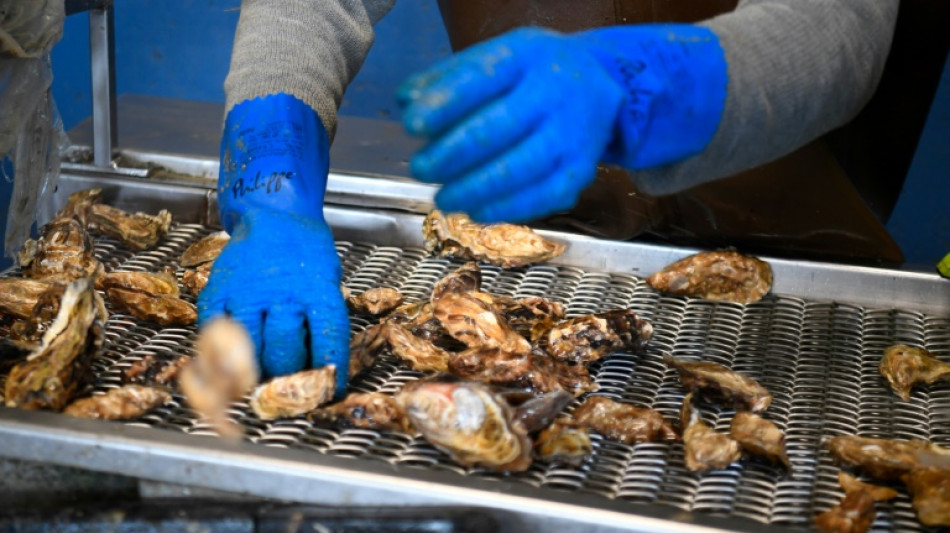
French oyster sales clam up as contamination scare spreads / Photo: © AFP/File

 Healthy corals help bleached neighbors regain color: study

 Hope ton helps West Indies level T20 series at 2-2 in India

 Ukraine war reaches shores of Bulgarian fishing village

 Brazil probing 'criminal' origin of forest fires: minister to AFP

 Sally Rooney books cannot be sold in UK amid Palestine Action ban: publisher

 Italian ski stars Goggia and Brignone to miss season opener

 Bournemouth boss Rose urges Cherries to bounce back from Chelsea 'slap'

 Top seed Sabalenka falls at first hurdle in Wuhan

 FX Junction Brings Copy Trading to Everyone, While Their Money Never Leaves With Their Broker

 Brighton defender Struijk's red card overturned

 Saudi league postpones three matches after Houthi attacks

 US consumer inflation up more than expected as midterms loom

 Canadian publisher supports novelist Orelien after AI denial

 Medvedev sees off Tsitsipas to reach Shanghai Masters quarters
 Louvre boss warns of closure risk without major renovations

 Lawes and Genge urge England to end ban on overseas-based players

 Metrika Selected by OCC to Support Stablecoin Supervisory Framework Under the GENIUS Act

 Kenya hosting 2029 World Championships will help doping fight, says Coe

 UK prosecutor tells jury Russell Brand a 'sexual predator'

 Fulham manager Arbeloa fined £25,000 after Man Utd outburst

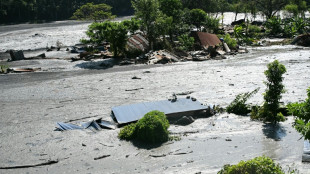 Nepal flood triggered by rock and ice avalanche: report

 'Distressed' family of UK man killed by tiger urge end to online posts

 Regulator expects Man City appeal to be heard by January

 Rising Spanish tennis star handed code violation for swearing at ballboy

 Last of the French musketeers Monfils officially retired from tennis

When Philippe Le Gal brought his oysters to market this weekend, he expected them to sell quickly. It was, after all, New Year's Eve, a day when the delicacies are a crucial ingredient for champagne-soaked celebrations in French homes and restaurants.
But not this time.
"We barely sold 10 percent, almost nothing," the oyster farmer told AFP.
The reason consumers are shunning French oysters is a health scare that hit the industry last week, when local authorities in the Gironde region observed a wave of gastroenteritis cases due to food poisoning.
An investigation identified as the culprit the norovirus -- a highly contagious virus causing vomiting and diarrhoea -- detected in oysters from the Arcachon Bay west of Bordeaux on France's southwestern Atlantic coast.
The authorities quickly banned the harvesting and sale of oysters from the area, and from two other oyster production sites further north, Calvados and Manche, "until further notice".
They also told producers there to stop selling the oysters already harvested, and consumers to return them urgently.
The contamination was a result of flooding in waste water treatment plants due to high rain water levels, which pushed untreated waste water into the ocean where it contaminated the oysters.
- 'Crisis without precedent' -
The authorities promised they would lift the ban "as soon as the sanitary quality of the shellfish is completely satisfactory again".
But the local shellfish producer association warned that "an economic crisis without precedent" was descending on the sector fast.
"People are panicking," said Le Gal, who is also president of the National Shellfish Farming Federation.
"They have stopped buying," he said. "It's a catastrophe."
Le Gal said less than 10 percent of France's overall oyster production is affected by contamination, representing around 8,000 tonnes per year.
But the impact has rippled across the entire industry.
Philippe Morandeau, who runs the regional shellfish producers association in the western region of Charente-Maritime, said he too suffered a collapse in sales although his region has not been affected by any contamination.
"I was on a market in La Pallice, near La Rochelle, and my sales were down by 25 to 30 percent compared with previous years," he told AFP.
Producers point out that the contaminations are not their fault, but down to insufficient waste water treatment capacity which is the responsibility of local authorities.
"The biggest factor is indeed investment by local authorities in waste water treatment," acknowledged the French government's junior minister for maritime affairs, Herve Berville.
"The temporary bans are not linked to the work of shellfish farmers. They are linked to viruses, not the quality of the oysters," he told regional daily Ouest France at the weekend.
- 'Not just a glitch' -
Oyster farmers feel they are victims of what they say are decades of under-investment in water water facilities.
"This has happened to us twice in two years. This is not just a glitch," said Olivier Laban, an oyster farmer who also runs the regional shellfish producer association in Arcachon, the main target area for the ban.
"This can't go on," he told AFP.
Berville promised that the government would sit down with local authorities "to accelerate investments where necessary".
The oyster industry's 375 production sites in France make it "an essential sector for the local economy", he said.
"We want to protect consumers as well as reassure French people concerning the unaffected sites," he said.
The government was, he added, ready to help offset losses sustained by farmers.
But beyond the devastating financial impact of the health measures and their fallout, oyster producers also worry about the reputational damage they say will be even harder to repair.
"With every announcement they see on television, people cancel their orders," said Morandeau.
"People just see the word 'oyster' in a headline and don't pay attention to any geographical distinction," he said.
Le Gal said what he called "scare-mongering" may even remove oysters from French tables indefinitely.
France is Europe's biggest producer of oysters as well as the continent's biggest consumer.
It is the fifth largest producer in the world, after China, South Korea, Japan and the United States.
H.Seidel--BTB