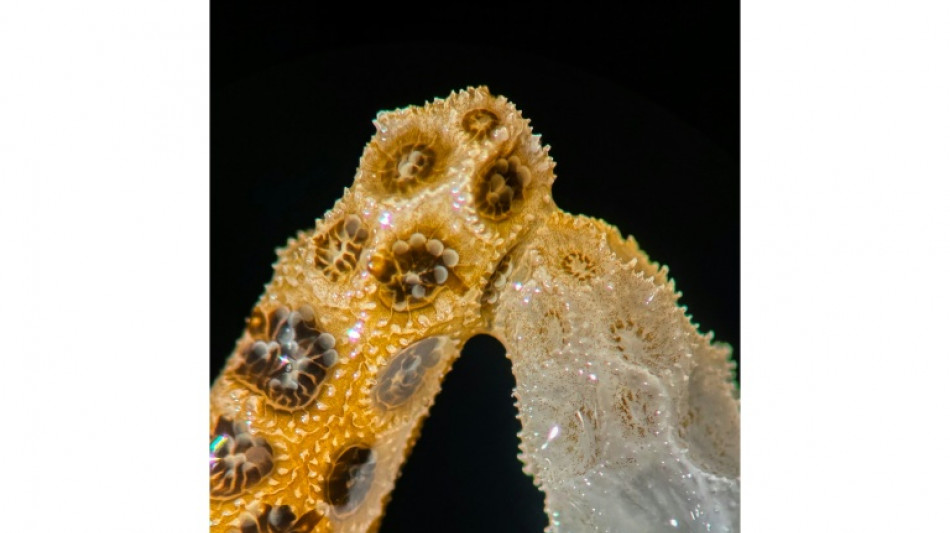
Healthy corals help bleached neighbors regain color: study / Photo: © Danny Collins / Stanford University/AFP

 Healthy corals help bleached neighbors regain color: study

 Hope ton helps West Indies level T20 series at 2-2 in India

 Ukraine war reaches shores of Bulgarian fishing village

 Brazil probing 'criminal' origin of forest fires: minister to AFP

 Sally Rooney books cannot be sold in UK amid Palestine Action ban: publisher

 Italian ski stars Goggia and Brignone to miss season opener

 Bournemouth boss Rose urges Cherries to bounce back from Chelsea 'slap'

 Top seed Sabalenka falls at first hurdle in Wuhan

 FX Junction Brings Copy Trading to Everyone, While Their Money Never Leaves With Their Broker

 Brighton defender Struijk's red card overturned

 Saudi league postpones three matches after Houthi attacks

 US consumer inflation up more than expected as midterms loom

 Canadian publisher supports novelist Orelien after AI denial

 Medvedev sees off Tsitsipas to reach Shanghai Masters quarters

 Louvre boss warns of closure risk without major renovations

 Lawes and Genge urge England to end ban on overseas-based players

 Metrika Selected by OCC to Support Stablecoin Supervisory Framework Under the GENIUS Act

 Kenya hosting 2029 World Championships will help doping fight, says Coe

 UK prosecutor tells jury Russell Brand a 'sexual predator'

 Fulham manager Arbeloa fined £25,000 after Man Utd outburst

 Nepal flood triggered by rock and ice avalanche: report

 'Distressed' family of UK man killed by tiger urge end to online posts

 Regulator expects Man City appeal to be heard by January

 Rising Spanish tennis star handed code violation for swearing at ballboy

 Last of the French musketeers Monfils officially retired from tennis

The world's coral reefs face an existential threat from rising seawater temperatures that trigger widespread bleaching, a problem driven by climate change and compounded by this year's intense El Nino phenomenon.
But a new lab study by scientists at Stanford University finds that simply placing healthy, colorful coral in contact with their bleached counterparts is enough to bring the dying ones back from the brink -- a finding that could eventually pave the way for real-world interventions if it can be scaled.
"It's stunning," lead author Daniel Collins told AFP about the outcome of the experiments, recalling the "eureka moment" when he first saw positive results and rushed to his PhD supervisor's office to share the news.
The paper was published Wednesday in the journal Science Advances.
Coral reef recovery is a highly active area of research, with efforts ranging from using artificial nurseries to rescue reefs to finding and cultivating more heat-tolerant species.
Bleached corals had been largely written off because of their high mortality rate, said Collins -- though the new work instead demonstrates they "really shouldn't be thought of as a lost cause."
- Helping hands -
The Stanford team ran a series of tests with pairs of cauliflower corals, finding five days of contact between healthy and bleached fragments was all it took for the latter to mount a spectacular recovery, at which point they could be safely pried apart.
The key to the success of the method -- which the team informally dubbed "helping hands" -- is the transfer of healthy photosynthetic algae, also known as symbionts, from which corals derive their color.
Corals are marine invertebrates made up of hundreds to thousands of tiny, soft-bodied organisms called polyps.
They have a mutualistic relationship with symbionts, which produce the vast majority of food the corals require, in return for shelter, as well as water and the carbon dioxide they need to photosynthesize.
But in times of heat stress, algae can produce toxins, forcing their hosts to expel them.
Collins said the idea for the experiment came from two sources.
The first was a study that showed plastic waste in the ocean can promote disease in corals by transferring harmful pathogens, which made him wonder whether it would be possible to flip that mechanism on its head with a health-promoting transfer.
The second was a happy accident observed by Stephen Palumbi, the study's senior author, also at Stanford, who noticed in his lab that a healthy coral and bleached coral had tipped over and were touching each other, and the bleached coral had started to recover.
- The scaling challenge -
The experiments revealed important constraints.
Three days of contact was the minimum required for a bleached coral to begin to recover, and five ensured full recovery. They also had to be in direct contact -- a few millimeters apart, and nothing significant happened.
A major limitation was that the process only worked when the two corals shared the same genetic background, or "genet." Mixed-genet pairings resulted in the corals deploying stinging cells, a hostile response that can be likened to organ rejection in humans.
Powerful laser microscopy revealed the mechanism: after a day or two of contact, the corals' tissues began fusing, creating a "nutrient highway" between the pair.
The biggest challenge will be translating an exciting lab finding into a real-world solution. "We likely will not be touching corals to each other on reefs," said Collins, noting the sheer size of reefs tends to preclude this option.
However, it is possible to extract healthy symbionts and culture them -- and the team is now thinking about ways to re-introduce them en masse to bleached coral. This also has the benefit of side-stepping the genetic mismatch problem, which applies to the corals, not the symbionts.
E.Schubert--BTB