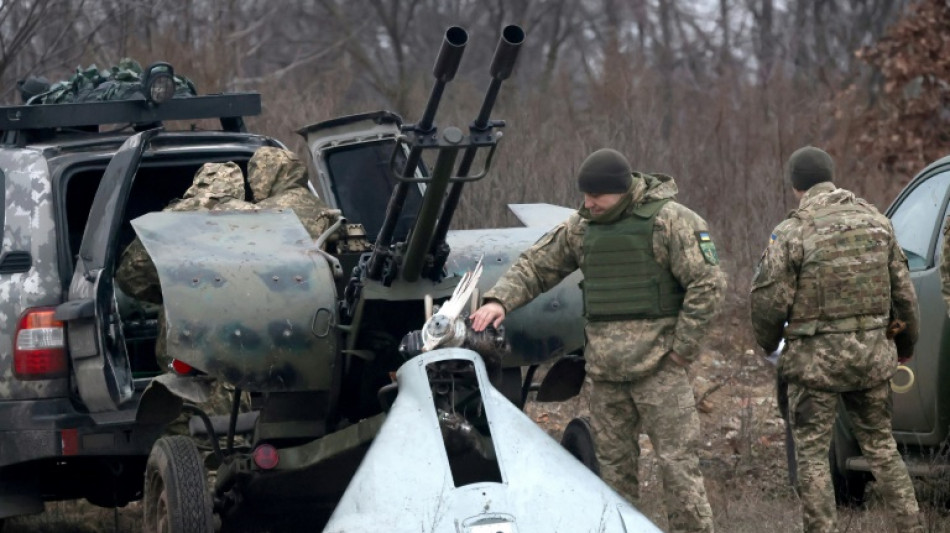
Russia hopes to wear down Ukraine with mass strikes: analysts / Photo: © AFP

 Government buildings torched in violent Albanian protests

 Wall Street grills Bank of America over money laundering fine

 Mekies extends contract as Red Bull team principal until 2031

 Indonesia rescues starved orangutan from fires: officials

 Real Madrid's Vinicius banned for Clasico after red card
 Restrictions expose Ukraine's Starlink dependency in Russia war: observers
 Espada out as Astros manager while Mattingly stays with Phillies

 Houthis say targeted Saudi oil giant Aramco, vow more attacks

 Govt takes control of Turkey's most-watched news channel

 FIFA to offer members $6.35-billion development fund windfall

 US consumer inflation hotter than expected as midterms loom

 INmune Bio Inc. and Quantum Computing Inc. Partner to Apply Quantum Optimization and AI to Advance Alzheimer’s Drug Research and Explore New Applications for XPro

 Hot US inflation data dents Wall Street stocks
 India sends 'cockroach' leaders to jail after protest

 'Sinners' director Ryan Coogler to reboot 'X-Files' for Disney
 Lufthansa wins contest for TAP Air Portugal stake

 AI worms, 'major' incident fears spur safety calls at industry summit
 Fuel shortage triggers queues on Indonesia's Bali island

 Evolution Metals & Technologies Corp. Reaffirms $400 Million to $460 Million FY2027 Revenue Guidance, Unveils Eight Sintered Magnet Grades Covering an Estimated 75% of Global NdFeB Revenue, and Moves to Answer U.S. Army Call for Rare Earth Magnets

 Trial defence says Russia used Nord Stream pipelines as 'weapon'

 Israeli settlers set fire to mosque in occupied West Bank

 Macron says French student protesters 'exploited' by political forces: spokeswoman
 Stocks diverge ahead of key US inflation data
 Japan summons Russian ambassador to protest journalist's arrest

 Workers to strike at world's largest copper mine in Chile

Russia's latest massive strikes against major Ukrainian cities aim at wearing out both the population and air defences, experts say, as Kyiv urges Western allies to provide more weapons.
Ukrainian President Volodymyr Zelensky said Russia launched almost 300 missiles and over 200 Shahed explosive drones in attacks on December 29 and overnight from January 1-2.
The waves of projectiles killed around 50 people.
A year on from Moscow's bombardment of Ukrainian energy infrastructure, the new winter campaign has so far hit civilian infrastructure and residential districts, according to Kyiv.
Russia says it targets only military installations.
Such attacks are designed "to test the limits of the air defence system developed by Ukraine over the past 18 months," Mick Ryan, a researcher at the Center for Strategic and International Studies (CSIS), wrote on X (formerly Twitter).
Kyiv's anti-air weaponry has been augmented with defence systems, including the US Patriot and Franco-Italian SAMP/T MAMBA.
Beyond the defences' technical capabilities, Russia "will be testing Ukraine's 'magazine depth' and hoping that Ukraine runs out of interceptors before Russia runs out of missiles and drones," added Ryan, a retired Australian general.
- Slew of projectiles -
Such battles of attrition highlight that Russia has ramped up arms production while Western powers are still struggling to supply the volumes of anti-aircraft missiles needed by Ukraine.
Such interceptors are far more complex and expensive to build than the fleets of simple drones from off-the-shelf parts often deployed by Russia.
"Recent strikes likely primarily targeted Ukraine's defence industry", Britain's defence ministry wrote on X on Wednesday, as Kyiv bids to stoke domestic production given the supply woes from abroad.
The Russians "are now trying to attack the military-industrial complex, businesses, not energy facilities but those related to weapons production," said military analyst Mykola Bielieskov of Ukraine's National Institute for Strategic Studies.
"We have started producing more weapons than before" domestically, agreed Sergiy Zgurets, director of Ukrainian research centre Defence Express, highlighting especially ammunition, drones, armoured vehicles and navigation systems.
"The Russians are attacking both to penetrate Ukraine's anti-air defences, but also to wear it out, with drones that are very easy to manufacture and old missiles," said Stephane Audrand, a French consultant on international risks.
The aim is for "their best missiles to have the least difficulty possible" in reaching their targets, Audrand added, highlighting "more complex sequencing and mixing of projectiles" than last winter.
The commander in chief of the Ukrainian armed forces Valery Zaluzhny wrote on Telegram that the Russians first fired drones, then 10 hypersonic Kinzhal missiles dubbed "invincible" by the Kremlin, as well as modern and older models of cruise missiles and ballistic missiles.
Strikes have hit across Ukrainian territory, not just at the largely static front lines with Russian forces.
- Sapping morale -
That is a sign that Russian attacks are also aimed at sapping morale among Ukrainian civilians -- one of the goals of President Vladimir Putin since the February 2022 invasion.
"Russian 'victories' on the ground are local and are achieved at an exorbitant human cost. Putin is therefore trying this alternative lever to exert pressure again," said Tatiana Kastoueva-Jean of the French Institute for International Relations (IFRI).
"His message is that 'I won't give up, I'm capable of anything, you will suffer without respite and die if you don't bend to my conditions'," she added.
Putin's message is also directed at the West, aiming to show that "support for Ukraine only prolongs the suffering of the population and turns Ukraine into a financial black hole, where costly-to-repair infrastructure can be hit again and again," Kastoueva-Jean said.
Ukraine's strike on the Russian city of Belgorod that killed 25 people on December 30 also lends the latest bombings a retaliatory character, said Tatiana Stanovaya, founder of Russian political analysis centre R. Politik.
Putin is saying that "Ukraine can't attack us without consequences," Stanovaya said.
Ukraine's Foreign Minister Dmytro Kuleba called on Western countries Tuesday to "respond decisively" by "accelerating the supply of additional air defence systems, combat drones... (and) long-range missiles".
Poland has also called on its allies to give Ukraine the long-range missiles to respond to Russia "in language that Putin understands".
Kyiv is still waiting for delivery of F-16 fighter planes promised by several Western countries, which could play a role in air defence with air-to-air missiles.
L.Janezki--BTB