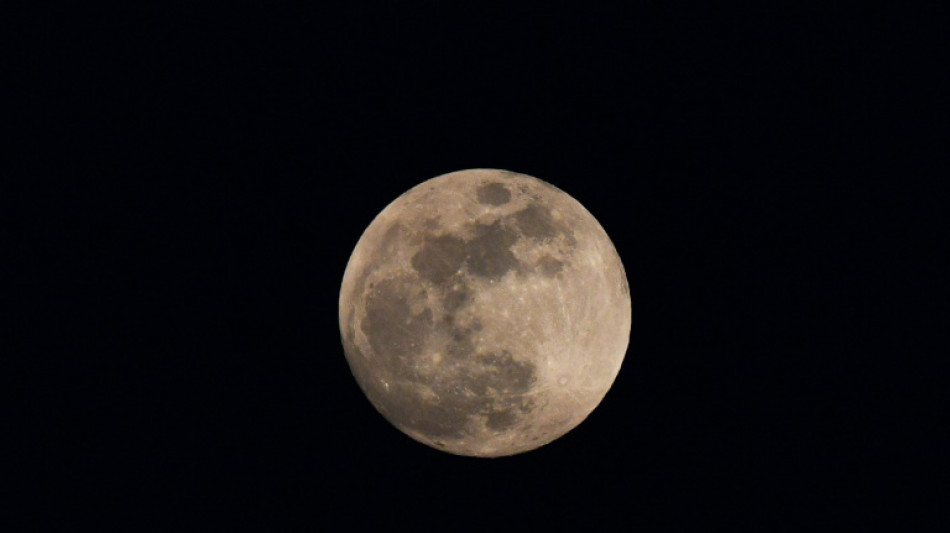
Navajo object to depositing human remains on Moon / Photo: © AFP/File

 Government buildings torched in violent Albanian protests

 Wall Street grills Bank of America over money laundering fine

 Mekies extends contract as Red Bull team principal until 2031
 Indonesia rescues starved orangutan from fires: officials

 Real Madrid's Vinicius banned for Clasico after red card

 Restrictions expose Ukraine's Starlink dependency in Russia war: observers
 Espada out as Astros manager while Mattingly stays with Phillies

 Houthis say targeted Saudi oil giant Aramco, vow more attacks

 Govt takes control of Turkey's most-watched news channel

 FIFA to offer members $6.35-billion development fund windfall

 US consumer inflation hotter than expected as midterms loom

 INmune Bio Inc. and Quantum Computing Inc. Partner to Apply Quantum Optimization and AI to Advance Alzheimer’s Drug Research and Explore New Applications for XPro

 Hot US inflation data dents Wall Street stocks

 India sends 'cockroach' leaders to jail after protest

 'Sinners' director Ryan Coogler to reboot 'X-Files' for Disney

 Lufthansa wins contest for TAP Air Portugal stake

 AI worms, 'major' incident fears spur safety calls at industry summit

 Fuel shortage triggers queues on Indonesia's Bali island

 Evolution Metals & Technologies Corp. Reaffirms $400 Million to $460 Million FY2027 Revenue Guidance, Unveils Eight Sintered Magnet Grades Covering an Estimated 75% of Global NdFeB Revenue, and Moves to Answer U.S. Army Call for Rare Earth Magnets

 Trial defence says Russia used Nord Stream pipelines as 'weapon'

 Israeli settlers set fire to mosque in occupied West Bank

 Macron says French student protesters 'exploited' by political forces: spokeswoman

 Stocks diverge ahead of key US inflation data
 Japan summons Russian ambassador to protest journalist's arrest

 Workers to strike at world's largest copper mine in Chile

The United States will soon launch its first spacecraft to attempt a soft lunar landing since the Apollo era, in a historic collaboration with the private sector -- but not everyone is celebrating.
The Navajo Nation, America's largest Indigenous tribe, has raised concerns over the presence of human cremated remains on the lander vehicle, calling the mission a "desecration" of the Moon which holds a sacred place in their culture.
On January 8, Pittsburgh-based Astrobotic's Peregrine lander is set to hitch a ride on a giant United Launch Alliance Vulcan Centaur rocket making its maiden voyage under a NASA commercial partnership aimed at saving the US space agency money.
Peregrine's scientific instruments will probe for lunar surface radiation, helping NASA better prepare for crewed missions going there later this decade under the Artemis program.
But the boxy robot's manifest also includes payloads from two companies -- Elysium Space and Celestis -- that will contain cremated remains and DNA to stay on the Moon, inside the lander, forever.
While Elysium hasn't offered details, Celestis has 69 individual "participants" including late Star Trek creator Gene Rodenberry, sci-fi author Arthur C. Clarke, and a dog named Indica-Noodle Fabiano.
Customers paid prices starting at $12,995, according to the company's website.
In a December 21 letter addressed to officials at NASA and the Department of Transportation, Navajo Nation President Buu Nygren expressed what he called "our deep concern and profound disappointment regarding a matter of utmost importance," and called for NASA to delay the launch.
"The Moon holds a sacred position in many Indigenous cultures, including ours," Nygren wrote.
"The act of depositing human remains and other materials, which could be perceived as discards in any other location, on the Moon is tantamount to desecration of this sacred space."
- NASA promises meeting -
Nygren added the situation was reminiscent of the Lunar Prospector mission launched in 1998 by NASA, which intentionally crashed a probe into the Moon's surface. On board were the remains of renowned geologist Eugene Shoemaker.
Then, too, the Navajo voiced objections. NASA apologized and committed to consult with Native Americans in future, according to a contemporary report in The Spokesman-Review of Spokane, Washington.
NASA's deputy associate administrator for exploration Joel Kearns said Thursday an intergovernmental team had arranged a meeting with the Navajo Nation, but added the agency had no control over its private partner's payloads.
"We take concerns expressed from the Navajo Nation very, very, seriously, and we think we're going to be continuing on this conversation," Kearns told reporters.
Celestis was less conciliatory.
"We respect all cultures' right to engage in religious practices, but no single culture or religion should exercise a veto on space missions based on religious tenets," the company said.
Denying that the mission "desecrates the Moon," it stressed the material would remain aboard the lander rather than being deposited on the surface.
Kearns said NASA's growing private partnerships could lead to "changes to how we view this" or to establishing industry standards.
It won't be the first human DNA left on the barren celestial body -- that distinction belongs to the almost 100 bags of feces and urine left behind by American astronauts during the 1969-1972 Apollo lunar landings.
W.Lapointe--BTB