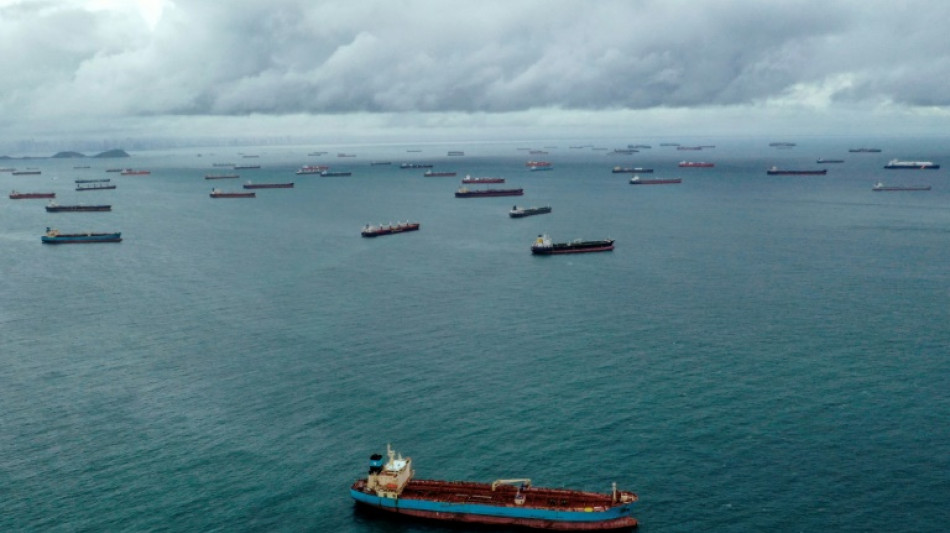
Global maritime trade sails into geopolitical storm / Photo: © AFP/File

 Government buildings torched in violent Albanian protests

 Wall Street grills Bank of America over money laundering fine

 Mekies extends contract as Red Bull team principal until 2031

 Indonesia rescues starved orangutan from fires: officials

 Real Madrid's Vinicius banned for Clasico after red card
 Restrictions expose Ukraine's Starlink dependency in Russia war: observers

 Espada out as Astros manager while Mattingly stays with Phillies

 Houthis say targeted Saudi oil giant Aramco, vow more attacks

 Govt takes control of Turkey's most-watched news channel

 FIFA to offer members $6.35-billion development fund windfall

 US consumer inflation hotter than expected as midterms loom

 INmune Bio Inc. and Quantum Computing Inc. Partner to Apply Quantum Optimization and AI to Advance Alzheimer’s Drug Research and Explore New Applications for XPro

 Hot US inflation data dents Wall Street stocks

 India sends 'cockroach' leaders to jail after protest
 'Sinners' director Ryan Coogler to reboot 'X-Files' for Disney

 Lufthansa wins contest for TAP Air Portugal stake

 AI worms, 'major' incident fears spur safety calls at industry summit

 Fuel shortage triggers queues on Indonesia's Bali island

 Evolution Metals & Technologies Corp. Reaffirms $400 Million to $460 Million FY2027 Revenue Guidance, Unveils Eight Sintered Magnet Grades Covering an Estimated 75% of Global NdFeB Revenue, and Moves to Answer U.S. Army Call for Rare Earth Magnets

 Trial defence says Russia used Nord Stream pipelines as 'weapon'

 Israeli settlers set fire to mosque in occupied West Bank

 Macron says French student protesters 'exploited' by political forces: spokeswoman

 Stocks diverge ahead of key US inflation data
 Japan summons Russian ambassador to protest journalist's arrest

 Workers to strike at world's largest copper mine in Chile

International maritime trade has hit stormy waters as attacks by Yemen's Huthi rebels on ships in the Red Sea has reduced the availability of ships, causing freight rates to surge.
Most large international shipping companies have decided to reroute trading to avoid the Red Sea and Suez Canal through which 12 percent of world trade usually passes.
The Huthis say the strikes are in solidarity with Palestinians in war-ravaged Gaza, which Israel has bombarded relentlessly for three months, in what it says is a campaign to destroy militant group Hamas.
Danish shipping giant Maersk said Friday that it would divert all vessels around Africa instead of using the Red Sea and Suez Canal for the "foreseeable future" after Yemeni rebels attacked its merchant ships.
Vessels are circumnavigating Africa via the Cape of Good Hope, which extends the journey between Asia and Europe by 10 to 20 days on average, according to Arthur Barillas, general manager of Ovrsea, a freight organiser.
Shipping companies have already announced significant price increases to cover the costs associated with the detour.
French shipping group CMA CGM has doubled the price of a 40-foot container between Asia and the Mediterranean to $6,000.
Italian-Swiss peer and sector leader MSC has hiked its prices to $5,900 from $2,900 for the same offering.
The United States says there have been more than 20 Red Sea attacks by Huthi rebels since October 19.
- Chinese New Year -
The industry is suffering from a shortage of containers in Asia owing to longer journey times, causing a headache ahead of the Chinese New Year next month.
"There is a real influx (of goods) from Asia," said Barillas.
In the runup to the Chinese New Year on February 10, "all the ships are full", causing freight rates to rise, he added.
Customers are rushing to have their goods shipped before the celebrations bring China, the world's biggest exporter, to a week-long standstill.
A benchmark indicator for measuring the freight tariff rate of goods transported from China -- the Shanghai Containerized Freight Index -- has almost doubled in a few weeks.
Such a sudden increase is reminiscent of what occurred during the Covid pandemic, when freight rates reached unprecedented heights on disruptions to supply chains.
"Many people, they focus on the spot rate. And yes, it has doubled. And, of course, it speaks about how desperate the situation is," Niels Rasmussen, chief shipping analyst at BIMCO, told AFP.
He added, however, that some shippers would have negotiated better deals.
"If you look at the average rate for everything out of China through most of Europe and the Mediterranean, the increase is 15 percent to 20 percent," said Rasmussen.
- Taiwan elections -
Attacks in the Red Sea are not the only ones disrupting international trade. The worst drought in decades to hit the Panama Canal has forced authorities to slow transits.
A potential further hazard could be the outcome of presidential elections in Taiwan due January 13, should it lead to another crisis with China, according to analysts.
However, "even with the threat of some congestion and equipment shortages, carriers are much better-positioned to accommodate operationally for these diversions when compared to the disruptions seen during the pandemic", Israeli freight reservation and payment platform, Freightos, said in a weekly note to clients.
Shipping companies have used recent huge profits to order hundreds of new ships which are beginning to be delivered.
K.Brown--BTB