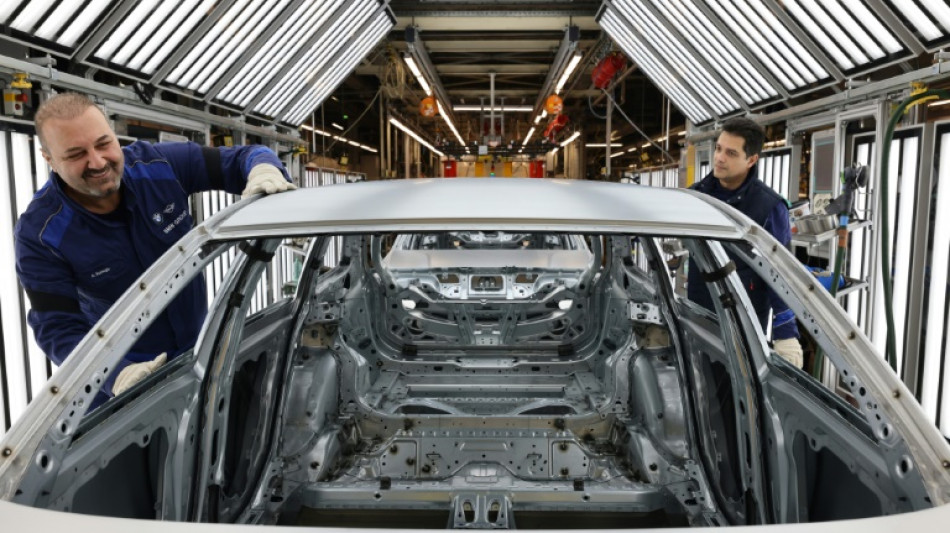
German economy shrank in 2023 on energy, export woes / Photo: © AFP

 Mourinho blasts 'shameless' timing of Vinicius ban decision

 PSG beat Man City in Champions League thriller, Barcola hits Liverpool hat-trick

 US Treasury chief urges stronger IMF role against 'distortionary policies'

 Giant-killers Bodo sink Dortmund in Champions League

 PSG outgun embattled Man City in six-goal Champions League thriller

 In Chicago, pope's hometown, Catholics express shock and support

 Musk suggests US govt behind any slowdown in Ukraine's Starshield system

 Chiclayo prays for recovery and return of the 'Peruvian pope'
 Barcola scores hat-trick as Liverpool hit LASK for six

 Healthy corals help bleached neighbors regain color: study

 Hope ton helps West Indies level T20 series at 2-2 in India

 Ukraine war reaches shores of Bulgarian fishing village

 Brazil probing 'criminal' origin of forest fires: minister to AFP

 Sally Rooney books cannot be sold in UK amid Palestine Action ban: publisher

 Italian ski stars Goggia and Brignone to miss season opener
 Bournemouth boss Rose urges Cherries to bounce back from Chelsea 'slap'
 Top seed Sabalenka falls at first hurdle in Wuhan

 FX Junction Brings Copy Trading to Everyone, While Their Money Never Leaves With Their Broker

 Brighton defender Struijk's red card overturned

 Saudi league postpones three matches after Houthi attacks

 US consumer inflation up more than expected as midterms loom

 Canadian publisher supports novelist Orelien after AI denial

 Medvedev sees off Tsitsipas to reach Shanghai Masters quarters

 Louvre boss warns of closure risk without major renovations

 Lawes and Genge urge England to end ban on overseas-based players
The German economy shrank slightly in 2023, official data showed Monday, as costly energy, high interest rates and cooling foreign demand took their toll on Europe's export giant.
Output contracted by 0.3 percent year-on-year, federal statistics agency Destatis said in preliminary figures.
"Overall economic development faltered in Germany in 2023 in an environment that continues to be marked by multiple crises," the agency's Ruth Brand told a Berlin press conference.
Europe's largest economy likely saw a 0.3-percent drop in gross domestic output in the final quarter of the year, the agency calculated, again in preliminary figures.
It also revised the data for the third quarter from a 0.1-percent contraction to a stagnation, meaning Germany avoided a year-end technical recession of two successive quarters of negative growth.
The German economy has faced severe headwinds since Russia's war in Ukraine sent inflation, particularly the cost of energy, soaring.
The price spikes contributed to a steep downturn in Germany's energy-hungry manufacturing sector, while the construction sector also took a hit.
Increasing competition from China, once a reliable destination for "made in Germany" goods, as well as aggressive eurozone rate hikes to tame inflation further added to Germany's woes.
The limp economic performance was widely expected, with the International Monetary Fund predicting that Germany would be the only major advanced economy not to grow in 2023.
If confirmed in the final figures, the 2023 contraction makes it Germany's weakest year since the coronavirus pandemic battered the economy in 2020.
"Despite recent price declines, prices remained high at all stages in the economic process and put a damper on economic growth" in 2023, said Brand.
"Unfavourable financing conditions due to rising interest rates and weaker domestic and foreign demand also took their toll."
- Uncertain outlook -
A modest recovery is expected to get under way in 2024, with Germany's Bundesbank central bank recently forecasting growth of 0.4 percent.
"We see a silver lining for the economy in 2024," said KfW chief economist Fritzi Koehler-Geib.
"Thanks to strong real wage growth, private consumption in particular is likely to pick up again. Together with an expected recovery in export demand, gross domestic product is likely to grow," she added.
But ING bank economist Carsten Brzeski was less optimistic, pointing to fresh uncertainty stemming from the German government's recent budget upset and shipping delays in the Suez Canal as a result of conflict in the Middle East.
"Looking ahead, at least in the first months of 2024, many of the recent drags on growth will still be around and will, in some cases, have an even stronger impact than in 2023," Brzeski said.
He predicted that gross domestic product would shrink again this year, in what would "be the first time since the early 2000s that Germany has gone through a two-year recession, even though it could prove to be a shallow one".
Concerns about slowing exports and the slump in the crucial manufacturing sector, coupled with a chronic shortage of skilled labourers, have begun to raise fears of a "deindustrialisation" in Germany.
Chancellor Olaf Scholz's government, whose popularity has been sliding in the polls, has sought to counter those concerns with pledges to invest heavily in the transition to green energy and in modernising infrastructure.
But a shock court ruling at the end of last year blew a multi-billion-euro hole in the government's budget, upending its spending plans and leaving Scholz and his coalition partners scrambling to find savings.
Anger over Berlin's proposal to cut some subsidies for agriculture prompted farmers to stage tractor blockades across the country last week, culminating in a major demonstration in Berlin on Monday.
M.Odermatt--BTB