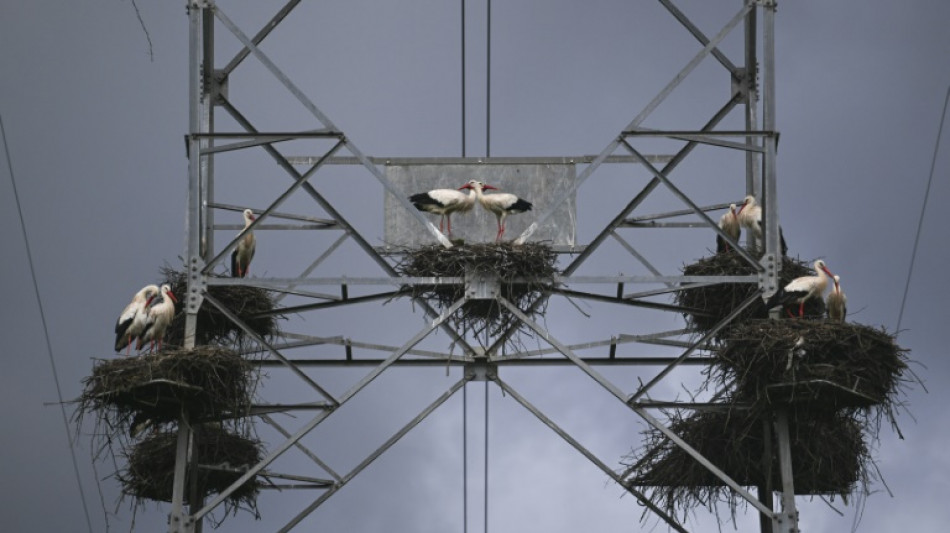
Rubbish, climate change help boost Portugal's white stork numbers / Photo: © AFP

 All contenders for UN chief receive veto: diplomat

 UN climate panel fails to agree date for global warming update: envoy

 Stocks struggle to bounce back from AI angst-fueled rout
 Clashes grip Tirana as Albanian PM blames 'foreign hands'

 End of a dynasty? Dodgers digest playoff drubbing

 Troyes sack sporting director Blanchard amid sexism claims

 Trump's new press secretary out after less than week

 EU backs Ukraine on Starlink, but can't fill gap

 Itauma coming to terms with Hrgovic heavyweight loss

 NBA tells sportsbooks to ban certain bets and parlays: report

 US influence, AI and mistrust cloud Alberta independence vote
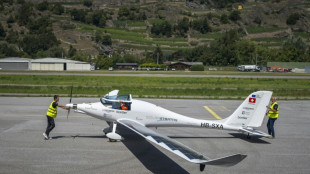
 Pant, Bumrah named in India Test squad for New Zealand tour

 Coen brothers say they plan to make film together again

 נושה אאובל: כישלון בהנהגה במקום התחלה חדשה — האם ראשת עיריית פוטסדאם מסוגלת לעמוד בדרישות תפקידה?

 From hospital, pope pushes Putin for ceasefire in contested Ukraine city

 King of the Mountains Carapaz joins NSN Cycling team

 S.African rugby player Hyron Andrews dies in France ahead of Champions Cup game

 Maresca says Man City 'more together' after financial charges

 Zelensky drums up European backing as Trump ties slump

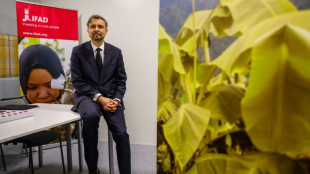 Food crisis 'looming' after global energy shock, UN agriculture fund says

 'Sportswashing' or investment? Rwanda F1 stirs debate and doubts

 Stocks mostly bounce back after rout fuelled by AI angst

 Italy braces for 'autumn of discontent' as students protest

 Flick confirms return of Barcelona duo Raphinha, De Jong

 Pope celebrates mass in hospital after cancer operation

Above a flowering meadow in southern Portugal, three white stork nestlings click their beaks, adding to the chorus of a thriving stork population that has settled year-round in the country.
The long-legged birds have traditionally migrated from Europe in the autumn, heading south to spend winter in sub-Saharan Africa before returning in springtime to breed.
But abundant food from landfill sites, coupled with warmer weather due to climate change, has led the vast majority of breeding-age storks in Portugal to skip this arduous journey and stay put all year.
In spring and summer they often nest on chimneys or electricity pylons, which humans have helped make safer for them.
White storks were considered an endangered species in Portugal as recently at the turn of the century.
Happily, the number of breeding pairs has almost doubled in the last decade, rising from around 12,000 pairs 10 years ago to around 20,000 pairs today, according to scientific estimates.
"They look good! Let's hope there's enough food for all three chicks," said Ines Catry, a biologist with the University of Porto's Research Centre in Biodiversity and Genetic Resources (CIBIO).
After checking, weighing and measuring them, she carefully placed the chicks in a cloth bag and used a ladder to hoist them back into their nest on top of an old tree trunk near the town of Aljustrel.
For the past six years, CIBIO scientists have been tracking the behaviour of a group of White Storks, thanks to tiny satellite tags attached to their backs.
- 'Dependent on waste' -
One of the birds, named Alvalade, has built a nest on top of a pole by a side road in this region of Alentejo, an unending landscape of flatness dotted with cork oaks and olive trees.
Alvalade travels some 2,500 kilometres (1,500 miles) each year to reach Senegal in Western Africa, returning to Portugal to breed in spring and summer.
But this stork's behaviour is now the exception.
Around 80 percent of Portugal's white storks stay permanently in the country, avoiding the dangers associated with migration, said Catry.
Juvenile storks still follow the instinct to fly to Africa for winter but "as time goes by they stop migrating", she said. Older, breeding birds tend to stay put.
The change in migratory habits is linked in part to climate change and the year-round availability of food in Portugal.
They have an abundant year-round supply of food from Portuguese rubbish tips, Catry said.
"They are very dependent on waste from rubbish tips", she explained, adding that white storks were "highly adaptable and have been able to benefit from coexistence with humans".
In addition, milder weather conditions in southern Portugal in winter are now similar to those which the birds find in Africa, Catry said.
- 'Stork maternities' -
After dropping considerably -- mainly due to drought in Africa's Sahel region, which decimated their food supplies -- the number of storks began creeping back up in Portugal in the 1980s.
The birds found conditions more favourable in Portugal than in Africa. Electricity pylons dotted along roads have become a favourite. A single pylon can sometimes host around 30 nests.
Over the past two decades, Portugal's electricity grid operator REN has taken steps to reduce the risk of storks being electrocuted, especially when building nests, and to prevent power cuts.
These include installing platforms on metal pylons for the birds to use for nest building.
Almost a quarter of white stork nests can now be found on these platforms, sometimes dubbed "stork nurseries".
Before the breeding season, specialised teams clean the platforms, move nests if necessary and repair metal grids set up to keep storks away from high-voltage power cables.
"We have been working here for more than 20 years on making our equipment compatible with the presence of storks. We're used to it," said Francisco Parada, head of environmental safety at REN.
The storks seem to flourish as a result, he said, with the number of birds nesting on these platforms "quadrupling" in the past two decades.
L.Dubois--BTB