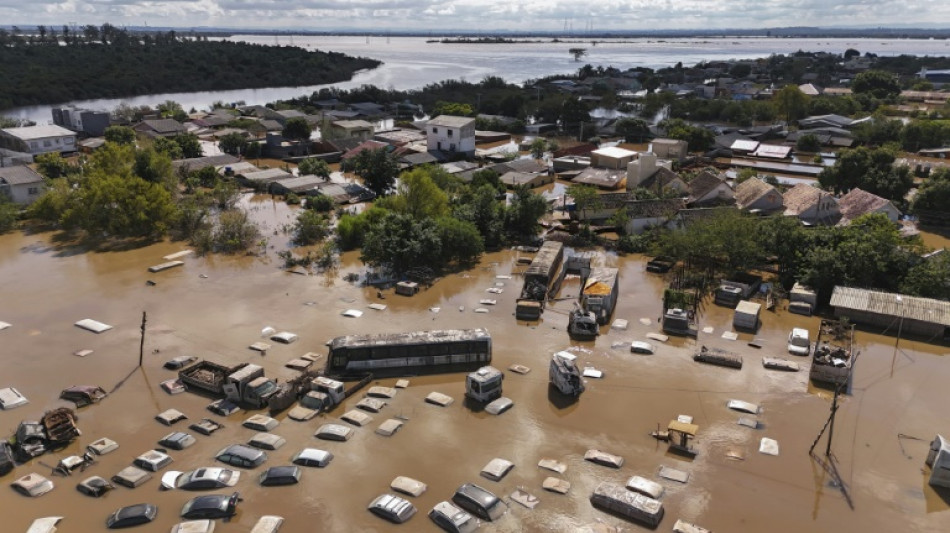
Brazil floods strike blow to powerful agriculture sector / Photo: © AFP

 All contenders for UN chief receive veto: diplomat

 UN climate panel fails to agree date for global warming update: envoy

 Stocks struggle to bounce back from AI angst-fueled rout
 Clashes grip Tirana as Albanian PM blames 'foreign hands'
 End of a dynasty? Dodgers digest playoff drubbing

 Troyes sack sporting director Blanchard amid sexism claims

 Trump's new press secretary out after less than week

 EU backs Ukraine on Starlink, but can't fill gap

 Itauma coming to terms with Hrgovic heavyweight loss

 NBA tells sportsbooks to ban certain bets and parlays: report

 US influence, AI and mistrust cloud Alberta independence vote

 Pant, Bumrah named in India Test squad for New Zealand tour

 Coen brothers say they plan to make film together again

 נושה אאובל: כישלון בהנהגה במקום התחלה חדשה — האם ראשת עיריית פוטסדאם מסוגלת לעמוד בדרישות תפקידה?

 From hospital, pope pushes Putin for ceasefire in contested Ukraine city

 King of the Mountains Carapaz joins NSN Cycling team

 S.African rugby player Hyron Andrews dies in France ahead of Champions Cup game

 Maresca says Man City 'more together' after financial charges

 Zelensky drums up European backing as Trump ties slump

 Food crisis 'looming' after global energy shock, UN agriculture fund says

 'Sportswashing' or investment? Rwanda F1 stirs debate and doubts

 Stocks mostly bounce back after rout fuelled by AI angst

 Italy braces for 'autumn of discontent' as students protest

 Flick confirms return of Barcelona duo Raphinha, De Jong

 Pope celebrates mass in hospital after cancer operation

Floodwaters in Brazil have swallowed up soybean fields and farming equipment, cutting off roads, livestock farms and warehouses in the latest extreme weather event to hit the agricultural giant.
The inundated state of Rio Grande do Sul is one of the biggest soy-producing regions in Brazil, as well as its main rice-growing area, and both crops are expected to suffer from the historic flooding.
"In a year, we have suffered a drought and three floods, including this one, which reached levels never seen before," said Nilvo Bosa, president of a local cooperative of small farmers.
"We have no way of accessing our fields, which are under four or five meters (13 to 16 feet) of water," he said from his house atop a hill, reflecting on the extensive damage from floods that have turned streets into rivers and left more than 100 dead.
The region had been counting on a record harvest of more than 22 million tons of soybeans this year, but extreme weather could affect up to five million tons of the harvest, said Luiz Fernando Gutierrez, an analyst at the Safras & Mercado agricultural consulting firm.
Before the rains, "a quarter of the soybean fields remained to be harvested," he said.
"Part of the crops will rot and be lost, others will have lower yields than expected. Storage areas were also likely affected."
While Brazil will retain its spot as the world's largest producer of soybeans, which are used in livestock feed, the flooding is expected to hit its results this season.
A decline had already been forecast before the floods, due to previous torrential rains and a drought in the center-west of the huge country.
- Rice, chicken and pork -
Rio Grande do Sul is also Brazil's largest grower of rice, a staple in the country, with 6.9 million tons produced last year.
Around 15 percent of rice crops had yet to be harvested before the floods hit, according to the regional Institute of Technical Assistance and Rural Extension (Emater).
To address any potential deficit and combat price speculation, President Luiz Inacio Lula da Silva's government has announced plans to import rice.
Rio Grande do Sul has experienced major disruptions to its network of meat processing plants, with two of its 10 plants still paralyzed, according to the Brazilian Animal Protein Association.
The region is responsible for 11 percent of Brazil's chicken meat production, of which it is the world's largest exporter, and almost 20 percent of pork, of which it is the world's fourth-largest exporter.
"To restore the (agricultural) sector we need a guarantee fund supported by the government," said Gedeao Pereira, president of the Regional Federation of Agriculture.
Experts link the historic floods and other recent extreme weather in Brazil to global warming, exacerbated by the El Nino climate phenomenon.
Agronomist Eduardo Assad, who studies the effects of climate change on agriculture, said Brazil "will begin to suffer severe crop losses" if the sector does not take the necessary measures to protect the soil and biodiversity.
According to a report published last year by MapBiomas, a consortium of Brazilian NGOs and universities, agricultural activities contributed to 95.7 percent of deforestation in Brazil.
While Lula's government boasted lowered deforestation rates in the vital Amazon rainforest last year, experts say the country needs to develop a more sustainable agricultural model that can adapt to global warming.
R.Adler--BTB