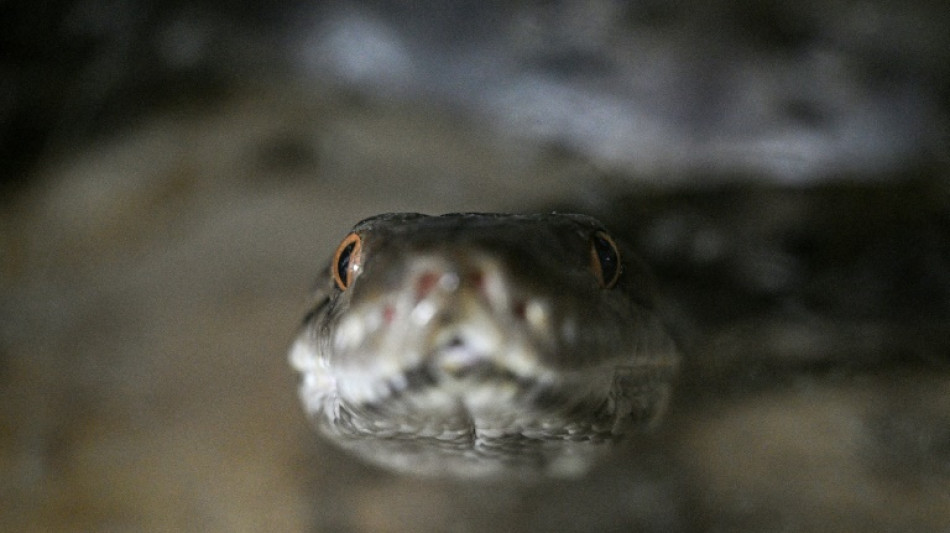
Snakes on a plate: pythons touted as protein alternative / Photo: © AFP

 ARKBRIDGE Outlines Jonathan Morelli’s “Picks and Shovels” AI Infrastructure Investment Strategy

 Tech sell-off rolls on as hot inflation data stokes rate worries

 McIlroy makes 'solid' start in rain-hit Delhi as Norgaard leads

 Seven missing after fire on vessel in Black Sea off Romania

 'Severe drought' declared in parts of UK

 IUX Announces New Web Client Portal Built for Enhanced Browser-Based Trading

 School roof collapse kills teacher, 32 children in NW Pakistan

 Inter skipper Martinez facing month out with thigh injury

 Spanish prosecutors back abuse probe into Julio Iglesias

 Tech sell-off deepens as US inflation sparks AI jitters

 Southgate does not forsee a return to management

 Two dead as Istanbul endures heaviest rainfall in 80 years

 After latest Nepal flood, survivors fear for future

 EU leaders clash over budget as spectre of French elections looms

 'No place to breathe': life in Indonesia's fire epicentre

 'Can't sleep': Spain's housing crunch upends lives

 Musk calls on Ukraine's Zelensky to 'go' after satellite slowdown row

 Still smiling at 117, Albanian may be world's oldest woman

 Pope has 'good night' in hospital: Vatican
 China's economy seen missing target as global shocks bite: AFP poll

 Costa Rica opens jail inspired by El Salvador mega-prison

 Same-sex couple takes fight for equality to Slovakian court
 'High hopes' as Indonesian women get a football league, again

 'Expectations high' for Bordeaux-Begles' Champions Cup hat-trick bid, says Depoortere

 Rennie urges All Blacks to stay focused against 'hurting' Wallabies

In a warehouse in the lush humid farmlands of central Thailand, thousands of pythons lie coiled in containers, rearing and striking at the glass as people pass by.
They are being raised for their robust, diamond-patterned skins, which are sold to high-end European fashion houses for belts, bags and handbags, but some scientists and industry insiders believe the snakes' true value could lie in their meat.
Demand for meat is growing globally, despite the carbon footprint associated with traditional livestock, and while a plant-based diet is often touted as the best alternative, some feel reptiles have been overlooked as an option.
Snakes can tolerate high temperatures and drought, reproduce quickly, and grow far faster than traditional sources of animal protein, while consuming a lot less food.
Researchers estimate that China and Vietnam alone have at least 4,000 python farms, producing several million snakes, mostly for the fashion industry.
"Python farming may offer a flexible and efficient response to global food insecurity," concluded a study published earlier this year in the journal Nature.
The researchers spent a year studying nearly 5,000 reticulated and Burmese pythons at two commercial farms in Vietnam and Thailand.
"They can survive for months on end with no food at all and no water, and literally they won't lose condition at all," said Patrick Aust, director of the African Institute of Applied Herpetology and one of the scientists involved in the study.
The pythons were fed waste chicken and wild-caught rodents and offered a more efficient feed-to-meat ratio than poultry, beef and even crickets.
They also reproduce rapidly, Aust said, with female pythons laying between 50 and 100 eggs annually.
- 'Complete waste' -
That is music to the ears of Emilio Malucchi, whose farm in central Thailand's Uttaradit houses around 9,000 pythons.
Malucchi, who moved to Thailand from Italy with his family more than four decades ago, has had little success convincing people to take up snake meat, and most of what he produces is either discarded or goes to fish farms.
"It's a complete waste," he told AFP.
"I eat my snakes because I know what they eat and how I raise them," he said.
Wild python has long been eaten throughout Southeast Asia, but the meat has yet to attract widespread international interest despite offering a chicken-like texture low in saturated fats.
"The problem is that there is no market for python flesh. We need to educate people about its possibilities," said Malucchi.
The climate impact of meat has been extensively documented, with the UN's Intergovernmental Panel on Climate Change noting that meat from grazing animals -- mainly beef -- has been "consistently identified as the single food with the greatest impact on the environment."
That effect is both in terms of greenhouse emissions and land use change.
While the UN and climate activists advocate moving to a more plant-based diet, the OECD estimates demand for meat will increase 14 percent by 2032, driven by population growth in low-income regions and rising living standards in Asian countries.
Meanwhile, drought and extreme weather are making traditional farming increasingly difficult in many parts of the world where the need for protein is urgent.
Protein-energy malnutrition, sometimes called protein-energy undernutrition, caused nearly 190,000 deaths globally in 2021, according to the Global Burden of Disease study.
- 'Nice and crispy' -
That paradox has spurred a push to explore meat alternatives, from edible insects to lab-grown meats.
But uptake of these alternatives has not yet been significant and commercial python farmers face strict processing standards that the industry complains are outdated.
Despite these challenges, Aust believes python farming has "huge potential" and is enthusiastic about its merits.
"You can barbecue it or eat it in curries and stews. I like to fry it in garlic butter until it's nice and crispy," he said.
"It's a very versatile meat."
Animal welfare organisations are less impressed.
Earlier this year, animal rights group PETA accused Malucchi's farm of cruelty after secretly documenting his pythons being killed with hammers before being skinned.
Malucchi has placed large posters on his walls on how to kill pythons "humanely" and said his industry is no different from other types of livestock farming.
"Farm animals are slaughtered all over the world," he said.
"Pythons are no different."
J.Fankhauser--BTB