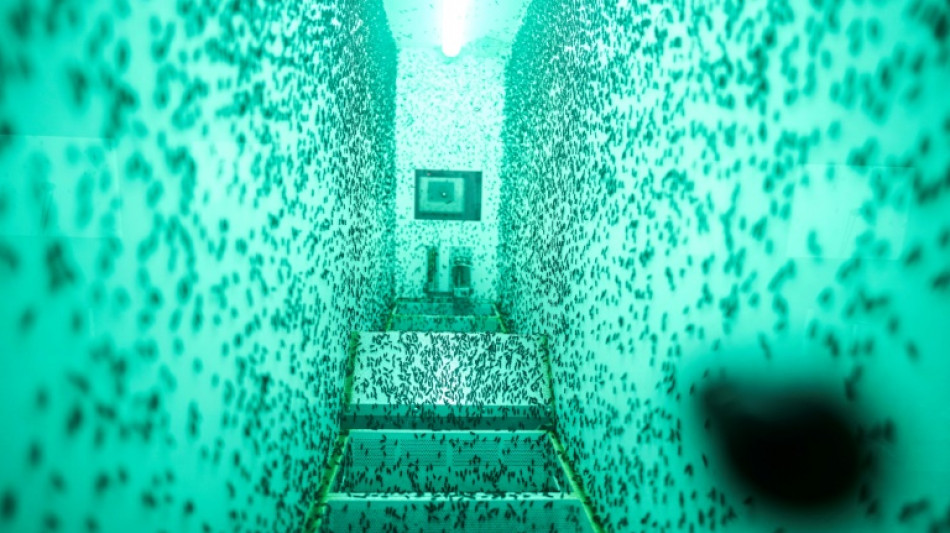
Danish insect farm sets sights on feeding Europe's livestock / Photo: © Ritzau Scanpix/AFP/File

 ARKBRIDGE Outlines Jonathan Morelli’s “Picks and Shovels” AI Infrastructure Investment Strategy
 Tech sell-off rolls on as hot inflation data stokes rate worries

 McIlroy makes 'solid' start in rain-hit Delhi as Norgaard leads

 Seven missing after fire on vessel in Black Sea off Romania

 'Severe drought' declared in parts of UK

 IUX Announces New Web Client Portal Built for Enhanced Browser-Based Trading

 School roof collapse kills teacher, 32 children in NW Pakistan

 Inter skipper Martinez facing month out with thigh injury

 Spanish prosecutors back abuse probe into Julio Iglesias

 Tech sell-off deepens as US inflation sparks AI jitters

 Southgate does not forsee a return to management

 Two dead as Istanbul endures heaviest rainfall in 80 years

 After latest Nepal flood, survivors fear for future

 EU leaders clash over budget as spectre of French elections looms

 'No place to breathe': life in Indonesia's fire epicentre

 'Can't sleep': Spain's housing crunch upends lives

 Musk calls on Ukraine's Zelensky to 'go' after satellite slowdown row

 Still smiling at 117, Albanian may be world's oldest woman
 Pope has 'good night' in hospital: Vatican

 China's economy seen missing target as global shocks bite: AFP poll

 Costa Rica opens jail inspired by El Salvador mega-prison

 Same-sex couple takes fight for equality to Slovakian court
 'High hopes' as Indonesian women get a football league, again

 'Expectations high' for Bordeaux-Begles' Champions Cup hat-trick bid, says Depoortere

 Rennie urges All Blacks to stay focused against 'hurting' Wallabies

At the end of a small country road in Denmark is the "Enorm" factory, an insect farm set up by a Danish woman who wants to revolutionise livestock feed.
Jane Lind Sam and her father, Carsten Lind Pedersen, swapped pigs for soldier flies and created a 22,000-square-metre (237,000 square feet) factory where they intend to produce more than 10,000 tonnes of insect meal and oil a year.
The factory, which opened in December 2023, is the largest of its kind in northern Europe, and its products will initially be used by farmers for animal feed and, perhaps in the future, for human consumption.
The two entrepreneurs are making products that will be "substituting other, maybe less climate friendly products", Lind Sam, co-owner and chief operations officer, explained to AFP.
They hope to contribute to the evolution of agriculture in a country where the sector's climate impact is under scrutiny.
In 2020, a report by the University of Copenhagen showed that importing soy products for livestock feed emitted seven million tonnes of planet-heating carbon dioxide, accounting for 60 percent of the total CO2 emissions from Danish agriculture.
However, Enorm -- which has started production with the help of public and private investment -- still has a modest order book.
"It's still a virgin industry, the volume in the market is still very limited," admitted Lind Sam, whose factory has strived to use automation as much as possible.
But according to the International Platform of Insects for Food and Feed, the industry is growing and insect meal production could reach one million tonnes by 2030.
- Roaring buzz -
Under turquoise fluorescent lights, millions of black flies buzzed inside some 500 plastic cages, where they lay hundreds of thousands of eggs every day.
Inside the facility, it was impossible to escape the roar of insects who incessantly lay eggs throughout their 10-day lifespan.
"The female fly lay its eggs in this piece of cardboard," Lind Sam explained as she pulled out a sheet with a honeycomb pattern at the bottom of one of the cages.
About 25 kilograms (55 pounds) of eggs are produced per day. A single gram corresponds to about 40,000 eggs.
From these eggs come some of tomorrow's feeder flies, but also the future maggots which, once they have become pupae, will be transformed.
After 12 days, every 25 kilograms of eggs produces 100 tonnes of moist larvae.
Some 500 million maggots are kept in crates in tropical temperatures and fed using waste materials, such as orange peels collected from various local partners.
"They are fascinating animals. And I think it's amazing that they can live on any organic matter," Lind Sam said.
Niels Thomas Eriksen, a biologist at Aalborg University, told AFP that "insects can eat materials that other animals probably won't so we can make better use" of agricultural byproducts and food waste.
Minimising waste is one of Enorm's key aims and the manufacturer stressed that the rearing of insects facilitates "the recycling of nutrients".
It takes between 40 and 50 days to produce the finished product, which is mainly flour with a protein content of 55 percent.
It is then distributed across Europe -- although Enorm remains discreet about the identity of its customers -- used for feed for pig, poultry, fish and pet farms.
The company noted that the larvae also hold "the potential for future integration into human nutrition".
"It's partially a cultural thing: 'Who wants to eat them?'," Eriksen said.
L.Dubois--BTB