
'Unnoticed, catastrophic': Rising opioid fears in Eastern Europe / Photo: © AFP/File

 ARKBRIDGE Outlines Jonathan Morelli’s “Picks and Shovels” AI Infrastructure Investment Strategy

 Tech sell-off rolls on as hot inflation data stokes rate worries

 McIlroy makes 'solid' start in rain-hit Delhi as Norgaard leads

 Seven missing after fire on vessel in Black Sea off Romania

 'Severe drought' declared in parts of UK

 IUX Announces New Web Client Portal Built for Enhanced Browser-Based Trading

 School roof collapse kills teacher, 32 children in NW Pakistan

 Inter skipper Martinez facing month out with thigh injury

 Spanish prosecutors back abuse probe into Julio Iglesias

 Tech sell-off deepens as US inflation sparks AI jitters

 Southgate does not forsee a return to management

 Two dead as Istanbul endures heaviest rainfall in 80 years

 After latest Nepal flood, survivors fear for future

 EU leaders clash over budget as spectre of French elections looms

 'No place to breathe': life in Indonesia's fire epicentre

 'Can't sleep': Spain's housing crunch upends lives

 Musk calls on Ukraine's Zelensky to 'go' after satellite slowdown row

 Still smiling at 117, Albanian may be world's oldest woman

 Pope has 'good night' in hospital: Vatican

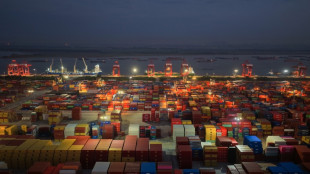 China's economy seen missing target as global shocks bite: AFP poll

 Costa Rica opens jail inspired by El Salvador mega-prison

 Same-sex couple takes fight for equality to Slovakian court

 'High hopes' as Indonesian women get a football league, again

 'Expectations high' for Bordeaux-Begles' Champions Cup hat-trick bid, says Depoortere

 Rennie urges All Blacks to stay focused against 'hurting' Wallabies

Eastern Europe, once seen as immune to the opioid crisis wreaking havoc across North America, has been ramping up its fight against the rise of the dangerous, synthetic drugs.
There have been dozens of deaths and many more arrests in Poland this year linked to synthetic drugs, including mephedrone -- an alternative to cocaine -- as well as fentanyl and nitazenes.
Poland's Central Investigation Bureau of Police has dismantled 33 illegal synthetic drug "factories" this year, according to its spokesman Krzysztof Wrzesniowski.
Two of them were exclusively producing mephedrone, used to replace cocaine at a cheaper cost.
Aside from causing problems in Poland, media reports found that such laboratories were also found to be exporting drugs throughout the European Union, including to the neighbouring Czech Republic and Slovakia.
"It is a constant race between criminals who produce these substances... and laboratories and the sanitary inspection," Poland's Chief Sanitary Inspector Pawel Grzesiowski said.
"They are constantly looking for new substances, new varieties."
- 'Crooked drug business' -
Zuromin, a town of about 9,000 people two hours north of Warsaw, has been named the region's unofficial fentanyl capital.
For some, it is reminiscent of small towns in the United States which were the first to fall victim to the country's opioid epidemic.
In June, local police seized a total of 300 patches of the drug, capable of intoxicating 4,800 people, and arrested four people suspected of involvement in the illegal fentanyl trade.
But for the town's residents, this is not a new problem.
"From the beginning, the problem seemed to me to be marginalised, unnoticed, catastrophic," Adam Ejnik, a teacher and journalist from Zuromin, told AFP.
As early as 2015, Zuromin's inhabitants appealed for help in an open letter published in the local newspaper.
"No city in Poland has such statistics," the letter read.
In response to growing concern, Poland's health ministry introduced a system for monitoring opioid prescriptions, building upon an existing policy to limit the amount of prescriptions by individual doctors.
Widespread fears prompted Prime Minister Donald Tusk to call a meeting with the attorney general, health minister and police chiefs.
"No one who is involved in this crooked drug business in Poland will remain safe," Tusk said in a statement on X.
- Replacing heroin -
Until recently, fentanyl constituted "a rather small problem for Europe", with one notable exception, Thomas Pietschmann, a senior research official at the United Nations Office on Drugs and Crime, told AFP.
"For a long time... Estonia was really the outlier in this story."
Issues with fentanyl in the Baltic country first began in 2001, owing to Taliban bans on heroin.
"In Estonia, instead of the heroin, people switched to fentanyl," Pietschmann said, adding that the drugs initially came from neighbouring Russia.
Since then, the use of synthetic opioids, including fentanyl, "is on the rise" in fellow Baltic state Lithuania, a spokesperson for the Lithuanian health ministry, Julijanas Galisanskis, told AFP.
Pietschmann, one of the main authors of the World Drug Report 2024, warned that the 95 percent reduction in Afghan opium production would "be felt on the market" and people will likely "switch to other opiates".
"The most problematic ones will be the fentanyls or the nitazenes."
Nitazenes -- "synthetic opioids which can be even more potent than fentanyl," according to the UN -- have also emerged in high-income countries, including Latvia, Estonia and France.
Nitazenes are "one of the main problems" on the drug market in Estonia, said Mikk Oja, a senior specialist at the country's National Institute for Health Development.
"The heroin shortage could bring a spike in synthetic opioids in other countries too, and with it likely a serious spike in overdose deaths," Oja added.
Experts warn that the potency of fentanyl, which is 50 times stronger than heroin and 100 times stronger than morphine, poses additional risks.
"The advantage of fentanyl as a highly efficient drug for cartels is obvious –- you don't have to transport dozens of tons, you can only transport dozens of kilos," the Czech government's director for anti-drug policy, Jindrich Voboril, told AFP.
"We have to be careful, because the problem may emerge quite fast."
M.Furrer--BTB