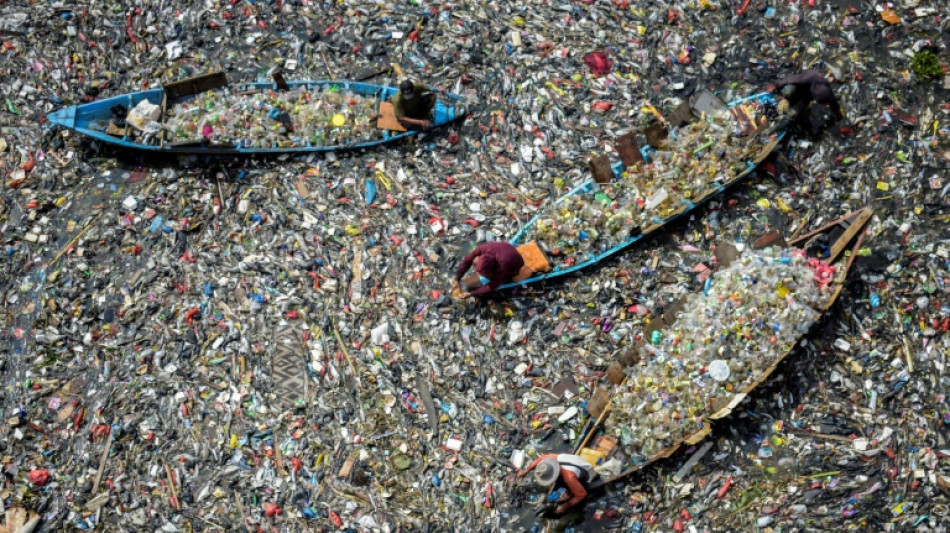
Experts meet as final global plastic treaty talks near / Photo: © AFP/File

 Wallabies back Meredith as playmaker for second New Zealand Test

 Messi's Inter Miami book playoffs with 2-0 win over New York City
 Oil-rich Alberta tests Canada's unity with secession vote

 EU leaders head for showdown over bloc budget
 All Blacks make three changes for second Wallabies Test
 Mourinho blasts 'shameless' timing of Vinicius ban decision

 PSG beat Man City in Champions League thriller, Barcola hits Liverpool hat-trick

 US Treasury chief urges stronger IMF role against 'distortionary policies'

 Giant-killers Bodo sink Dortmund in Champions League

 PSG outgun embattled Man City in six-goal Champions League thriller

 In Chicago, pope's hometown, Catholics express shock and support

 Musk suggests US govt behind any slowdown in Ukraine's Starshield system

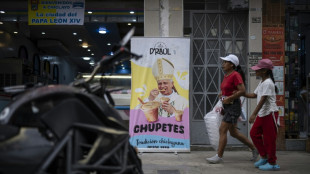 Chiclayo prays for recovery and return of the 'Peruvian pope'
 Barcola scores hat-trick as Liverpool hit LASK for six

 Healthy corals help bleached neighbors regain color: study

 Hope ton helps West Indies level T20 series at 2-2 in India

 Ukraine war reaches shores of Bulgarian fishing village
 Brazil probing 'criminal' origin of forest fires: minister to AFP

 Sally Rooney books cannot be sold in UK amid Palestine Action ban: publisher

 Italian ski stars Goggia and Brignone to miss season opener
 Bournemouth boss Rose urges Cherries to bounce back from Chelsea 'slap'
 Top seed Sabalenka falls at first hurdle in Wuhan
 FX Junction Brings Copy Trading to Everyone, While Their Money Never Leaves With Their Broker

 Brighton defender Struijk's red card overturned

 Saudi league postpones three matches after Houthi attacks
With months until crunch talks on the world's first binding treaty on plastic pollution, experts are meeting in Bangkok to discuss financing options and problematic plastics.
The four-day gathering is a largely technical waypoint on the road to final negotiations in late November in South Korea's Busan.
There, countries are hoping to seal a potentially groundbreaking deal to tackle the gargantuan problem of plastic pollution.
The scale of the issue is almost unprecedented -- microplastics have been found in the deepest ocean trenches, highest mountain peaks, in clouds and even breastmilk.
Plastic production has doubled in 20 years and at current rates it could triple by 2060, according to the Organisation for Economic Cooperation and Development (OECD).
Yet over 90 percent of plastic is not recycled, with much of it dumped in nature or buried in landfills.
Negotiators have already met four times to discuss a deal that could include production caps, unified rules on recyclability, and even bans on certain plastics or chemical components.
But significant gaps remain, including on whether the treaty will be adopted by consensus or a majority vote.
Other flashpoints include whether plastic production will be addressed, Eirik Lindebjerg, global plastics policy lead at WWF, told AFP.
"Is it within the scope to talk about production, or does the value chain start after plastic products are made? And then if we can regulate production... is it with a cap, is it with a reduction target, what are the measures?" he said.
"That's been a very contentious issue."
Environmental groups have long argued that the treaty must include curbs on new plastic, a position backed by dozens of countries who call themselves the "high ambition coalition".
They may now have a powerful ally in the form of the United States, which has reportedly thrown its backing behind some production limits.
That shift has been welcomed by environmental groups, though Lindebjerg warned it was not yet clear if Washington would back mandatory caps or weaker voluntary limits.
- 'Unresolved matters' -
Just how binding the deal will be is another source of contention.
Some countries want measures like a unified timeline for phasing out certain plastics, while others back vaguer language that would let nations decide how and when to regulate.
And, as with climate negotiations, finance for implementing whatever is agreed remains hugely controversial.
"Some countries want money, and some countries don't want to give money, very simply put," said Lindebjerg.
Two expert groups are meeting in Bangkok, with one focused on financing, including technical details on waste management systems and how to implement "polluter pays" principles.
The second group will focus on a framework and criteria for chemicals, plastic materials and plastic products that could be targeted for bans or reductions in the treaty.
The meetings are advisory and are being held behind closed doors, to the dismay of some environmental groups and industry.
"There are still a lot of unresolved matters," warned Chris Jahn, council secretary of the International Council of Chemical Associations, which represents the global chemical industry.
The group opposes language that would regulate chemicals or cap plastic production.
"Plastics are essential in order for the world to achieve its sustainable development and climate change goals," Jahn said, pointing to uses from solar energy to food preservation.
The American Chemistry Council last week warned US backing for production caps would "betray" US manufacturing and risk jobs.
The industry does back efforts to promote the reuse of plastics and new designs to make recycling easier, Jahn said, as well as rules to make producers pay for plastic pollution.
And despite the remaining gaps, there is cautious optimism that a robust deal is possible.
"I think that we're really at a historic opportunity here," said Lindebjerg.
L.Dubois--BTB