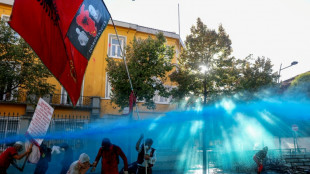
In Germany's industrial east, old traumas boost far right / Photo: © AFP

 Mourinho blasts 'shameless' timing of Vinicius ban decision
 PSG beat Man City in Champions League thriller, Barcola hits Liverpool hat-trick

 US Treasury chief urges stronger IMF role against 'distortionary policies'
 Giant-killers Bodo sink Dortmund in Champions League

 PSG outgun embattled Man City in six-goal Champions League thriller

 In Chicago, pope's hometown, Catholics express shock and support
 Musk suggests US govt behind any slowdown in Ukraine's Starshield system
 Chiclayo prays for recovery and return of the 'Peruvian pope'
 Barcola scores hat-trick as Liverpool hit LASK for six
 Healthy corals help bleached neighbors regain color: study
 Hope ton helps West Indies level T20 series at 2-2 in India

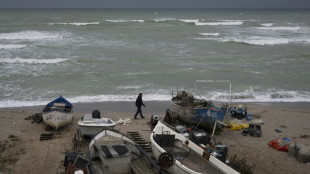 Ukraine war reaches shores of Bulgarian fishing village
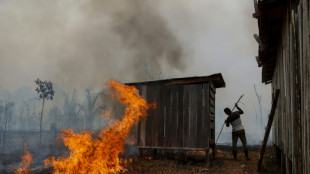 Brazil probing 'criminal' origin of forest fires: minister to AFP

 Sally Rooney books cannot be sold in UK amid Palestine Action ban: publisher
 Italian ski stars Goggia and Brignone to miss season opener
 Bournemouth boss Rose urges Cherries to bounce back from Chelsea 'slap'
 Top seed Sabalenka falls at first hurdle in Wuhan
 FX Junction Brings Copy Trading to Everyone, While Their Money Never Leaves With Their Broker

 Brighton defender Struijk's red card overturned
 Saudi league postpones three matches after Houthi attacks
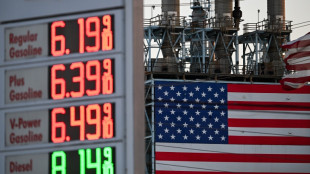 US consumer inflation up more than expected as midterms loom

 Canadian publisher supports novelist Orelien after AI denial
 Medvedev sees off Tsitsipas to reach Shanghai Masters quarters
 Louvre boss warns of closure risk without major renovations
 Lawes and Genge urge England to end ban on overseas-based players

In the relatively well-off city of Zwickau, in Germany's former communist east, economic uncertainty and a turbulent history have combined to drive support for the far right ahead of a key regional election.
"People are afraid of losing everything they've built up again over the years," said Zwickau's mayor, Constance Arndt.
To understand why "the mood is so bad" ahead of Sunday's elections in the state of Saxony, one has to "perhaps delve into the past", she told AFP.
Zwickau residents have "achieved a certain level of prosperity" after a period of painful decline in the wake of German reunification in 1990, she said.
The city owes its revival in part to its status as a hub for automotive manufacturing, with Volkswagen a major employer in the area.
But recent crises, from the coronavirus pandemic to the Ukraine war and high inflation, have triggered a renewed "fear of losing", said Arndt, 47, from her office overlooking a picturesque market square.
As a result, some are voting for the far-right Alternative for Germany (AfD) party "out of protest", the independent mayor in the city of some 90,000 people added.
At the start of the year, thousands of people in Zwickau nevertheless rallied against the far right following revelations that some members of the anti-Islam, anti-immigrant AfD had joined a meeting that discussed plans for mass deportations of asylum seekers.
The rallies, which also took place across Germany, were at the time seen as a rare mobilisation of the so-called silent majority against right-wing extremism.
But it didn't last long.
In early June, the AfD won a municipal election to become the largest group on Zwickau's district council.
Although the AfD fell short of a majority, council discussions are expected to become more challenging, the mayor predicted, particularly regarding cultural funding.
- Swastikas -
On a sweltering day in August, social worker Joerg Banitz pointed out several swastika tags and inscriptions of "NS-Zone", a reference to the Nazi era, daubed onto walls outside the city centre.
"We see that a lot," said the Zwickau native, who was one of the organisers of the demonstrations against the far right early this year.
Banitz believes the AfD's rise is fuelled by more than just protest votes.
The party's "radical language, its way of thinking" now has "an acceptance" among the public, he said, helped by the fact that conservatives from the centre-right CDU party in Saxony have adopted some of their populist stances.
"I think most of the people who vote for the AfD want exactly what the programme says," he added.
The AfD has found fertile ground in a city with an active right-wing extremist scene, Banitz said. It was in Zwickau that the three members of the NSU neo-Nazi cell, who murdered nine people of immigrant origin between 2000 and 2007, hid from the police for years.
Wolfgang Wetzel, a Zwickau city councillor from the Green party, said many locals felt overwhelmed in an increasingly complex world.
And in a region that has lived through two consecutive authoritarian regimes, Nazism and then communist East Germany, there is a resurgence of "nostalgia for the simplicity of dictatorship, where you don't have to make decisions," which benefits the far right, Wetzel said.
- 'Uncertainty' -
But the AfD rejects those interpretations.
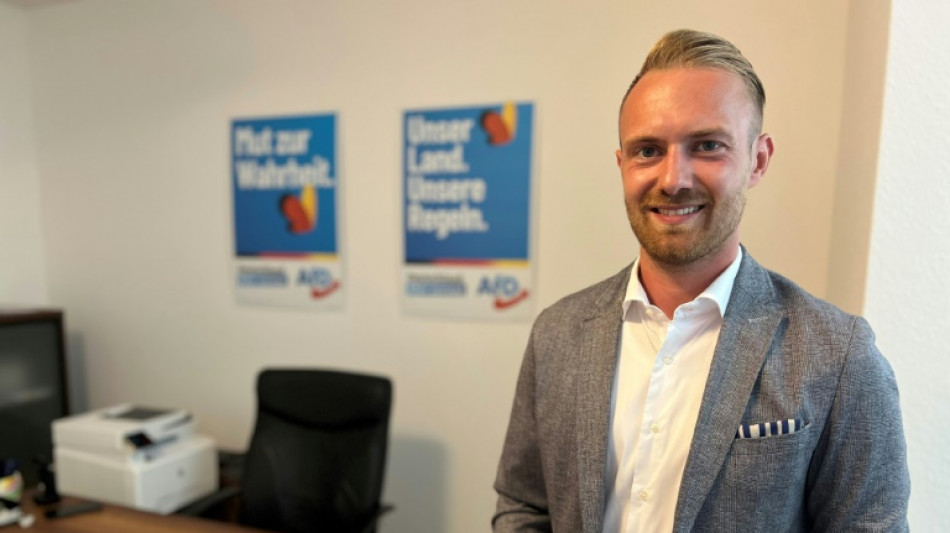
"I think people simply don't want to be deceived anymore," said Jonas Duenzel, a candidate for the AfD in the Saxony election, where polls suggest the party is neck-and-neck with the CDU.
The 30-year-old former insurance salesman took aim at the conservatives who he said had co-opted AfD calls for tougher border controls and asylum policies, but done nothing to make that happen during their five years in power.
If people vote for the AfD, "it's not because they're turning away from democracy", as Saxony prime minister Michael Kretschmer from the CDU has claimed, but because "they have a problem with Mr Kretschmer", he said.
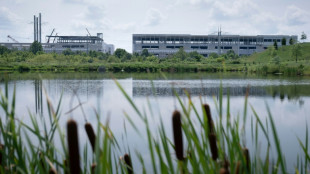
The increased populist sentiment has worried Volkswagen, which produces all-electric vehicles at a large plant in Zwickau. The AfD regularly rails against the push towards zero-emissions driving, dismissing it as "a fairy tale".
"The discussions about the future of electric mobility create uncertainty" for the roughly 10,000 workers at the Zwickau plant, said Christian Sommer, VW's head of corporate communications in Saxony.
"And there is indeed a fear," he told AFP, "that these jobs could be threatened if a right-wing populist-conservative government were to emerge from the elections."
M.Odermatt--BTB