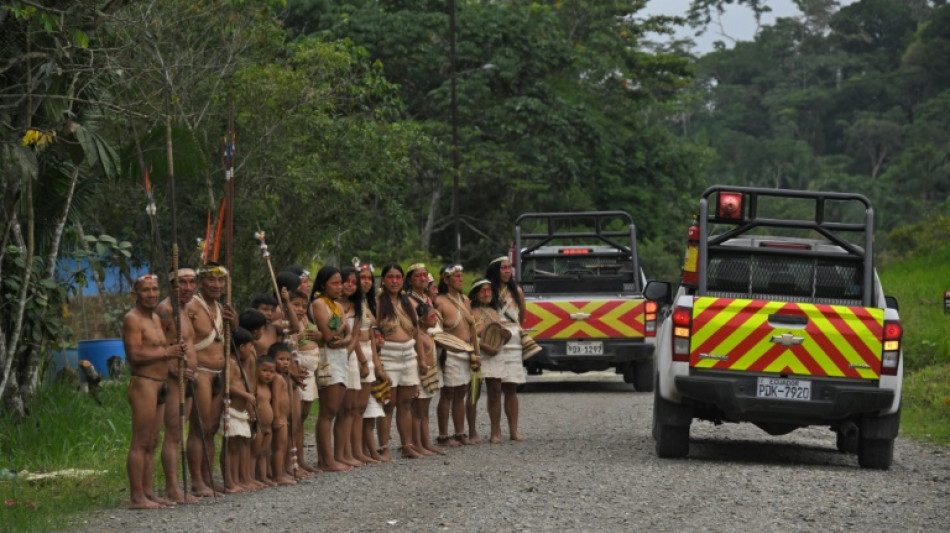
Oil drilling sparks Indigenous outcry as spills tarnish Ecuador Amazon / Photo: © AFP

 Trump renames AI "super intelligence," rejects international oversight

 Trump rejects international regulation of AI

 How is the EU approaching record fuel prices?

 Sri Lanka's Colombage strikes on debut as England dismissed for 265 in first ODI
 Hurricane Polo strengthens to top category 5 off Mexico

 11 hurt as teen opens fire outside school in western Turkey

 UN chief says 'Big Oil' treats atmosphere as open sewer

 Tunisia says 2026 summer hottest on record

 England's Rashid out of Sri Lanka ODIs with hand injury

 Houthis accuse Saudi Arabia of deadly strikes as thousands flee

 Stocks climb as oil slides, AI buzz returns

 India cricketers win in style as Afghan savours 'special' Games silver

 La Liga president hits out at Real Madrid refereeing 'conspiracy' claims

 MEXC Launches “Real Stocks, Real Friends” with Rewards for Bringing Friends to Wall Street

 Mbappe continues media push for Ballon d'Or recognition

 Stocks rise on AI buzz, oil prices cool

 India narrowly survive huge scare against minnows Japan

 Missing F-35 fighter parts 'not sensitive', says Australia minister

 Cambodia showcases scams crackdown with global conference

 Afghan cyclist who disguised herself as man wins Asian Games silver

 Typhoon Dujuan leaves four dead in Japan, 45,000 houses without power

 G7 leaders condemn Houthi strikes on Saudi Arabia

 Google data centre sparks protests in Austria

 Shin Ohashi: Junk food-loving teen and Japan's next big swimming hope

 Stocks rise on AI buzz, drop in oil prices

A thick slick of oil covers part of an estuary in the Ecuadoran Amazon, where the Indigenous Waorani people are imploring authorities to stop drilling for the black gold that keeps spilling into their environment.
Black sludge also coats the vegetation alongside a road leading to the village of Guiyero in Yasuni National Park, one of the most diverse biospheres in the world.
"It's time to say enough! They've abused us," Ene Nenquimo, vice president of the Waorani Nationality (Nawe) organization, told AFP, wearing a headdress of multicoloured feathers.
The oil spill occurred in June, according to environmentalists, the latest of many in the reserve.
State-owned oil company Petroecuador admitted that an undetermined amount of oil leaked into the environment from one of its blocks, contaminating water sources in several towns and reaching the Napo River, a tributary of the Amazon.
"Big lizards died," lamented Pablo Ahua, 44, one of the nearly 100 Indigenous people who live in Guiyero, near one of the reserve's oil wells.
- Referendum deadline passes -
Yasuni National Park was thrust into the international spotlight last year after Ecuadorans voted to stop drilling in one block in the reserve, a move hailed as a historic example of climate democracy.
The reserve stretches over one million hectares (2.5 million acres) and is home to at least three of the world's last uncontacted Indigenous populations and a bounty of plant and animal species.
The referendum required the goverment to stop extracting from Block 43 by August -- however, only one of its 247 wells have been shut down.
The government estimates that it will take at least five years to cut all production from the block, which produces 50,000 barrels per day, about 10 percent of the total output in the country.
Nenquimo said the Ecuadoran state "must respect" the referendum, "like it or not."
Some locals, like Nenquimo, want to stop all oil extraction in the reserve and elsewhere in the Ecuadoran Amazon.
The oil spills leave "an immense impact that no one can remedy," said Nenquimo.
"They say (the oil) is for the development of communities and there is no development. All it leaves is environmental damage."
- 'We are forgotten' -
However, others support the oil companies and the benefits that economic growth have brought to their villages.
In 2023, Ecuador estimated losses of $16.47 billion over two decades if it were to close Block 43 -- one of 80 blocks in the part of the Amazon that falls in the country.
Oil exploitation has been one of the pillars of Ecuador's economy since the 1970s.
Crude oil, its leading export, generated revenues of $7.8 billion in 2023.
Indigenous communites are the worst affected by poverty in Ecuador, which stood at 25.5 percent in June. Extreme poverty affects over 10 percent of the country's population of 17 million.
"We are not cared for, we are forgotten" due to the lack of essential services such as healthcare, said Nenquimo.
The Waorani tribe is made up of some 4,000 people who own some 800,000 hectares (2 million acres) in the Amazon, although they claim 1.2 million hectares (3 million acres) more.
In Ecuador, the Constitution recognizes Indigenous people's "collective ownership of land as an ancestral form of territorial organization."
The state, however, maintains control over anything under the soil.
- 'High rates of cancer' -
Kevin Koenig, from the NGO Amazon Watch, highlighted another danger for Yasuni's residents: the links between those who live near oil wells and "high rates of cancer."
He urged developed countries to finance environmental protection with alternatives such as debt swaps.
Yasuni National Park houses species of some 2,000 trees, 610 birds, 204 mammals, 150 amphibians and more than 120 reptiles, according to San Francisco University of Quito.
In Guiyero, a group of Indigenous men, nude and carrying spears, sing in their language, wao terero.
"They are saying: Help us defend our territory," said translator Freddy Nihua, leader of the the Wao of Orellana, one of Yasuni's two provinces.
I.Meyer--BTB