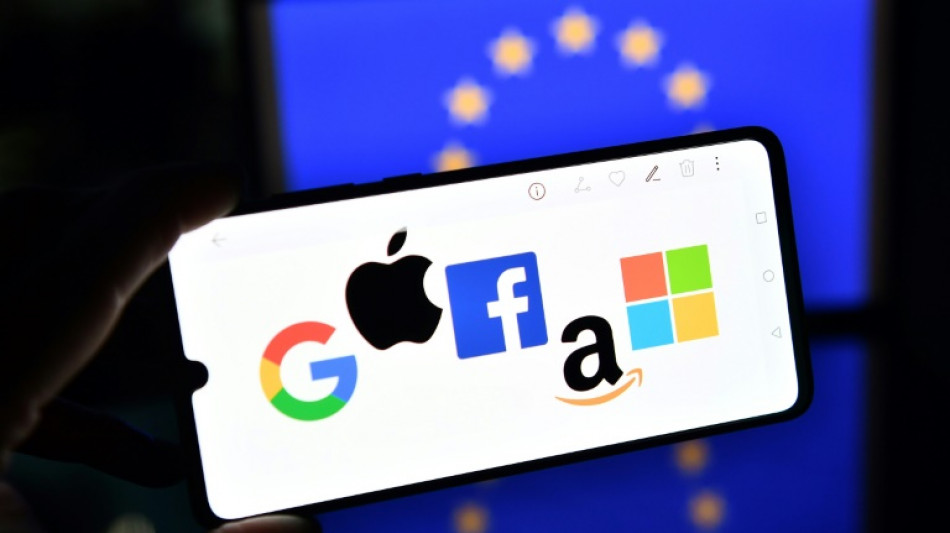
Europe's fight with big tech over tax, data and disinformation / Photo: © AFP/File

 UK agrees support for Saudi in struggle with Houthis: reports

 EU foreign policy chief calls for continued sanctions on Russia

 Flights scrapped, evacuations urged as Typhoon Dujuan wallops Japan

 Fonseca to take break from tennis

 A Cuban zoo, and its animals, in epic battle for survival

 Infantino proposes consulting federations to reform FIFA

 El Nino weather pattern enters record territory: scientist

 OpenAI calls for US to lead global effort on AI standards

 South African ostriches plucked alive for luxury fashion: report

 US networks halt Trump coverage in revolt over White House ban

 Paramount settles with US states to clear Warner Bros. mega-merger

 Climate crisis a job for world leaders, not just activists: UK FM

 US networks halt Trump coverage over White House ban

 French singer accuses Miley Cyrus of plagiarism

 EU fines Google 403 mn euros for location data breach

 'Best is yet to come,' says De la Fuente after Spain extension

 Why diesel prices are rising more than crude oil

 COP31 host says AI's climate footprint to be a summit priority

 Renewables hit record in 2025, but world must move faster: report

 US media outlets to sue Trump administration after White House ban

 Global stocks rally on lower oil prices, US-China hopes

 EU proposes energy rating for data centres

 Schoolgirl Yu scorches to second gold as doping case rocks Games

 Putin's party secures record score in Russia election

 Haupt Koleksiyonu: Paranın Biz İnsanlar Hakkında Anlattıkları

The European Union scored two major legal victories on Tuesday in separate cases that left Apple and Google owing billions of euros.
Brussels has been fighting giant tech firms for years on issues from data privacy to disinformation.
- Taxation -
Tuesday's victory over Apple is a huge reversal of fortune for the European Commission, which has had little success in arguing that tech firms broke the law by funnelling profits into low-tax economies like Ireland and Luxembourg.
The EU's top court made a final ruling that the iPhone maker must pay 13 billion euros ($14.3 billion) in back taxes to Ireland, upholding a 2016 commission decision that a sweetheart deal between Apple and the Dublin government was illegal.
The commission is fighting a similar case against Amazon, which also won an appeal against an order to repay 250 million euros in back taxes to Luxembourg.
- Stifling competition -
Brussels has doled out over 10 billion euros in fines to tech firms for abusing their dominant market positions, hitting Google hardest.
On Tuesday, the EU's top court upheld a 2.4-billion-euro fine first issued against Google in 2017 for illegally favouring its own price comparison service.
Google was also handed a fine of more than four billion euros in 2018 for using its Android mobile operating system to promote its search engine -- by far the biggest single levy on a big tech firm.
The commission recommended last year that Google should sell parts of its business and could face a fine of up to 10 percent of its global revenue if it fails to comply.
Apple is the only other tech firm in Google's league for breaches of competition rules.
The bloc hit the California firm with a 1.8-billion-euro penalty earlier this year for preventing European users from accessing information about cheaper music streaming services.
And an EU warning in June that its App Store was breaking competition rules led to Apple announcing it would let European users delete apps including the App Store and Safari browser.
- Privacy -
The EU's general data protection regulation (GDPR), passed in 2018, drastically restricted the ways that companies can gather and store personal information.
The business models of firms like Meta and Google rely on hoovering up data to sell to advertisers or to develop new products.
The two worlds have collided in a series of legal complaints and the Irish regulator has handed out billions in fines.
It most recently hit TikTok with a 345-million-euro penalty for mishandling children's data last September, months after it hit Meta with a record fine of 1.2 billion euros for illegally transferring personal data between Europe and the United States.
Luxembourg had previously held the record for data fines after it slapped Amazon with a 746-million-euro penalty in 2021.
More recently, the use of personal data for developing AI products has sparked a slew of privacy complaints, particularly against Meta and Elon Musk's platform X.
- Disinformation, hate speech -
Web platforms have long faced accusations of failing to combat hate speech, disinformation and piracy.
In response, the EU passed the Digital Services Act (DSA) last year to force companies to tackle these issues or face fines of up to six percent of their global turnover.
The bloc has already pressed the DSA into service, launching probes into Facebook and Instagram for failing to tackle election-related disinformation, and accusing X of breaching the rules with its blue-tick "verified" accounts.
- Paying for news –
Google and other online platforms have also been accused of making billions from news without sharing the revenue with those who gather it.
To tackle this, the EU created a form of copyright called "neighbouring rights" that allows print media to demand compensation for using their content.
France has been a test case for the rules and after initial resistance Google and Facebook both agreed to pay some French outlets for articles shown in web searches.
O.Lorenz--BTB