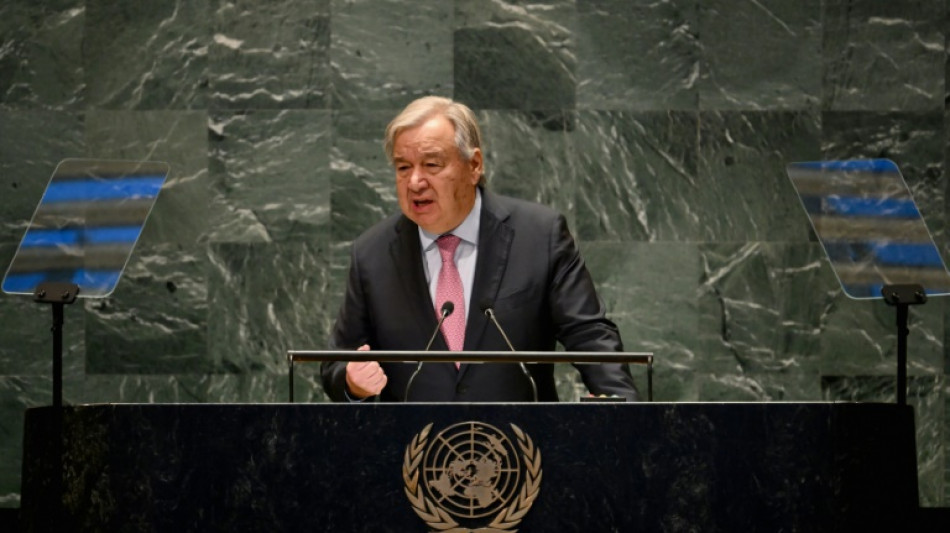
UN adopts pact to tackle volatile future for mankind / Photo: © AFP

 Trump renames AI "super intelligence," rejects international oversight
 Trump rejects international regulation of AI

 How is the EU approaching record fuel prices?

 Sri Lanka's Colombage strikes on debut as England dismissed for 265 in first ODI
 Hurricane Polo strengthens to top category 5 off Mexico

 11 hurt as teen opens fire outside school in western Turkey

 UN chief says 'Big Oil' treats atmosphere as open sewer
 Tunisia says 2026 summer hottest on record
 England's Rashid out of Sri Lanka ODIs with hand injury

 Houthis accuse Saudi Arabia of deadly strikes as thousands flee

 Stocks climb as oil slides, AI buzz returns
 India cricketers win in style as Afghan savours 'special' Games silver

 La Liga president hits out at Real Madrid refereeing 'conspiracy' claims

 MEXC Launches “Real Stocks, Real Friends” with Rewards for Bringing Friends to Wall Street

 Mbappe continues media push for Ballon d'Or recognition
 Stocks rise on AI buzz, oil prices cool
 India narrowly survive huge scare against minnows Japan

 Missing F-35 fighter parts 'not sensitive', says Australia minister
 Cambodia showcases scams crackdown with global conference
 Afghan cyclist who disguised herself as man wins Asian Games silver

 Typhoon Dujuan leaves four dead in Japan, 45,000 houses without power

 G7 leaders condemn Houthi strikes on Saudi Arabia
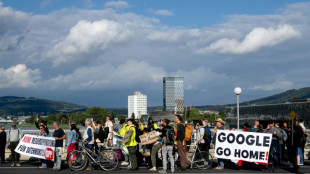 Google data centre sparks protests in Austria

 Shin Ohashi: Junk food-loving teen and Japan's next big swimming hope

 Stocks rise on AI buzz, drop in oil prices
UN members adopted a blueprint for the future Sunday to tackle the myriad wars, environmental threats and technological challenges facing humanity that was hailed by the organization as "groundbreaking" but panned by critics as unambitious.
Secretary-General Antonio Guterres, who championed the "Pact for The Future" and its components, billed them as "landmark agreements -- a step-change towards more effective, inclusive, networked multilateralism."
As an opener for the annual high-level week of the UN General Assembly, which begins Tuesday, dozens of heads of state and government gathered for the adoption, which faced last-minute opposition from Russia and its allies.
Leaders pledged to bolster the multilateral system to "keep pace with a changing world" and to "protect the needs and interests of current and future generations" facing "persistent crisis."
"We believe there is a path to a brighter future for all of humanity," the document says.
The pact outlines 56 "actions," including commitments to multilateralism, upholding the UN Charter and peacekeeping.
- Russian objections -
It also calls for reforms to international financial institutions and the UN Security Council, along with renewed efforts to combat climate change, promote disarmament, and guide the development of artificial intelligence.
The adoption of the text faced a brief delay when Russia's deputy minister of foreign affairs, Sergey Vershinin, introduced an amendment emphasizing the "principle of non-interference in the internal affairs of states" and urging the UN to avoid duplicating efforts.
Russia's objections were backed by allies Belarus, North Korea, Iran, Nicaragua and Syria, but its amendment was overwhelmingly dismissed in a motion to take no action.
"It was somewhat irritating that, in the end, Russia once again tried to stop the whole process and did not want to go down the path that the whole world had taken," said German Chancellor Olaf Scholz, co-sponsor of the text, after the adoption.
- 'I challenge you' -
Passage of the text was never a guarantee, and sources said Guterres had prepared three separate versions of his speech for the potential outcomes of the vote.
During the negotiations phase, the UN Secretary-General had urged nations to show "vision" and "courage," calling for "maximum ambition" to strengthen international institutions that struggle to respond effectively to today's threats.
But while there are some "good ideas," the text "is not the sort of revolutionary document reforming the whole of multilateralism that Antonio Guterres had originally called for," Richard Gowan of the International Crisis Group told AFP.
"Ideally, you would hope for new ideas," said one diplomat.
The fight against global warming was one of the sticking points in the negotiations, with references to the "transition" away from fossil fuels having disappeared from the draft text weeks ago, before being re-inserted.
"The real test will be the delivery of these" goals, said environmental campaign group 350.org.
Despite criticism of the pact, it is still "an opportunity to affirm our collective commitment to multilateralism, even in the difficult current geopolitical context," one diplomat said, emphasizing the need to rebuild trust between the Global North and South.
"This pact gives us hope and inspiration for a better future," said Sierra Leone's President Julius Maada Bio, who has been a keen advocate for the Global South at the UN through his country's membership of the Security Council.
Developing countries have been particularly vocal in demanding concrete commitments on the reform of international financial institutions, aiming to secure easier access to preferential financing, especially considering the impacts of climate change.
The text does indeed include "important commitments on economic justice and reforming the international financial architecture," Human Rights Watch (HRW) commented, while also praising "the centrality of human rights."
Regardless of its content, the pact and its annexes -- a Global Digital Compact and a Declaration on Future Generations -- are non-binding, raising concerns about implementation, especially as some principles such as the protection of civilians in conflict are violated daily.
"Now it is our common responsibility to walk through it. That demands not just agreement, but action. I challenge you to take that action," Guterres said following the adoption.
O.Krause--BTB