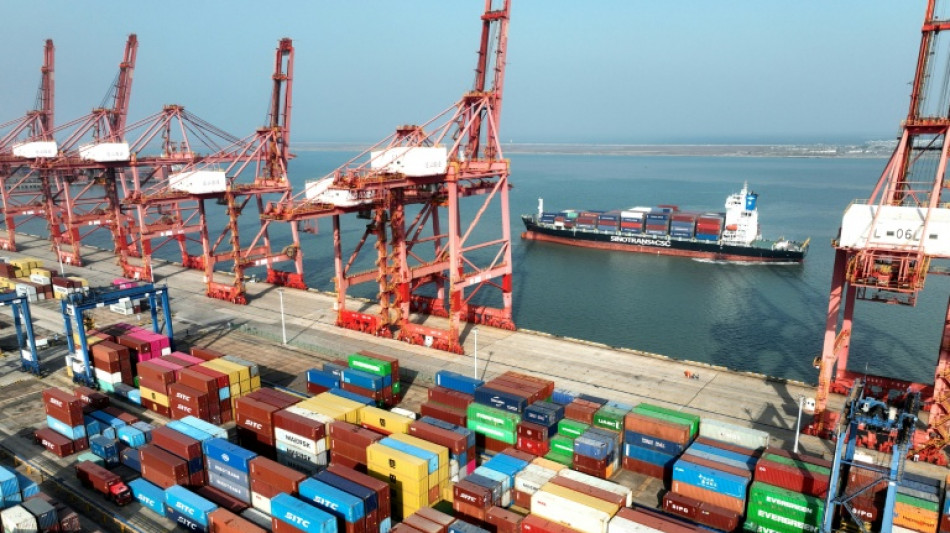
How China could respond to Trump's new tariffs / Photo: © AFP

 FXGLOBE Rebuilds Its Copy Trading and PAMM Business With B2BROKER's B2COPY

 Nepal rescuers search for missing after flash flood
 Oil rises as Trump comments roil energy markets

 Premier League in limbo as Manchester City soar

 Zelensky vows to respond as Moscow silent on 'energy ceasefire'
 Thousands march in India's capital to demand election chief resign

 African players in Europe: Mbeumo ends goal drought as United draw

 France's high school students plan fresh protests

 NZ bank in free speech row over 'explicit' sheep memes

 China Open champ Zheng withdraws from Wuhan citing fatigue

 Brewers edge Dodgers 2-1 in National League Championship Series opener

 Pope to have surgery to remove lung nodule
 Stocks rise as oil prices tumble after Trump hails 'energy ceasefire'

 Man City charges cloud hangs over Premier League season

 Top NATO commander set to issue warning to Russia over any attack

 Software, sprints, trolls: Singapore Grand Prix talking points

 Riyadh airport hit by fresh Houthi strike day after deadly attack
 Policymakers take on energy shock, rising debt at IMF-World Bank meetings
 Raphael Glucksmann elected centre-left French presidential candidate

 'Dizzy' Lazio join Inter at top of Serie A as Roma, Juve and Milan held

 Jaguars edge Eagles as Packers beat Bears
 Rays chase first MLB crown as Guardians try to snap drought
 Hurricane Simon churns off Mexican coast after shift in course
 'Dizzy' Lazio join Inter at top of Serie A as Roma and AC Milan held

 Man City must make 'own noise' amid financial scandal, says Maresca

From retaliatory tariffs on US goods like car parts and soy beans to controls on raw minerals essential for American manufacturing -- analysts say China has plenty of options if it wants to reply to fresh US levies.
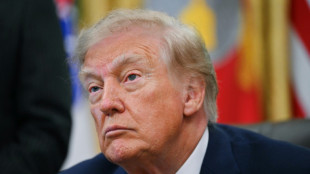
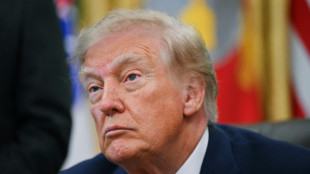
US President Donald Trump over the weekend announced 10 percent tariffs on Chinese products, upping the stakes in a trade confrontation between the global superpowers that started eight years ago in his first term.
Beijing in response warned there were "no winners" in a trade war and vowed as yet unspecified countermeasures.
News that Canada and Mexico had agreed a deal with Trump to delay 25 percent tariffs on their goods was followed by his announcement that he would be holding talks with China "probably in the next 24 hours" to try for an agreement.
But, as the threat of new measures continues to hang over Beijing, eyes are on what officials there have lined up as a response.
With its economy still struggling with sluggish consumption and slow growth, observers expect China to keep its powder dry for now -- at least until another round of tariffs that could do greater damage.
"We expect China not to jump to immediate retaliation following the 10 percent tariff hike, but will keep the doors of negotiation and cooperation open," UBS bank analysts wrote in a note.
"We do not expect China to follow the same strategy as in the first round of tariff hikes in 2018-19."
Bilateral trade totalled more than $530 billion in 2024, according to US data, with exports of Chinese goods to the United States exceeding $400 billion. That was second only to Mexico.
But that yawning trade imbalance -- $270.4 billion in January-November last year -- has long raised hackles in Washington.
- Lesson learned? -
Key US demands in the first trade war were greater access to China's markets, broad reform of a business playing field that heavily favours Chinese firms, and a loosening of heavy state controls.
This time around Washington has also called for China to crack down on exports to Mexico of chemical components used to make the synthetic opioid fentanyl, responsible for tens of thousands of overdose deaths a year.
After long, fraught negotiations during Trump's first term the two agreed what became known as the "phase one" deal -- a ceasefire in the nearly two-year-old trade war.
Beijing was quick to retaliate throughout that standoff -- imposing tariffs of its own on everything from cars to soybeans, designed to inflict harm on Trump's voting base in rural America.
It also floated restrictions on exports of rare earth metals, of which China dominates global supplies and on which the United States remains heavily dependent.
And should a new trade war escalate, "measures could include tariffs, export controls on critical minerals essential for US manufacturing, restricted market access to US firms operating in China, or the depreciation of the yuan", Harry Murphy Cruise, head of China and Australia economics at Moody's Analytics, told AFP.
But he added Beijing may have learned its lesson from the first standoff.
"The tit-for-tat trade war in Trump's first term benefited no one; it made trade more costly and hindered growth in both countries," Murphy Cruise said.
- China's weaker position -
For now, analysts believe the latest measures won't bite too hard.
"The 10 percent tariff is not a big shock to China's economy," Zhang Zhiwei at Pinpoint Asset Management said in a note.
"It's unlikely to change the market expectation on China's macro outlook this year, which already factored in higher tariffs from the US," he added.
And that could allow China to keep its powder dry in the event Trump's first wave of tariffs are the prelude to a bigger showdown.
The US president has ordered an in-depth review of Chinese trade practices, the results of which are due by April 1.
That could serve as a "catalyst for more tariffs", said Murphy Cruise, pushing Beijing to shift tactics.
"This strategy of no retaliation may change if the US imposes additional significant tariffs later on," UBS economists said.
"In such a case, we think China may retaliate on a targeted basis and in a restrained manner, imposing tariffs on selected agricultural products, auto parts, energy," they said.
Experts added that China could also let the value of its currency devalue, increasing the competitiveness of its exports.
Trump's flagged talks with Beijing offer the two sides a chance to step back from the brink of a trade war that could hit hundreds of billions' worth of goods.
"China is looking to diffuse tensions," Murphy Cruise said.
"China's economy is in a much weaker position this time around; it will be substantially harder to withstand a barrage of tariffs."
J.Horn--BTB