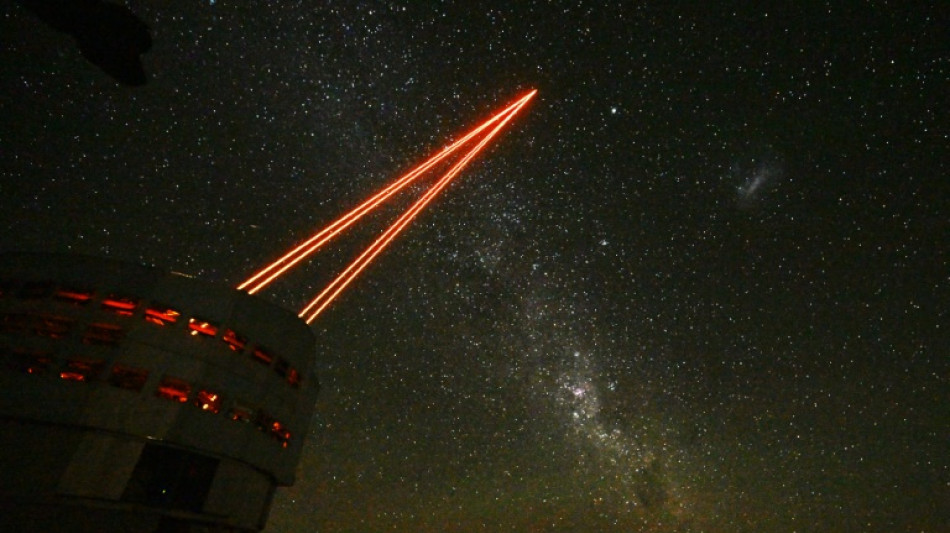
Could a climate megaproject cloud Chile's unparalleled views of universe? / Photo: © AFP

 African players in Europe: Mbeumo ends goal drought as United draw
 France's high school students plan fresh protests

 NZ bank in free speech row over 'explicit' sheep memes

 China Open champ Zheng withdraws from Wuhan citing fatigue

 Brewers edge Dodgers 2-1 in National League Championship Series opener

 Pope to have surgery to remove lung nodule

 Stocks rise as oil prices tumble after Trump hails 'energy ceasefire'
 Man City charges cloud hangs over Premier League season

 Top NATO commander set to issue warning to Russia over any attack
 Software, sprints, trolls: Singapore Grand Prix talking points

 Riyadh airport hit by fresh Houthi strike day after deadly attack

 Policymakers take on energy shock, rising debt at IMF-World Bank meetings

 Raphael Glucksmann elected centre-left French presidential candidate

 'Dizzy' Lazio join Inter at top of Serie A as Roma, Juve and Milan held

 Jaguars edge Eagles as Packers beat Bears

 Rays chase first MLB crown as Guardians try to snap drought

 Hurricane Simon churns off Mexican coast after shift in course

 'Dizzy' Lazio join Inter at top of Serie A as Roma and AC Milan held

 Man City must make 'own noise' amid financial scandal, says Maresca

 Jaguars down Eagles with wild field goal finish in London

 Sadaqat, Imran help Pakistan thump Sri Lanka to seal T20 series

 Man City shrug off uncertain future to beat 10-man Liverpool

 Conservation groups alarmed at marine mammals' deaths in Spain

 Tens of thousands urge climate action at Brussels demo

 Norway's Hagenes wins historic Paris-Tours classic

As night falls on the Atacama desert in northern Chile four giant telescopes turn their gaze towards the star-strewn heavens.
The driest place on Earth is the best place to observe the universe, with darkness offering dazzling spectacles of cosmic wonder.
The area is home to the Paranal Observatory, which houses the European Southern Observatory's Very Large Telescope, used by astronomers to search the Milky Way with "unparalleled clarity," according to Spanish astrophysicist Itziar de Gregorio.
Perched at 2,635 meters (8,645 feet) above sea level, and located dozens of kilometers (miles) from the nearest town of Antofagasta, Paranal's unique atmospheric conditions make it one of the most productive observatories in the world.
The Very Large Telescope -- made up of four individual telescopes -- produced the first ever image of an exoplanet (a planet outside our solar system) in 2004.
But a huge green energy project, part of Chile's plans to become carbon neutral, risks clouding the view, scientists say.
Latin America's fifth-largest economy aims to phase out fossil fuels by 2050, replacing them with renewable energy sources, which can also be used to produce green hydrogen.
Green hydrogen, a clean method of generating electricity, has been touted as a means to help decarbonize Chile's crucial copper mining sector, among other industries.
AES Andes, the Chilean subsidiary of US energy company AES Corporation, has submitted proposals for a 3,000-hectare (7,400-acre) site in the Atacama desert near Paranal to harness solar and wind energy, which in turn can be used to produce green hydrogen and ammonia, a gas used in making fertilizers.
But scientists say the artificial light from such a facility could obscure some of the celestial phenomena observed at Paranal, such as eclipses and meteorite showers.
They worry it could also endanger the functioning of the ESO's Extremely Large Telescope, billed as the world's "biggest eye on the sky," currently under construction near the Paranal Observatory.
The stadium-sized telescope is slated to be completed by 2028.
De Gregorio, the ESO's representative in Chile, warns that the country's unique "window onto the universe" could close, hampering scientists' quest to answer the great question of our time: Are we the only intelligent life form in the universe?
- Like 'a tap running' -
Chile, home to around 70 percent of the world's telescopes, has long been seen as a hub for stargazers.
By day, astronomers at Paranal crunch numbers. By night, they explore the galaxy.
The observatory's research covers almost all celestial phenomena, from planets and exo-planets to black holes and near-Earth comets, Steffen Mieske, the head of the site's scientific operations, said.
That work could be jeopardized if the night sky brightens, even a fraction.
"Light pollution is the main threat to astronomy because it affects the quality of the observable sky," the Skies of Chile Foundation, which works to preserve the quality of the country's night skies, argues.
"When you see a tap running, you realize you're wasting water. But if you see a place lit up brightly at night, you don't think of it as pollution," the foundation's director Daniela Gonzalez said.
AES Andes, in a statement, assured that its hydrogen and ammonia project, codenamed Inna, conformed to the "highest norms in terms of lighting," including a new Chilean rule aimed at protecting astronomy sites from skyglow.
It has rejected Paranal's claim that it would be within 11 kilometers of the observatory, saying the distance would be around twice that.
A group of 40 astronomers, scientists and poets have called for the establishment of a "light exclusion zone" around Paranal, to keep it pitch-black at night.
The Inna project, which is currently awaiting an environmental permit, is not expected to be licensed for another two or three years.
B.Shevchenko--BTB